
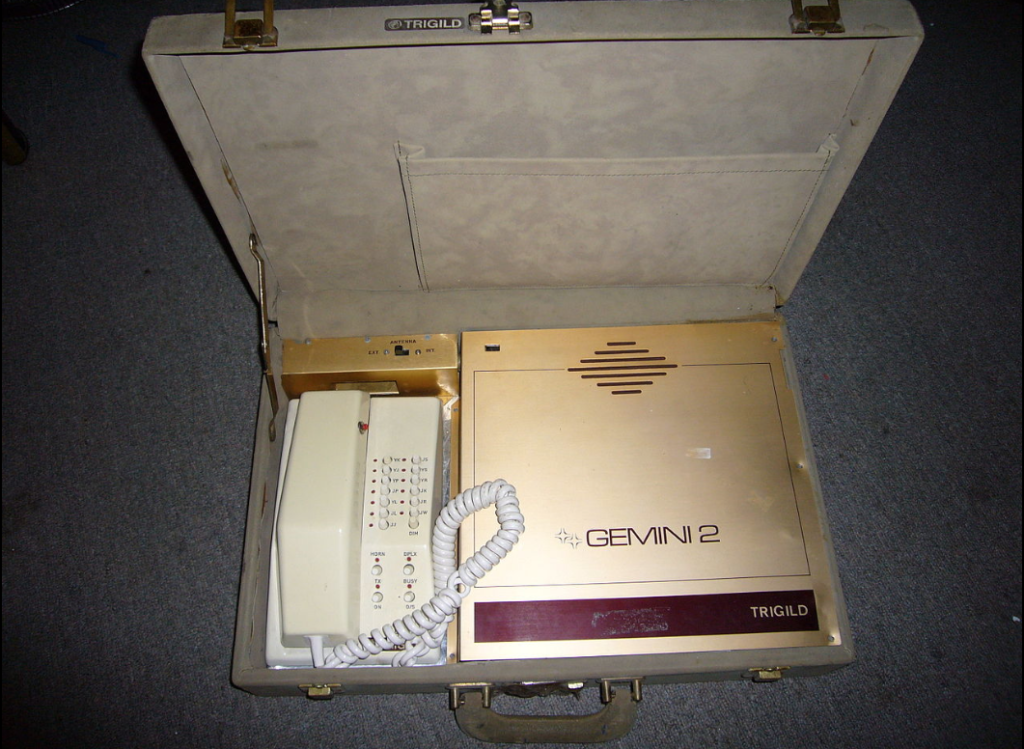
Often taken for granted is the supercomputer that rests in everyone’s pockets. Not many remember a day when a real map had to be used, when writing letters was the only way to contact a distant friend, or when real people had to perform any of the tasks that a smartphone can complete at the touch of a finger.
One of the men responsible for making cell phones an achievable dream, Adam Rosenberg, Ph.D.–a Stanford and Princeton educated expert in telephony–visited on September 11 to talk to Hillsdale students about his experience in the innovative field of early cell phones.
Rosenberg’s talk “did a good job of making the topic accessible for people at all levels of math,” according to Rose Schweizer, a senior studying math and Spanish.
“He explained the necessary basics while still including the higher math that is more interesting to older students,” Schweizer said.
Rosenberg began his talk with an introduction to the difference between analog and digital phone lines and the fight against interference.
“If there was a radio station in Hartford Connecticut, the nearest place they would reuse that station was in Baltimore,” Rosenberg said. “Hundreds of miles away…the notion of interference being something we could manage was totally new.”
He went on to introduce two important figures who helped introduce the idea of cellular telephony. According to Rosenberg, cellular didn’t really become “real” until Dick Frenkiel and Phil Porter at Bell Laboratories wrote a memo in 1966 describing how this system would work.
The system this memo described consisted of radio antennae that would be placed atop large towers in major cities. Each of these antennae would be able to take 12 calls at a time on a separate channel each. Anybody attempting to make a call within the city would have to wait for one of these channels to open up.
Engineers called this system Improved Mobile Telephone Service, although, as Rosenberg said, “Heaven knows what it was improved from.”
Obviously, the IMTS system did not last long. Rosenberg went on to explain the decision to divide the world up into regions which they called cells, giving each cell its own site or bay station in the middle where they could manage interference.
He explained that this emerging cellular technology is called Advanced Mobile Phone Service, or AMPS for short.
Rosenberg himself helped create the system we use today—a grid made up of connected hexagons with a cell site within each. Making the grid out of hexagons ensures that there is always a sizable distance between each cell to minimize interference.
“The further apart they are,” said Rosenberg, “the better.”
The initial tests of the AMPS system began in Chicago. When the engineers realized how well the cell system worked, they discovered that they could place smaller cells within the original grid and increase the ability of the system substantially.
“Soon, we have added enough cells into the old grid that we have created a whole new grid,” Rosenberg added.
Combining these two grids, the engineers for AMPS were able to have lines available for more than 10,000 people, a remarkable feat for the time.
Rosenberg told some 20 students in attendance that he has always been a “math geek” and that learning to program a computer and the idea of creating a machine that could do a mathematician’s dirty work helped him make the decision to go into the field of telephony.
The talk drew many students seeking to learn about not only the history of cellular telephony but the science and math behind it as well. Jadon Lippincott, a senior studying mathematics, went into the talk with no previous knowledge regarding cellular telephony.
“I wanted to attend the talk because math is the most beautiful subject around, and math makes unexpected appearances all the time,” Lippincott said.
Schweizer commended Rosenberg’s application of math to everyday functions.
“It was nice to see how topics that seem completely theoretical, like modular arithmetic or geometry, can be used in a real-world setting,” she said.
Rosenberg’s talk highlighted some of the reasons such powerful machines now exist within arms reach whenever needed, or wanted, while addressing the sheer unpredictability of technology.
“Do I know what it’s going to look like in five years?” Rosenberg said. “I haven’t a clue.”
