
(photo: Wikimedia Commons)
An ocean away, amidst the peace and beauty of the French countryside, a memorial stands adorned with the statue of an American soldier. Harriet Beale commissioned this memorial as a tribute to her son, First Lieutenant Walker Beale, who was killed in action on 18 Sept. 1918, at 22-years-old. A simple, mournful inscription is written above the statue’s head: “He sleeps, far from his family, in the sweet soil of France.”
Monuments such as this one adorn American World War I battlefields and cemeteries all across northeastern France. Millions of young American men fought in World War I, and over 100,000 died in it. Yet visitation to the places where they violently struggled and now peacefully rest is often eclipsed by more recent and more famous pilgrimage sites such as Normandy.
In large part, this results from the post-1918 collective national disillusionment with American involvement in a war that was supposed to, as Woodrow Wilson naively put it, “make the world safe for democracy.” In World War II, by contrast, America accomplished nearly everything it had set out to do after Pearl Harbor, and far more American men and American deaths were involved in the effort.
The final result is that Americans today are far more likely to know relatives who fought in “the Good War” than in “the Great War”, and far more likely to recognize names like Omaha Beach, Ste. Mere Eglise, and Bastogne than names like Château-Thierry, St. Mihiel, and the Meuse-Argonne.
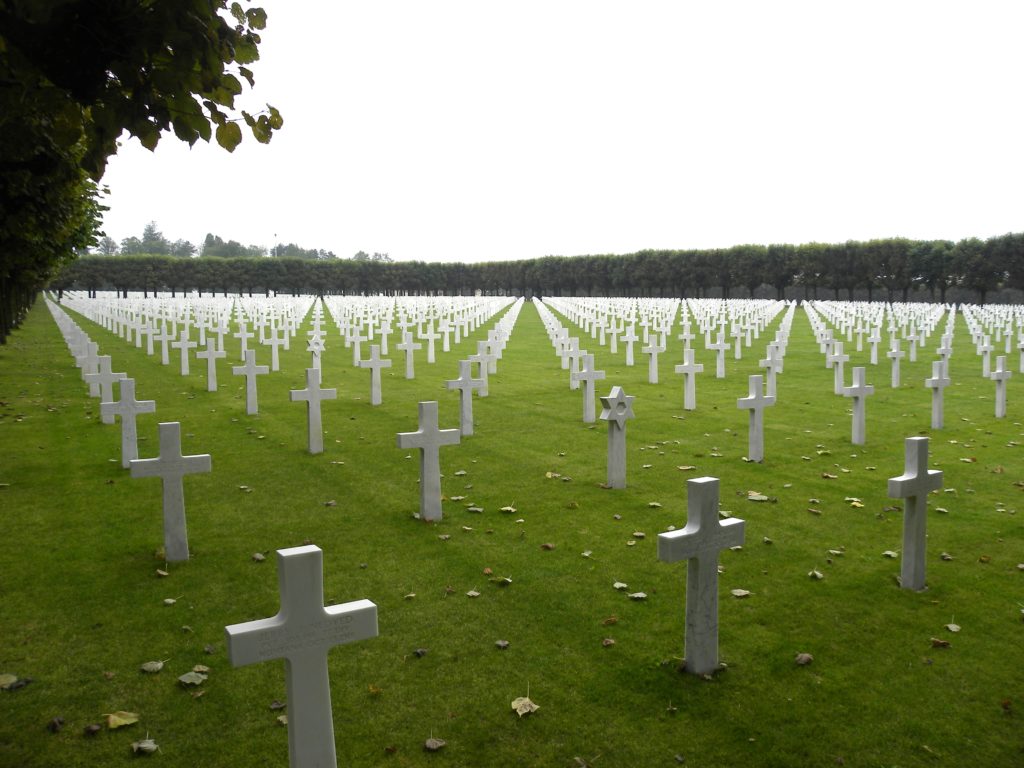
As we approach the centenary of Armistice Day, it is important that Americans today remember the ultimate sacrifice made by so many Americans 100 years ago. Many of those soldiers, popularly known as “doughboys,” now lie in the Meuse-Argonne Cemetery, the largest American war cemetery in Europe. With 14,246 men resting there, the cemetery serves as a peaceful and fitting memorial to the men who attacked well-protected and in-depth German trench systems during the Meuse-Argonne Offensive.
Fought from Sept. 26 to Nov. 11, 1918, the Offensive remains the bloodiest battle in American history, with over 26,000 dead and another 96,000 wounded. It was the American Expeditionary Force’s largest battle and played a critical role in the final Allied push to break through the infamous Hindenburg Line and force Germany’s capitulation.
Today, tragically large number of crosses and Stars of David beautify pastures once disfigured by shell holes and machine gun nests. Yet, for all the Meuse-Argonne’s importance to the ending of World War I, the cemetery has never once been visited by a sitting American president.
President Bill Clinton came the closest in 1998, when the White House announced plans for him to visit the cemetery on the 80th anniversary of the battle’s beginning. Unfortunately, by September, scandal preoccupied Clinton and the Secretary of Veterans Affairs was sent in his place. Since then, no administration has announced any intention of adding the Meuse-Argonne Cemetery to the presidential itinerary.
However, this year finally presents the perfect chance to afford these American heroes the recognition they deserve. The Trump administration should make plans to visit the Meuse-Argonne Cemetery this autumn to commemorate the centenary of the Meuse-Argonne Offensive and the end of the War. Such a trip would have the potential to bring Americans together in remembrance of the fallen and reignite national interest in our involvement in World War I, much as Reagan’s Pointe Du Hoc speech did for World War II. The President should not pass up this opportunity to honor World War I veterans and give the nation the unifying, patriotic moment it so sorely needs.
Joshua Waechter is a sophomore studying history.
