
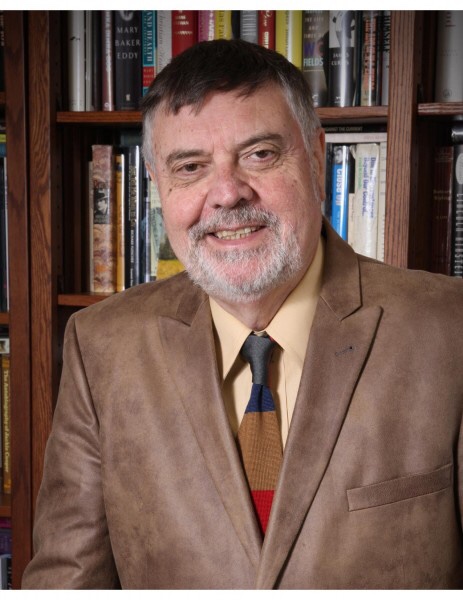
Anthony Slide spoke on “Billy Wilder and Hollywood’s Golden Age” at Hillsdale College for the fourth Center for Constructive Alternatives seminar of the academic year on Billy Wilder. Courtesy | Cinema Museum
Anthony Slide spoke on “Billy Wilder and Hollywood’s Golden Age” at Hillsdale College for the fourth Center for Constructive Alternatives seminar of the academic year on Billy Wilder. Slide is the editor of “It’s the Pictures that Got Small: Charles Brackett on Billy Wilder and Hollywood’s Golden Age.” He is a former associate archivist of the American Film Institute and resident film historian of the Academy of Motion Pictures Arts and Sciences. He has authored and edited over 200 books on the history of popular entertainment and received an honorary Doctor of Letters from Bowling Green University in recognition of his work on popular culture. The American Library Association awarded his books “The American Film Industry: A Historical Dictionary” and “The Encyclopedia of Vaudeville.”
What initially peaked your interest in films?
As a teenager, I enjoyed reading about old films. I was born in Birmingham, England, and I used to go to the Birmingham Library on Saturday mornings and get out old film books and magazines and sort of became interested in old films.
What do you think films mean to our culture and the history of society?
I don’t think films mean very much to our culture anymore, but I think that’s because students go to university, but don’t learn about popular culture. I really think they need to understand the past and about radio, for example, and silent film; these things aren’t taught. Today, I don’t think American culture is influenced by entertainment. It should be, but it isn’t. Films gave entertainment to the society. If you think back to the Depression, people had no money and desperately tried to find work, and the only escape they had was the motion picture. That’s what movies were all about at one time: escaping from reality. Now, movies want to influence your thinking, they want to influence your views on society. Films were entertainment, and that’s really what they should be.
What movies do you enjoy seeing on a regular basis?
“The Night of the Hunter,” directed by Charles Laughton. That was the only movie he ever directed, and he was a famous British actor. It’s a very marveloustic play about two children who try to escape a murderer. It’s beautifully shot — very atmospheric and very absorbing. My favorite silent film is “Intolerance” from 1916. I like it because I was lucky enough to have met a lot of people that are in the film. It brings happy memories to me of those people. When I watch the film, I’m not just seeing a great spectacle, a great drama; I’m thinking to myself, “Oh, there is Miriam Cooper. She shared a dressing room with so-and-so when she made the film.” It’s bringing something to me personally, but maybe not to anyone else. It is very much a personal experience.
What was the impact of Billy Wilder on the art of films?
My interest in Billy Wilder comes from my interests in his first writing partner, Charles Brackett. They hated each other, but they were together for 14 years and turned out some great films, including “Sunset Boulevard.” I was interested in Charles Brackett, and if I’m interested in Charles Brackett, I have to be interested in Billy Wilder, as well. A lot of people tend to give credit to Billy Wilder, but without Charles Brackett’s co-authorship of the scripts, Billy Wilder would not have had a career. Later when Billy Wilder became a director, not only did he continue to write the scripts with Charles Brackett, but Charles Brackett was his producer. In a way, they are collective auteurs. There are two of them, writer, director, producer, but you need the two men to be auteurs.
Have you been here before? What are your thoughts on Hillsdale College?
To be honest, I had not heard of Hillsdale College, but I looked it up and was impressed by it after reading about it. Being here, I don’t necessarily agree with all that it stands for, but it’s very strange it has a lot in its past that’s very impressive. People should know more about it. I’m quite impressed that it was the first college to give a degree to a woman, and that African-American students were here in the early years of abolition. I will say, everything about the college is first-rate, in terms of the hospitality. The people here are extraordinarily friendly. It’s actually like being in the South. When you go to the South everyone is overly-friendly, and this is the way Hillsdale College strikes me.
What are your thoughts on the state of the entertainment industry today, specifically regarding its activism in politics?
I think, unfortunately, there is a lot of hypocrisy in Hollywood. You have a lot of people that are liberal, espousing liberal causes and unaware of what the country as a whole believes and thinks. I think if you want to push your liberal cause, I would say don’t push it in people’s faces. Be a little more subtle about it. Don’t stand up at the Oscars and start going on about this, that, or the other. Whenever you watch the Academy Awards, you are very much aware this is Hollywood hypocrisy. They congratulate each other and say, “You’re so courageous to make this film.” There is no courage or bravery involved in making a film, you just make a lot of money from it. Going out on the battlefield, that’s brave. Not making a film in Hollywood.
What has been lost through the great history of films and what do you believe the future of cinematography to be?
People don’t remember the past. It’s about time you teach popular culture in college. In the silent days, people used to say that film was a universal language because there was no dialogue. There were only titles that could be translated into any language. Once you had talkers, you lost that universality. People make a big deal that “Lady Bird” was directed by a woman, but back in the silent area, there were lots of women directors. It was not unusual to have a film directed by a woman, but then the industry changed and suddenly you didn’t have films directed by women. In a way, we’re going back in time as women begin to influence filmmaking again.
The film industry has lost an older audience. Movies are getting more and more expensive, pricing themselves out of the market, and they’re made for young people. I think the film industry’s present status will die. They’re still going to make films because people are always going to want to be entertained, but that will be streamed, watched on television, or what not.
