
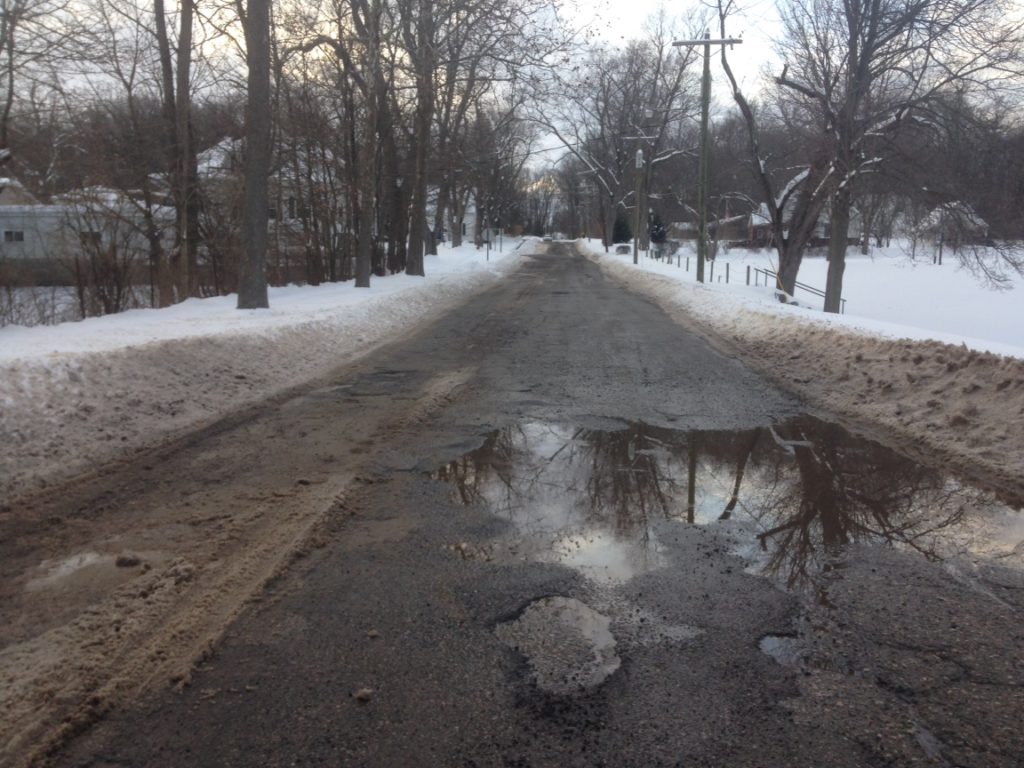
When a snowstorm blanketed Hillsdale on Friday and Saturday, Christ Centered Home Manager Jennifer Wagner knew the slick road could pose serious problems for her assisted living home.
“This is a company. We have handicapped people here. If there’s an emergency, we have to take them to the doctor,” Wagner said. “When it snows, we’re the last road to get plowed.”
But even when the road is not covered by more than a foot of wet, packed snow, the street still causes Wagner trouble.
“The road is horrible. There are bumps and potholes. Last summer, I had to have my vehicle fixed because of the road,” she said. “I want the city to fix it. I think it needs to just strip the whole thing down and redo it.”
The 2017 Road Preservation Project aimed to repair Fayette Street West, Lewis Street, Westwood Street, Spring Street, State Street, East Bacon Road, Barnard Street, Budlong Street, and Hillsdale Street. The project had only completed repairs for two streets — Bacon and Barnard — when winter weather halted progress, but its two contractors will continue to work on the roads in the spring.
City Councilman Bruce Sharp told the Collegian in September that his years in office have taught him the severity of Hillsdale’s crumbling roads. The problem began when the road’s maintenance budget was cut about 20 years ago and street upkeep stopped, according to former mayor Scott Sessions.
“The roads are the No. 1 issue in this town,” Sharp said. “We’ve ignored the streets for many years, and it’s going to take time and money to fix them.”
Hillsdale’s Director of Public Services Jake Hammel said repair, rather than complete reconstruction, is the best way the city can address the roads.
“Every dollar you spend on street maintenance will save you $6 on reconstruction costs down the road. In this business, that number is pretty commonly thrown around,” Hammel said. “Our city’s money is really best spent on streets worth saving.”
Hammel said the city selected two contractors to work on the 2017 Street Preservation Project, which cost $280,000. One contractor cuts out and clears broken portions of the streets before filling the cleared spot with asphalt. The other contractor fills in any cracks with hot rubber, ensuring the edges of the patch are completely sealed to keep moisture out.
“By doing all of these repairs, it’ll buy us six to eight years of life on each street, maybe more,” Hammel said.
The total cost of repairing the streets encompasses more than supplies and labor. When the city repairs a road, it must make sure its work also brings the road and its surrounding sidewalks and driveways comply with the rules set by the Americans with Disabilities Act.
“If we do anything more than fix a chip in a road, we have to bring all the roads and sidewalks and driveways up to code with the ADA,” Hammel said. “We are more than happy to do that, but that does add a whole new set of costs to our project.”
As the 2017 Street Preservation Project completes its work this spring, a different set of roads will be repaired or reconstructed by fall 2018, according to Hammel. The city received a $2 million grant from Michigan’s Infrastructure Capacity Enhancement (ICE) to fix roads situated over city utilities like water and sewage mains in need of repair.
“ICE is really looking for cities to replace utilities in areas where they’re overused or overburdened,” Hammel said. “It just so happened that these were found in areas where the street conditions were very poor.”
The project funded by the ICE grant will repair Garden Street, Mead Street, Vine Street, and portions of Rippon Avenue and Spring Street.
