
WASHINGTON — “God have mercy on us all.”
Standing at the pulpit in St. John the Beloved Catholic Church in McLean, Virginia, Fr. Chris Pollard addresses the congregation gathered for Mass before the 45th March for Life. Dressed for a day on the streets in downtown Washington, D.C., these soon-to-be marchers consist of students flown up from Ave Maria University in Florida, local McLean Catholics, and the studentry of St. John’s parochial K-8 grade school.
Pollard directs his homily at the children. He asks them to think what human life means and how they would feel about protecting the unborn 35 years from now, when they are raising children of their own.
“Hopefully, in 35 years, we will not have to protest injustice done to the unborn,” Pollard says. “Hopefully, we can change that. But we will always have problems. We will always have sin to contend with. And we will always have God’s mercy.”
This year, the pro-life movement seems to have been granted some mercy. Since the United States Supreme Court effectively legalized abortion in the 1973 Roe v. Wade case, the pro-life movement has been fighting a bitter battle to reverse the decision. That has not happened, though most states now restrict late term abortions. But the issue remains one of the country’s most inflammatory issues — the sort of thing you don’t bring up in public.
This year, however, at the march, President Donald Trump addresses the crowd, making him the first president to do so. Trump calls the March for Life a “movement born out of love” and thanked everyone in America seeking to protect the unborn.
“You’re living witnesses of this year’s March for Life theme,” he says. “That theme is: Love saves lives.”
But a quick walk down Constitution Avenue from Stanton Park toward where the march begins on 7th Street challenges that thesis. Prominently displayed on billboard-sized posters are animated depictions of Satan, tearing a child limb from limb, bits of flesh dangling from his snarl. Alongside it, another gigantic poster shows off photographs of baby arms and legs, covered in blood and laid on top of a quarter. The posters are labeled with Bible verses and the slogan: “Abortion is child sacrifice.”
Nicole Cooley, project director at the Center for Bio-Ethical Reform, stands in front of the posters handing out business cards stamped with QR codes that lead to an informational website. Each QR code comes with a photo of a dead baby featured in its center.
Cooley explains that the baby-eating Satan is meant to be a depiction of Moloch, the ancient Canaanite god associated with child sacrifice in the Old Testament. According to Cooley, priests in the cult of Moloch would beat drums to drown out the sounds of the screaming babies they were sacrificing. The parents will be unaware of what was happening until it was too late to stop the sacrifice.
“It’s the same thing here,” Cooley says, gesturing to the animated picture. “We’re reliving it, except now our babies are being ripped from our wombs instead of our arms.”
To draw a parallel between the two situations, Cooley says her organization will play a soundtrack of intense drums and wailing babies as marchers filed past the posters.
Cooley explains that she was a victim of this sort of sacrifice; after she was raped, her pastor had advised her to abort her child as a way of healing from the rape.
“I went to the altar of Planned Parenthood and sacrificed my child so that I could be okay, not knowing it was actually going to make it 10 times worse and healing more difficult because it was going to feel like I was being raped again,” she says. “Only this time, I consented. Two different men assaulted me in different ways in the same part of my body. One took my virginity, and the other took my child.”
When she saw the depictions of Moloch at the March last year, the horror of the scene moved her to grieve her own loss. Now she says she wants everyone to see these images so the country can recognize the diabolical nature of abortion.
“We hope to work with the Holy Spirit to get people understanding God’s perspective on abortion,” she says.
As Cooley finished, a woman walking down to the march with her son covers his eyes as they walked past the posters.
“It’s okay; I’ll tell you when you can look, Benny,” she says.
Further down in the crowd — past the WARNING: GENOCIDE PHOTOS AHEAD signs — a voice on a megaphone rings out over the rest.
“Martin Luther!”
Pushing my way through the crowd, I find Stan Rehn, a balding real estate financier from the Baltimore, Maryland, area, addressing a crowd of highschool boys from Saint John Paul II in Greenville, North Carolina. He’s carrying a large sign that reads, “Happy 500th Anniversary Protestant Reformation.”
“The Catholic Church does not have the truth of the gospel!” Rehn shouts.
A middle-aged man in a Celtics scarf walking by stops short. He steps up onto the curb where Rehn is standing and starts antagonizing him.
“Oh yeah? That’s what you say.”
The high schoolers form a ring around the two men. They start chanting: “Fight! Fight! Fight!” One deep voice in the back of the mob belts out above the rest, “Get Physical!”
Caught off guard, Rehn retorts: “Jesus didn’t answer the skeptics!”
“Right. Right. That’s your opinion.”
The ring tightens, and the high schoolers begin cheering for Celtics Scarf.
“Talk that talk!”
Rehn leans down toward the crowd.
“Well, I think I speak God’s word.”
“Where’s your theological training from?” Celtics Scarf asks.
“That’s what they asked Peter. That’s what they asked Jonah.”
Celtics Scarf laughes.
“You’re not Peter, brother.”
“I have authority from scripture.”
“Oh, you do?”
“Oh, I studied. You don’t believe me, but I’m right. I’m a fighting fundamentalist. And the fundamentalists said the church has gone rotten! Back in the ’20s and ’30s.”
“Oh my—”
“And they were right! All the major denominations. The Catholics, the American Baptists, the Lutherans, and et cetera and et cetera and et cetera. They didn’t believe the gospel they once believed.”
Celtics Scarf gets in Rehn’s face, jabbing the air with his finger.
“That’s what you were taught. You were taught that by Baptist fundies! You were taught that by a guy who thinks he has a monopoly on the gospel.”
The high schoolers cheer more loudly than before and begin jumping up and down.
This whole time, my sister Ana has been standing outside the ring, face flushed with anger. At this last remark, she runs in between Rehn and Celtics Scarf and looks them both in the eye.
“Both of you — stop it! We’re all pro-life,” she says. “That’s what we’re here for.”
The crowd laughs and shouts some unprintable remarks, but they disperse.
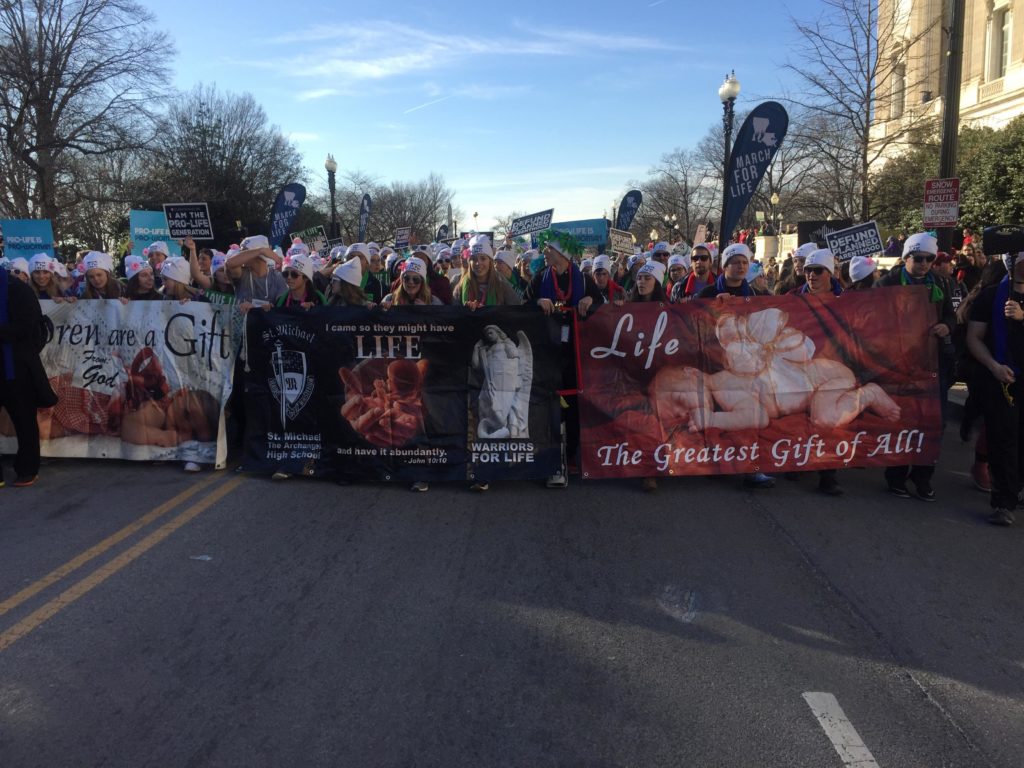
Maybe the crowd gives up on Rehn because the actual March is beginning. The Knights of Columbus lead the way (as they always do), rolling down the street with the 45th March for Life banner. About 100,000 pro-lifers follow behind.
Gerri Bosch, from Grand Rapids, Michigan, remarks that the March will eventually help reverse Roe v. Wade.
“I don’t think it will be overturned immediately,” she says. “I think it will be step by step by step. Abortion is so ingrained in our society that it will take more than just a march.”
I ask some highschool girls if they plan on coming back next year.
Anna Bloch: “Yeah.”
Marie Hales: “Wait, no, but it’s not annual.”
Bloch: “Oh yeah, no. We don’t want there to be abortion next year.”
As we approach the Moloch signs, some marchers have to sidestep a pool of vomit. A priest leading a group of middle-schoolers tells them, “There’s some signs coming up on your left that you might not want to look at. I’ll tell you when — just look to the right.”
A man standing on the other side of the road holding a broken crucifix shouts at the crowd, “Bring back the altar! You will die someday!”
Nick Leaver, a junior at the University of Virginia, sighs and surveys the scene. “Well, I think it’d be even sadder if there were no march at all.”
As we approach the march’s terminus at the Supreme Court, we meet up with a church group holding a banner and singing “Oh When the Saints Go Marching In.” Behind them, Greek Orthodox priests in their robes and hats are chanting traditional songs. Some senators and their staffers waving out of the windows of the Russell Senate Office Building.
A number of marchers are lined up with “Choose Life” signs outside the Russell, all ready to go in and talk to lawmakers about supporting pro-life legislature.
A young man prays his rosary in front of the Supreme Court.
We join briefly but then decide to leave the March for The Dubliner, a bar where everyone — all the big families, all the young people, my fourth grade teacher — gathers after the march. The smell of Guinness and fish ’n’ chips permeates the air all around North Capitol Street. Kids are running around while their parents talk about the march.
A sign reads “After party for life” and then — unprecedented for a bar near Union Station — “Bathrooms open to everyone!”
With blessings like these, I know God will have mercy on us all.
