
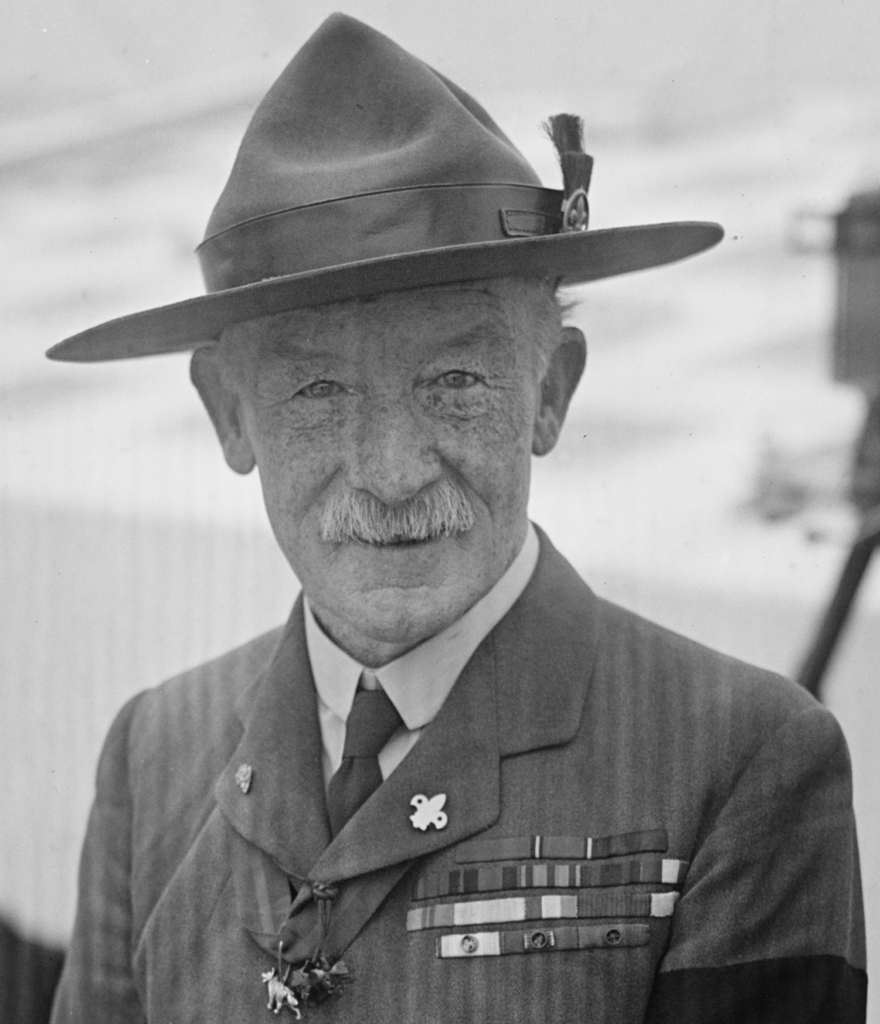
 When Lord Robert Baden-Powell, Lieutenant General of the British Army, wrote the manual Scouting for Boys in 1908, he wanted to combat the growing pervasiveness of “brooding and selfishness” in England.
His goal was to show the path he took to fulfillment and virtue to Britain’s younger generation so they could follow it, if they so chose. He expressed in the book, among other things, praise for the female scouts of the nation and a conviction that “it’s the spirit within, not the veneer without, that makes a man.”
Historian of Scouting Tammy Proctor said, in an interview with The Atlantic, that girls caught onto Powell’s project in Britain with as much enthusiasm as boys did. Girls were excluded from the original organization inspired by Scouting for Boys because early Scout leadership worried that a co-ed program would be unappealing to boys. Eleven year olds would think it was “unmanly” to practice outdoor skills and leadership development alongside girls.
But, Powell, seeing the importance of learning selflessness and service and excited about the potential of Britain’s young girl scouts, helped his sister set up a corresponding organization.
Now, at the beginning of 2018, the BSA is reuniting boys and girls at the beginning of the scouting path in response to surveys that revealed a demand for the instruction the BSA has to offer for both genders. Eighty-five percent of Scouting parents think it’s relevant for both genders. Ninety percent of non-Scouting parents would enroll a child of either gender in a program with the same values and activities as the BSA.
The BSA is changing, first, by letting girls into Cub Scouts. Next year, Cub Scout packs across the country will have the options of (1) creating an all-girl pack alongside their own pack, (2) form all-girl dens (groups of six-eight girls of the same age) in an already existing Cub-Scout pack, and (3) remaining all-boy. A track for girls in the Boy Scout program is a development that will allow girls to earn every Boy Scout rank and merit badge, including Eagle Scout.
Criticisms of this policy change fall under two categories. Some argue that the change poses a danger to youth development in single-gender groups and others say that the change is superfluous because girls already have a Scouting option (Girl Scouts of the USA).
The first criticism is well-intended but misdirected because it is impossible for the policy change to result in mixed genders in the small groups where growth actually occurs. There is something to be said for development alongside similar kids in single-gender groups. The BSA administration agrees. That is why there will be no co-ed dens in Cub Scouts and packs have the option of not allowing girls at all.
The Boy Scout track isn’t finalized yet, but the official statement of the BSA regarding the policy promises that the organization will “maintain the integrity of the single- gender model.” What’s more, the biggest gender integration that could possibly take place, boys and girls doing trips and activities together, already took place.
In 1998, the BSA initiated a program called Venture Scouts that wanted to instill Scouting values into teenage boys and girls through more intense options than normal BSA troops with younger boys could offer. If anyone thought absolute gender separation was the best option for the BSA, they lost their chance to object 20 years ago.
As it is, the recent change integrates boys and girls no more in the BSA than they already were. And it also preserves separation of the sexes until the age when working with the opposite gender becomes productive.
The second criticism, too, is theoretically sensible but disproved when one takes into account that the GSUSA is not, in practice, a mirror program of the BSA. The scouting that takes place in the two organizations is drastically different. Similar mission statements though they have, the BSA has always kindled the pioneer spirit of America — valuing physical labor and conserving the land — while the GSUSA has historically been a home for the urban-activist spirit of America.
An example of this is the difference between the requirements for the highest rank in each. In the BSA, most Eagle Scouts earn their award by completing a service project involving manual labor and handiwork. Gold Award projects in the GSUSA tend to value a scout’s efforts to educate about a social issue in a community.
Setting aside arguments about which program is better, we can definitively say they are different. If there ever was a girl who wanted to make the values of Scouting part of her life in an atmosphere that would cultivate a love of physical labor and adventure, while also providing the benefits of a rigorous curriculum in skills along with a nationally recognized award like Eagle Scout, she didn’t have the option. Until now.
There has been a trend since the 1970s of girls quitting the GSUSA for not meeting their expectations. They have looked to join the BSA as an alternative. In response to Sydney Ireland of Manhattan leaving the Girl Scouts this year for that reason, a representative from the GSUSA said “We’re not meant to be the girl equivalent of Boy Scouts… if [Girl Scouts] doesn’t feel right for certain girls, I really laud their parents and them for finding a place that is.”
Hats off to the BSA for creating that place.
Matt Wylie is a senior studying English. He is an Eagle Scout.
