
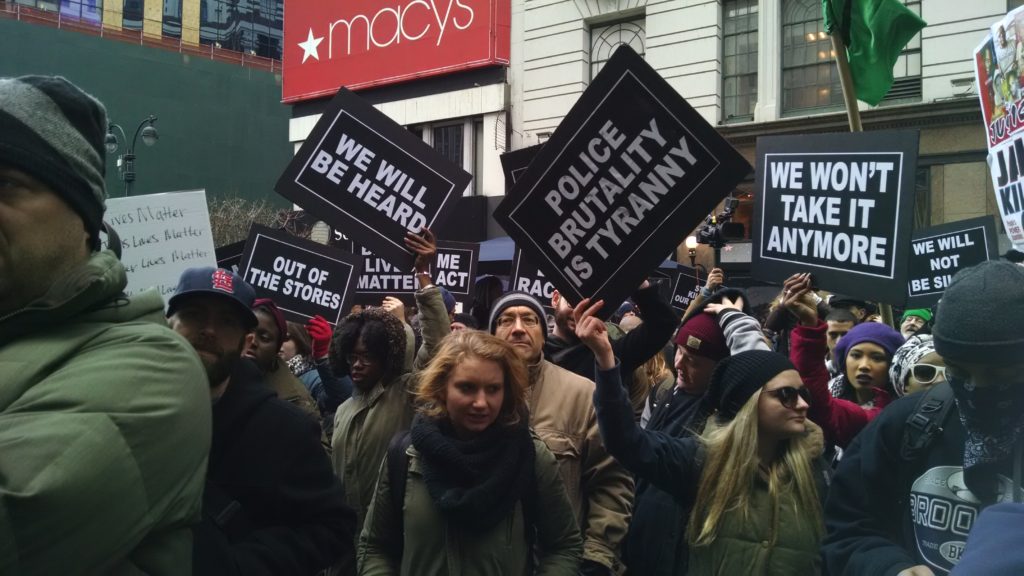
One of the few unapproachable topics at Hillsdale is identity politics, demeaned as a lesser form of discourse. At the same time, however, conservatives and liberals alike fall prey to it. Let’s turn to certain claims in contemporary discourse to understand why both sides fail to have healthy discussions: participating in the “Black Lives Matter” movement or saying “I am a feminist,” identifies the person marching or speaking with a specific set of political views. It is definitional as well as rhetorical.
Identity politics, at its core, is an identification of the self with some immutable characteristic with which others also identify themselves. It is a departure from a broader understanding of a political life as one aiding in the promotion of various civic virtues to one of factions making claims until their views become standard and the laws of a country change accordingly.
It polarizes discourse in America, preventing genuine discussion of political views because one’s self-identity feels at stake during any given debate. Moreover, this form of discourse pervades politics in general. Such a self-identity with a political view stems from a broadly Cartesian understanding of identity that refers mainly to an immutable and substantial self.
Of course, these rhetorical claims also carry a deeper meaning. Although many claim to be “open-minded,” everyday experience suggests otherwise. We defend the political identities that we assume with thin rhetorical claims, which mask our inability to discuss politics in an intelligible manner, consider different perspectives, and even “change our minds” on various topics.
For example, one of the largest flaws in the political manifestation of the feminist movement is their current attempt to use “empirical data” to demonstrate the need for equality. They want the data to speak for itself and act as the reason to accept their moral claims — yet they often fail to substantiate the rhetorical claims. In general, there is both a failure to place one’s claims within a coherent tradition and an inability to generate meaningful discourse about the given identities adopted therein.
The thinness of the rhetorical claims reveals that political views are more volatile than we believe. The claims typically take place in a vacuum, outside of a tradition or without meaning. The rhetoric and supposedly strong logical argumentation obscure our tendency to associate ourselves with an unchanging identity. Why is it that we tend to identify ourselves with a specific political movement rather than with a more coherent tradition, if you will? Why do we settle for logic or rhetoric without context?
There are many differing responses that have been given with respect to why our discourse has become so poor, yet they all seem to be correct in differing and yet related ways. Contemporary virtue ethicist Alasdair MacIntyre focuses on how our moral claims no longer hold the weight they do because they are merely expressions of preference, or, in my interpretation, they are merely articulations of identity. Friedrich Nietzsche — who influences MacIntyre in certain respects — discusses our nihilistic culture as one devoid of meaning and proposes how we might overcome this through a creation of meaning, whatever that may mean.
What unifies these thinkers is their discussion of a lack of meaning in society that identity politics reveals. Rather than identifying with a coherent tradition or, like Nietzsche, creating meaning for yourself over and against a meaningless society, identity politics stems from a lack of understanding of the self as dispersed; rather, it identifies the self with some immutable characteristic. In so doing, it precludes healthy discourse about the very subjects they aim to defend insofar as it treats them as settled matters of which there can be no further discussion. Discourse is merely a matter of defending one’s views, which are treated more like a “view-from-nowhere.”
