
A nod and a faint smile, that’s all.
In a world as small as Hillsdale, this happens every day. You walk down the hall in Kendall — and oh! — there’s that guy you thought was cute in freshman year. You’ve only spoken to him once, but every time you see him, you glance up and smile. It may happen every day, but each time it’s a fresh experience because that awkward eye-contact jolts your mind into potentiality — a world of perpetual possibility that will always be just out of your reach.
In the same way, “La La Land” lets its audiences enjoy a moment of pure potential. Critics love it for that, and the film just scored 14 Academy Award nominations — a big accomplishment for a musical. But “La La Land” does more than give its viewers a cute two-hour diversion from the real world. “La La Land” helps us understand ourselves as beings bent on escaping from ourselves, only to recognize when it’s far too late that there’s no escape from the self.
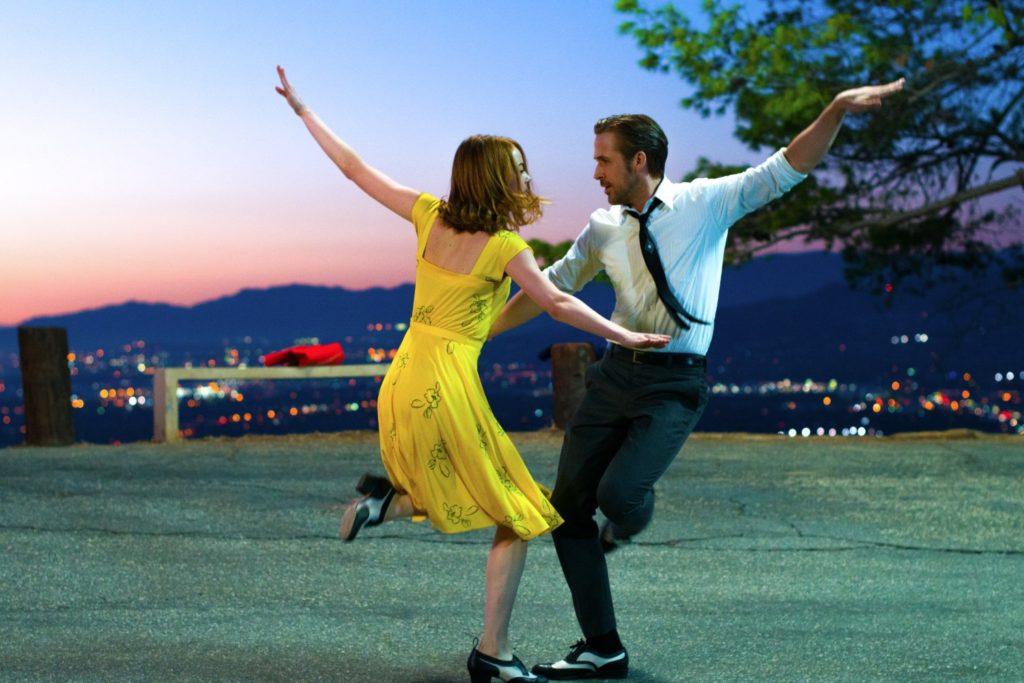
The film centers around a scene where Mia (Emma Stone), a hit movie star, is stuck in Los Angeles traffic with her husband. But she wasn’t always here — five years ago she was a barista working on the Warner Brothers lot, dating Sebastian (Ryan Gosling), a luckless jazz musician. She didn’t love him and he didn’t love her, but they awakened in each other the desire to pursue their dreams. She wanted to be an actress. He wanted to open a jazz club. Over the course of the film, we watch their relationship unravel as their respective passions lead them in different directions.
If you think you’ve heard this story a million times before, good. You have. “La La Land” takes everything about the millennial experience — from the colorful way we dress to our internet-era habit of spouting pseudo-science about electronic car keys causing cancer — and turns it into a musical imbued with 80 years of film tradition.
True to modern chic, the film does not present its heroes as commendable people. Sebastian is annoying about his passion — if the writers had replaced every one of his lines about music with Barry Benson from the “Bee Movie” saying, “But do you like jazz?” the audience would have gotten the point. And Mia is unrealistic about herself. She dropped out of college after two years — for what? — the chance to work across the street from the remnants of the “Casablanca” set and revel in the LA sunsets.
But that’s not the point. “La La Land” may be a punctual piece of social commentary and a terrific riff on a tired genre, but these are just buttresses for the universal — and truer — story the film tells.
It happens when we meet Mia in the film’s epilogue, five years after the action. We see her get out of her Mercedes-Benz and walk out onto the Warner Brothers lot. She’s no longer that cartoonish girl cutting work to audition for a role she knows she won’t get. As she walks the lot now, the firmness in her calves matched with the confidence in her step give her the grace of a lady.
And she’s a lady when she decides that her husband should get off the crowded LA highway and find a dingy joint for a dinner date at a new jazz club. And she’s a lady who sits down in a Singer-Sargent-like repose as a ragtime band in an underground club plays improvised jazz.
But it’s just Mia, unprepared and girlish, who looks up and meets eyes with her former lover as he awkwardly plays their song on the piano.
In that final moment — the awkward-eye-contact between Mia and Sebastian — “La La Land” blends past and future into an eternal present as the audience sees the endless possibility of the imagination: what could have been if Mia and Sebastian’s relationship had not ended.
But this isn’t a final toss at romance — Mia and Sebastian can’t get back together now. They have become themselves. Mia is a successful actress and Sebastian owns his own jazz club. The best the two can do when they look into each other’s eyes for that brief moment all is faintly smile and nod. For in that moment, they understand themselves as themselves. Everything else is just an abstraction — a world of untapped and untappable possibility.
Best not to dwell on it.
