
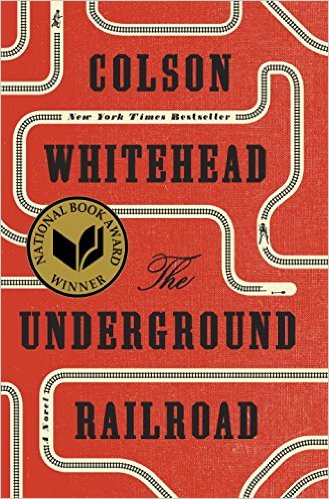
Enslaved, abandoned, bloodied, shackled, but never conquered. This is Cora, a slave picking cotton in antebellum Georgia, an escapee disappearing into assumed identities, a free woman emerging in the far north.
Colson Whitehead uses historical, pre-Civil War America as a backdrop for Cora’s story, but his plot hinges on a highly-fictional version of the Underground Railroad: his characters escape the south through subterranean steel tracks and rickety cars chugging north rather than through the network of abolitionists and safe houses. When Whitehead attempts to make a statement about slavery’s lasting effects and cultural implications, his proclamation loses its credibility and weight amid fictionalized history.
Cora’s mother, Mabel, birthed her in a slave’s cabin, and abandoned her daughter for the dream of freedom 10 years later. When Cora reaches adulthood, she flees bondage, trading one life of horror for another. She escapes Georgia, riding the underground railroad to South Carolina, where she finds herself living in a town where doctors secretly practice eugenics and institute dangerous medical experiments on fellow members of Cora’s race. Before she can warn her new friends, Ridgeway, the slave catcher who failed to return Mabel to Georgia, discovers Cora, forcing her to run again.
She finds refuge in an North Carolina attic, hiding in a few square feet of dust and suffering months of silent tedium. When Ridgeway discovers her, her confidants are hung, and Cora begins a journey back to Georgia in her slave catcher’s wagon until a trio of runaway slaves intercept and kill her captors. Together, the fugitives progress further north, settling in Indiana until the pattern repeats itself — they are safe until they must escape again.
Cora’s story reaches its abrupt ending in Michigan. After she descends into the underground railroad one last time, propelling herself in a handcar for miles, she finds genuine freedom: “Cora put miles behind her, put behind her the counterfeit sanctuaries and endless chains.”
Cora’s escape is gripping, and the other stories revolving around the underground railroad compliment her own to provide it due context. To tell these tales, Whitehead unravels each narrative with graphic detail that saturates every scene. The (nameless) narrator accounts for slavery’s violence with screams tearing from soundless pages, its injustice with images staining the unillustrated chapters.
This illustration allows readers to witness Cora’s tragedy, but Whitehead’s book is so full of fictional elements distancing it from historical reality that it lacks the credibility needed to make a statement about slavery, its enduring ramifications and its cultural implications. Whitehead does attempt to make such a statement when he slips into the first person plural for the first and only time near the end of the book, which otherwise uses the third person throughout the rest of the book.
“A horseshoe puckered on Sybil’s neck, ugly and purple… Cora thanked the Lord that her skin had never been burned in such a way. But we have all been branded even if you can’t see it, inside if not without.”
This is the only use of the pronoun “we” in more than 300 pages of text — 300 pages telling a story about the underground railroad so removed from historical fact that its plot hinges on a railroad built literally beneath the ground. For Whitehead to simply define slavery’s effects and declare them harbored by a non-specific we — does he mean himself? escaped slaves in the pre-Civil War era? all African-Americans? anyone with enslaved ancestors? — within the context of a highly fictional story damages his point.
With such a departure from history, it’s hard to believe an unwarranted statement that makes such a large claim about a national tragedy afflicting real people.
