
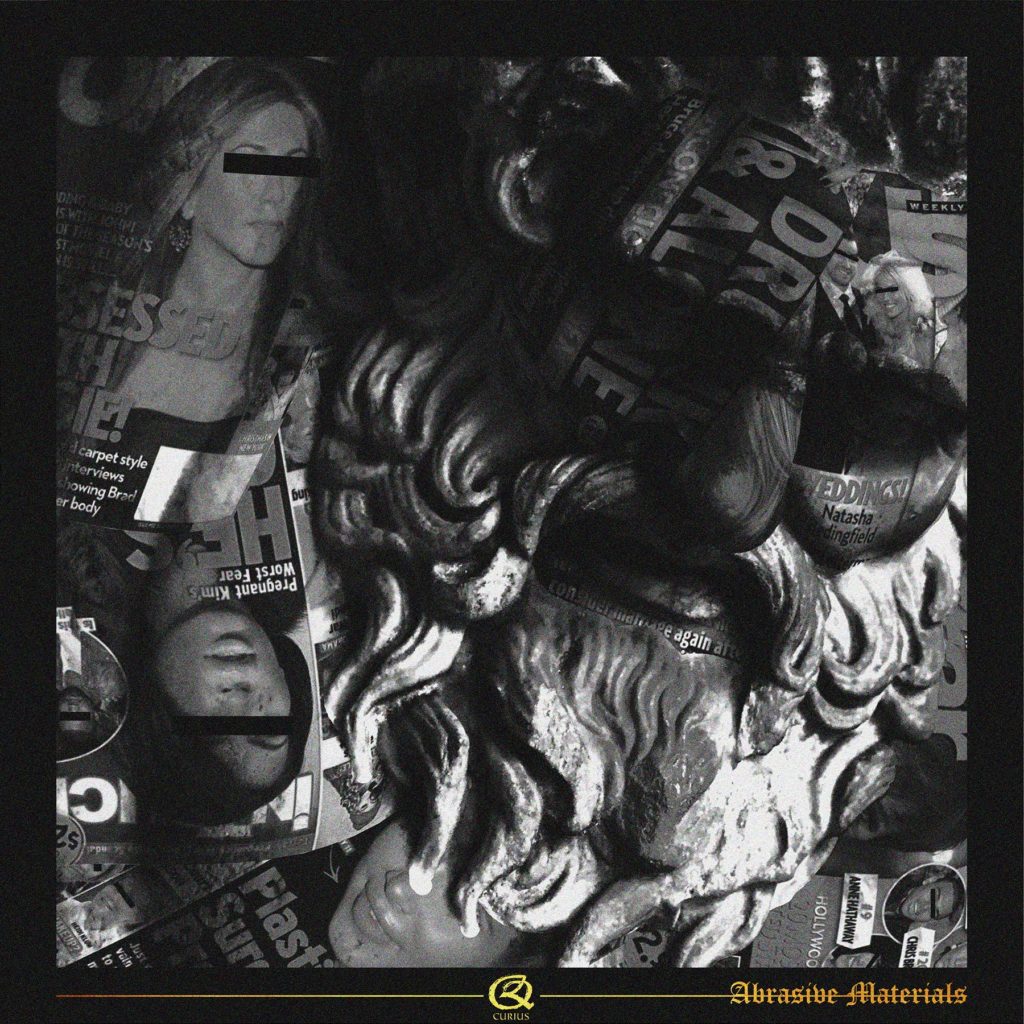
In the downpour of a cold November evening, while the trees bent to a 45 degree angle, I had the privilege of listening to an album that can only be described as torrential.
“Abrasive Materials” is the debut, full-length album from Q Curius, an electronic-rap duo composed of senior Joel Calvert and alumnus Forester McClatchey ’16, which will be available on all music streaming platforms. Calvert describes the project, which is over nine months in the making, as his “little thesis,” but this hardly begins to describe the intensity of Calvert’s and McClatchey’s work.
From a technical standpoint, the album synthesizes the duo’s individual talents. McClatchey, an English major, is without a doubt in his element composing intricate bars that resemble the works of Wallace Stevens, Lynette Roberts, and Andre 3000 (of OutKast fame) in equal measure. Undergirding these poetics are Calvert’s own melodic intricacies, which both pulse underneath and soar above his beats. These range from the atmospheric instrumental “LiquorChikenHorse” toward the front end of the album, to the alarming cacophony of “Sitting Stiller.”
“This album only exists because of the weird mechanism of artistic collaboration. I’d make a track and hate it and doubt its appropriateness for the project. Forester would reassure me, work his art, and then add his voice to it. When it returned, each song would be an entirely different piece than what I sent out to him,” Calvert said. “There’s a certain purity to collaboration like that.”
McClatchey speaks on the opening track, “Most Hated Man,” to his isolation from genuine love as he sings the chorus with, and to, Catherine Lennon, McClatchey’s girlfriend and a prominent contributor to the album. “I’m missing you, but I’m tied with pride / Vicissitudes are all I do / You miss the way that I tell you why.” McClatchey and Lennon grieve both the loss of themselves and each other with the utmost vulnerability, here and throughout the album. Lennon sings on “Make The Rules,” “Flood every vein in my heart, / And you tell me this is love, a holy sin,” a poignant, double-edged future wish and nostalgic recollection. Calvert begins the aforementioned song with a slightly off-kilter beat, catching the listener off guard and accentuating the feeling of unnatural confusion which McClatchey emblazons upon the instrumental with his lyrics — “I’m at the end of a montage: / Making order while I’m mixing up a loss.”
In bringing on the voices of junior Mark Naida (in “ETC”) and alumna Catherine Coffey ‘16 (in “Subsubculture” and “Needles or Leaves”), Q Curius does not so much craft a linear storyline, but a tension between their voices of despair and McClatchey’s sincere desire to abate detachment. Though Naida’s hook was recorded in a single night in Calvert’s basement, and Coffey’s contributions were recorded in the same span of time, they sound foreign to the tone of each song on which they feature. And yet their imparted work blends seamlessly with the barrage of emotions. Naida belts on “ETC,” “They burn everything I am, / And what little I have,” speaking for McClatchey, who sings on the same track: “Assimilate what I can’t relate, / What I can’t escape, I span the grate, / Try to celebrate what elevates.” There is an abundance of meaning in this interplay — McClatchey’s resignation is expressed through Naida’s vocals, yet McClatchey struggles to move beyond such despondency in his own words.
“Abrasive Materials” is not merely a composite of parts — it is a masterful unity, a cohesive whole wherein no element can be separated from another. The album is neither solely a showcase of Calvert’s undeniable skill as a producer, nor is it solely a spotlight on McClatchey’s opaque and masterful use of metaphor. Q Curius have produced art that proclaims anxiety in its fullness. Every track intends to turn the listener inward, considering the album’s deeply personal lyrics their own interior balance. It is a connection between persons, an experience which transcends the separation between artist and audience by appealing to the highest beauty, which is love, and the harshest pain, which is separation from it.
If “Abrasive Materials” could be summarized in a handful of words, it would not be the album that it is, because it spans an infinitude. The album itself is not an infinitude, though it “contains” artistic “multitudes”; it is its poetic breadth, the immensity with which the listener can feel the artists’ longing, mourning, and becoming, that makes it inexhaustible. It is alienation and its overcoming. It is love, and its absence. It is a torrential downpour, a life-raft in its ensuing flood, and more than a story. As McClatchey sings in the chaotic swirl of “Kairos”: “Whatever happens, narrative don’t come before affection.”
