
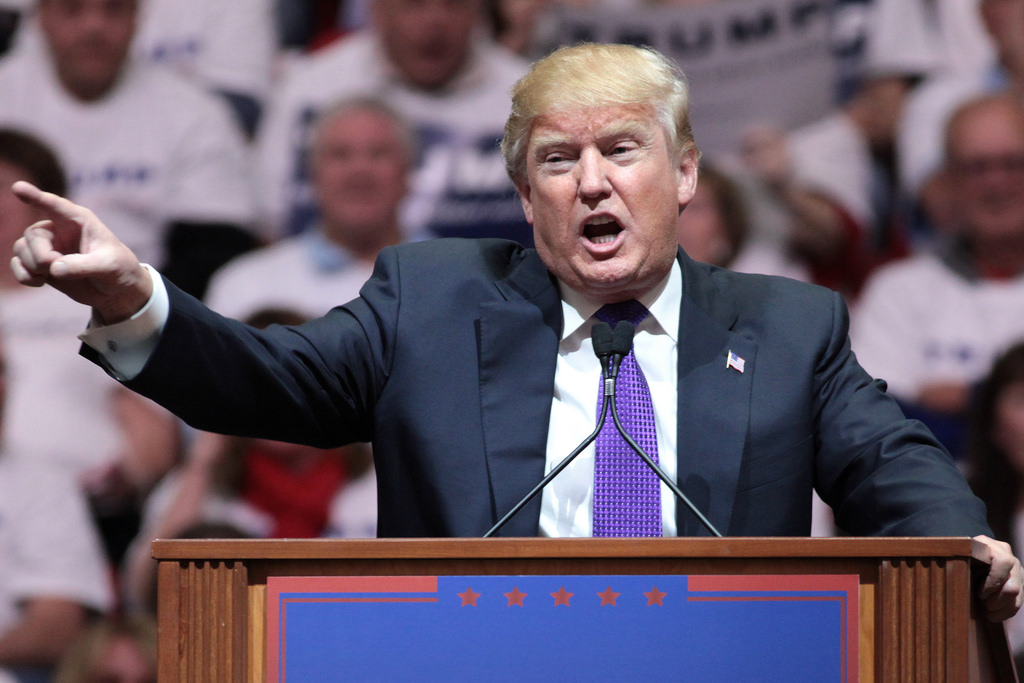
Donald Trump’s vocal opposition of the Johnson Amendment is a key factor of many Evangelicals’ seemingly confusing support of him.
The mainstream media has largely ignored Trump’s stance on the issue and instead spent time on his more controversial stances with protectionist trade, immigration, and foreign policy. But his stance hasn’t gone unnoticed Evangelical circles, and the Republican Presidential nominee’s opposition to the Johnson Amendment garnered him a lot of support.
For the last 62 years the Johnson Amendment to the tax code has sought to muzzle churches and other religious organizations from making political speech.
Many churches and Christian organizations are growing tired of restrictions brought about by the Johnson Amendment, and opposition to it has been growing in recent years. So when Trump began voicing his opposition to the amendment, many Evangelicals listened.
At the Republican National Convention in July, Trump promised to repeal the language which he said “threatens religious institutions.” At the Value Voters Summit in September he promised to “get rid of it so fast.”
Named after Lyndon B. Johnson, who proposed it as a Senator in 1954, the Johnson Amendment prohibits certain tax-exempt organizations, including churches, from endorsing political candidates. Congress strengthened the political gag-order in 1987 by further specifying that these organizations couldn’t oppose a specific political candidate either.
The Johnson Amendment doesn’t stop pastors from preaching for or against political issues. According to an August Pew Research Poll, among adults who have attended religious services in the months before the poll, 40 percent heard clergy address religious liberty and 39 percent heard clergy discuss homosexuality.
Further, according to the poll, 14 percent of respondents said they have heard a clergy member speak for or against a presidential candidate, possibly violating the Johnson Amendment.
Some pastors and leaders of Christian organizations sidestep the Johnson Amendment by saying they speak for themselves when they make political statements.
This line became especially blurry this election cycle when televangelist Mark Burns and Liberty University president Jerry Falwell Jr. openly campaigning for, and sometimes with, Trump.
Supporters of the Johnson Amendment argue that churches shouldn’t have tax-exempt status and be able participate in overtly political speech. By allowing the tax-exempt churches to engage in campaign politics, some argue, the government would essentially be subsidising their campaign activities.
But this argument falls flat because many tax-exempt organizations, such as labor unions, may campaign as long as they file the proper forms allowing their political expenditures to be taxed.
It doesn’t make sense that under the current tax code, labor unions should have more freedom to discuss politics than churches, which guide the spiritual lives of congregants.
Pastors should be free to speak frankly with congregants about current political matters. Given this freedom, it would be completely acceptable for churches to pay taxes on any actual expenditures they end up making to advance a political end.
Pastors have stood up to the Johnson Amendment even before Trump took up the issue. In 2008, a number of Protestant churches began participating in Pulpit Freedom Sunday, a day started by the Alliance Defending Freedom, where pastors explicitly preach against the amendment.
This session of Congress, two Republican Representatives have also challenged the Johnson Amendment.
Representatives Steve Scalise, R-La., and Jody Hice, R-Ga., introduced the Free Speech Fairness Act, which would restrict the Johnson Amendment from being enforced against churches and other non-profit organizations. The bill would ensure that political speech made by pastors no longer threatens a church’s tax exempt status and would free more pastors to be vocal about politics.
While Trump’s accommodations for the LGBT community and his flip-flopping on abortion may seem inconsistent to Evangelicals, his views on religious liberty, and especially the Johnson Amendment have been very steady.
“I think maybe that will be my greatest contribution to Christianity — and other religions — is to allow you, when you talk religious liberty, to go and speak openly, and if you like somebody or want somebody to represent you, you should have the right to do it,” Trump said at a June 21 speech.
And on that point, Trump is completely right.
Mr. Carter is a senior studying politics and journalism.
