
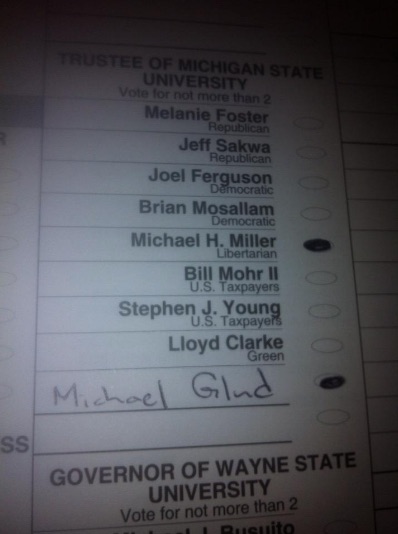
Michigan residents can now post “ballot selfies” to social media without fear of legal punishment, thanks to two Hillsdale alumni who won their case in front of a federal judge Monday.
“We’ve been working on this case since August,” Stephen Klein ’05 said. “It feels great to have this hard work pay off. To win this case just two weeks away from Election Day is significant.”
Klein — an attorney for the Pillar of Law Institute in Washington, D.C. — represented plaintiff and fellow classmate Joel Crookston ’06. When Klein discovered Crookston had posted a photo of his ballot on Facebook in 2012, they teamed up in September to file a lawsuit against existing state laws and orders from Michigan Secretary of State Ruth Johnson, which outlawed “ballot selfies” — the practice of taking a picture of a marked ballot and sharing it on social media — citing that it was a restriction of free speech.
“A ballot selfie is an unequivocal statement of who you voted for, and it’s important to who you are, especially in this election,” Klein said. “This law is designed to hang above people with hefty punishments, but the Michigan secretary of state doesn’t have any desire to enforce it. We recognized that these rules were unconstitutional.”
U.S. District Judge Janet Neff approved Crookston and Klein’s request for a preliminary injunction on Monday, temporarily suspending the prior punishment of 90 days in jail, a $500 fine, and the forfeit of one’s vote for the race associated with the photo. In her decision approving the injunction, Neff said Klein and Crookston’s case was convincing and that the law restricting ballot selfies may be unconstitutional nationwide.
“The court determines that the parties presented sufficient documentary evidence upon which to base an informed — albeit preliminary — legal conclusion on these claims and that there is a substantial likelihood that the two state laws and corresponding rules are unconstitutional under the First Amendment,” Neff said.
Klein said Johnson and Attorney General Bill Schuette filed an emergency motion to delay the injunction with Neff and Magistrate Judge Ellen Carmody in the U.S. District Court for the Western District of Michigan, shortly after Neff ruled in favor of Crookston and Klein.
Klein said Johnson claimed that the sudden change in the photography policy would be a logistical burden for poll workers throughout the state. However, he said he is staying optimistic and pointed out that Neff filed a more-than-14-page opinion for the decision in favor of Crookston, dispelling the secretary of state’s concerns.
“While fully mindful of the importance of an orderly election and the amount of time left until the November 8, 2016, election, the court is nonetheless unpersuaded that the burden to Secretary Johnson is a factor that tips the balance against issuance of the proposed preliminary injunction,” Neff said.
Crookston said Johnson will most likely take the case to the 6th District Circuit Court of Appeals to try to overturn it. If it fails, he said there is a chance she could take the challenge to the U.S. Supreme Court.
“Secretary Johnson is fighting this hard,” Crookston said. “But the judge said that there was no merit for the emergency stop that they just filed, so the injunction will definitely stand through this election.”
In 2012, Crookston posted a picture of his ballot on Facebook, when he wrote in his friend and fellow class of 2006 Hillsdale graduate Michael Glud for Michigan State University trustee as a prank.
“The picture was a joke between friends,” Crookston said. “Michael Glud always wanted to go into politics, so I wrote him in on the ballot.”
Crookston said Klein called him several years later and made him aware of the severe punishment he could have received when he posted the picture four years ago. Crookston said he was shocked.
“Stephen called me four years later and told me it was illegal,” Crookston said. “I couldn’t believe it. After a while I was worried that the state would go after me. He then asked me if I was willing to go forward with the lawsuit, and I was totally on board because I thought it was a stupid, antiquated law.”
Crookston said he and Klein were old friends at Hillsdale, bonding together in Simpson Residence and later as members of the Alpha Tau Omega fraternity on campus. Klein said he was looking for a way to challenge this ballot selfie ban and said Crookston’s case was a perfect example.
“Crookston’s lawsuit simply calls for recognition that the photography restrictions need to be narrower and not threaten people with jail time for photographing and publishing their own ballots,” Klein said of the case in September.
Crookston and Klein’s case is one of many ballot selfie-related incidents across the country. On Tuesday, actor and singer Justin Timberlake returned to his residence in Nashville, Tennessee, to vote, and the Shelby County district attorney’s office threatened him with a lawsuit after posting a ballot selfie on Instagram.
Klein said the unnecessary bureaucratic backlash from Timberlake’s post points out why his case with Crookston is important.
“Do you think that the Tennessee government really believes that Justin Timberlake is a threat to democracy?” Klein said. “Of course not. He’s trying to celebrate his right to vote. He wants to celebrate democracy.”
Klein said he is glad that he was able to stand for the principles he learned as a student at Hillsdale in this case.
“If you told me 10 years ago that Joel Crookston and I were going to stick it to the man, I wouldn’t have believed you,” Klein said. “The best part is, we aren’t alone. There are a lot of Hillsdale kids out there that are standing out and standing up for freedom everyday. In times like this, it’s crucial.”
