
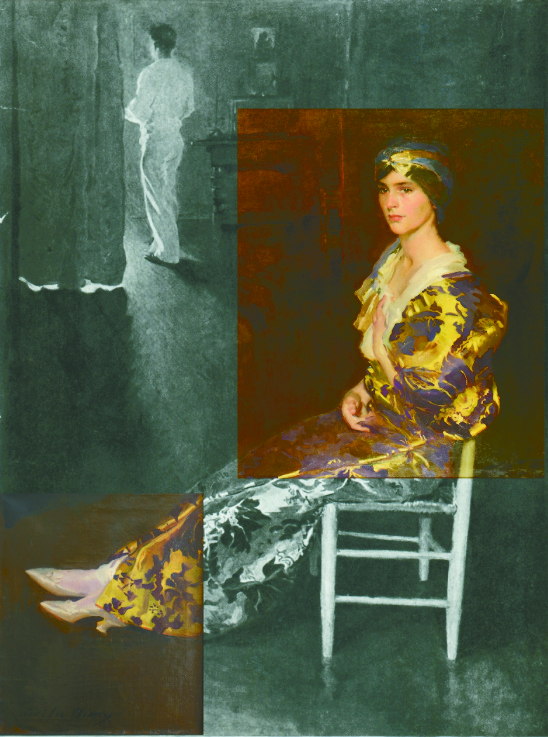
Hillsdale’s permanent art collection has received two new additions: “Ernesta” and “Ernesta’s Shoes,” both remnants of a much larger work by the Victorian artist Cecilia Beaux.
Professor of Art Sam Knecht unveiled the paintings, a gift from Ann Arbor resident Anne Natvig, to a faculty audience yesterday.
“Anne has been a supporter of the college for many years, and she was looking for a place for these works of art to go long-term,” Calvin Stockdale, institutional advancement associate, said. “Last fall, she generously decided to donate it to the college.”
Beaux, who lived from 1855 to 1942, ranked among the top celebrity portrait artists in the latter decades of the 19th century. Her clientele including members of the Roosevelt family. In addition, she was the first female instructor at the Pennsylvania Academy of the Fine Arts. William Merritt Chase, a contemporary artist, praised her as “the greatest woman painter of our age.”
“Ernesta” and “Ernesta’s Shoes” are parts of a portrait Beaux painted of her favorite niece, Ernesta Drinker. The original painting stood 6 feet tall. It was painted in the “grand manner,” a style employed by James McNeill Whistler and John Singer Sargent, the two foremost portrait artists of the time.
Knecht explained “Ernesta” marks a struggle that would haunt Beaux for the remainder of her career.
“It first appeared at a public exhibit in New York in 1913 at the National Academy,” he said. “It was written up in the New York Times. The reviewer found some faults in the painting, but also loved the shoes. He said that if the whole thing had been painted with the same kind of panache as the shoes, it would be a true winner.”
Beaux took the criticism poorly and revised the painting’s background twice over the years.
“First she painted out the figure in the background,” Knecht said. “Then some years later, she repainted the background entirely, placing Ernesta on a patio overlooking the sea and retitled it ‘On the Terrace.’ That’s the way the painting remained for several decades.”
When Beaux died, she bequeathed the painting to Ernesta, who eventually sold it in 1970. Knecht said he suspects that Ernesta is responsible for cutting the painting into multiple pieces.
“Ernesta needed money,” he said. “She owned ‘On the Terrace.’ She must have figured it would be easier and more profitable to sell several smaller canvases than one gigantic 6-foot-high painting.”
Knecht said he believes whoever cut the painting chose to preserve the shoe portion because the New York Times review had impressed itself so deeply on the Beaux family that the shoes became a valuable piece of art by themselves.
“I think it crept into family lore that the reviewer had loved the shoes,” he said. “That’s probably why we have that section specifically. After all, what woman doesn’t love her shoes?”
Knecht also said he hopes that this could be the beginning of an established art collection at Hillsdale.
“It was always my personal mission to start building a permanent art collection for the college,” he said. “This is
the second big acquisition that we’ve been able to secure for a top flight art collection.”
Associate Professor of Art Barbara Bushey affirmed that efforts have been made to consolidate Hillsdale’s art acquisitions over the years.
“We have a number of nice works of art scattered through the buildings,” she said. “I am currently working on developing a database so we know what exactly it is we own.”
Knecht will deliver a presentation on the paintings next week to Portrait Society of America in Washington, D.C., as the official speaker for the Cecilia Beaux Forum. He said these paintings are important pieces in Beaux’s legacy.
“Even though they have been chopped down, the paintings hold up on their individual merits,” he said. “Their story is so interesting because it speaks to the frustration of the artist in her quest for excellence.”
