
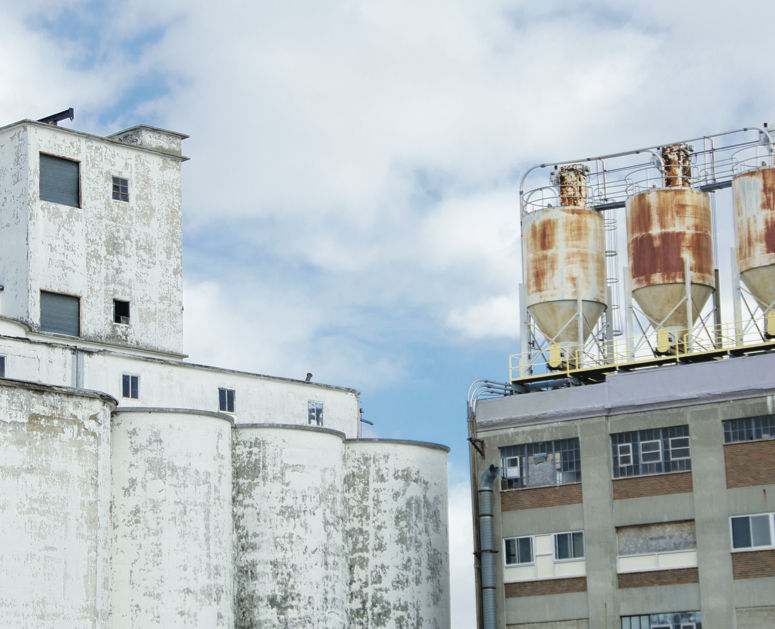
Once one of the largest and technologically advanced production centers of its kind in the country, the Hillsdale flour mill fell into disuse and disrepair after closing 10 years ago. The building looms over downtown Hillsdale, now empty of the hustle and bustle that characterized most of the structure’s 175-year history.
In 1838, John P. Cook and Chauncey W. Ferris arrived in tiny Hillsdale from Jonesville and built a simple mill with a water wheel on the St. Joseph River to serve the townspeople. The only previous provision for grinding grain was a crude contraption built by a man named Moses Allen after the earliest decades of settlement in Hillsdale. Before that, the earliest founders were forced to travel to Adrian with their wheat and grain.
Cook and Ferris’ mill was the first permanent and sizable method of grinding grain in Hillsdale, and as the town grew, the mill grew with it. In 1838, the mill started with a primitive millstone and water wheel, but was producing 8,000 barrels of flour annually and employing five men 12 years later.
In 1851, Ferris sold his share of the mill, prompting a long period in which the mill changed hands every few years. The owners of the mill continued to increase its capacity during this period, taking advantage of a new 35 horse power steam engine to produce a regular 50 barrels per day by the early 1860s. This period of intermittent ownership ended in June of 1869 when Prussian immigrant Frederick William Stocks moved to Hillsdale and purchased the mill from then owners James Pratt and Cornelius Ferris.
Stocks was born near Elberfeldt on September 11, 1825, and emigrated to America at the age of 30 after serving in the Prussian army. In 1855, Stocks arrived in Cincinnati, where he clerked in a flour store for $12 per month. Three years later, he rented a mill in Leesville, Ohio, beginning his career as a mill operator.
He moved to a mill in Tiffin and another in McGregor, which exploded. Afterwards, Stocks established larger mills in Delphos and Defiance, Ohio, as well as Peru and Rochester, Indiana. From there, he came to Hillsdale. Attracted by the area’s resemblance to his native Prussia, he “gave up further looking about” and settled here in 1862. He lived in Hillsdale for several years before purchasing the old Cook and Waldron Mill.
Stocks worked constantly to improve the mill and its production capacity. He completely replaced the old mill machinery with the newest technology available, expanding the building to 13,400 square feet and bringing in all-new internal gearing. He repeated this upgrading process several years later, and the plant remained state-of-the-art for the 89 years that the Stocks family ran the mill. The plant was among the first to install modern steam engines, eventually supplementing them with gas and diesel engines.
Stock took out a patent for a new method of milling grain eight years after buying the plant. The flour that his new process produced was “pure white and wholesome,” and it greatly increased the quality that bakers could achieve. “Stock’s Patent Flour” was a popular name-brand for many years around the world, identified by his distinctive whiskers printed on every package.
In 1879 a rail spur was constructed to better serve the mill from the Michigan Southern rail line, conveying freight cars full of flour, wheat, and oats directly to the mill. 3
Stocks incorporated his business in 1900, bringing his three sons into the firm F.W. Stocks & Sons, sending them to Minnesota, Ohio, and Virginia to expand the family business. In Norfolk, Virginia, his son Alexander began exporting the flour to other countries, expanding the business overseas and facilitating the opening of the first Western Union telegraph office in town. By this time, the mill’s output had increased thirty times over since Stock purchased it, with a significant increase in quality.
By the time Stock died in 1912 at the age of 87, he and his family had been integral in the development and improvement of Hillsdale. Stock constantly contributed to the churches and charities of the town. The city’s electricity was provided by Stock for several years from his own power plant before it was purchased by the municipal authorities.
His wife Wilhelmina – another Prussian immigrant whom he met and married in Ohio – worked to establish an extensive park near their home at 3 Broad St., planting hundreds of trees and forming two artificial ponds stocked with goldfish. The park is now maintained by the city as “Mrs. Stock’s Park.”
In his obituary in the Hillsdale Daily News, Stock was described as “a man of acute intelligence, broad sympathies, positive convictions and a ready wit,” and “a quiet illustration of the world-wide principle that success follows labor.”
The third Stock to run the mill, Harold Stock, sold the plant in 1959 to the Doughnut Corporation of America after managing the mill since taking over from Frederick’s son Alexander in 1942. The DCA expanded the operation even more, serving the annual needs of 1.74 million people and processing the equivalent of 325 acres of wheat daily, or 14 acres every hour.
By 1989, the mill area had expanded to 30 acres and employed 180 people from the surrounding area, employing two shifts of line workers and consuming wheat from Ohio, Indiana, and Michigan. The Michigan location allowed access to the higher-quality wheat of the region, and also kept production costs down.
Pillsbury acquired Kerry/DCA in 2000 for the price of $100 million, and later merged with General Mills in 2001.
The plant was closed by General Mills in 2003 shortly after its merger with Pillsbury, ending the production of dry mix products and flour for General Mills’ foodservice business. The plant was closed to eliminate redundancies that remained after the merger.
Dr. Jeffery Horton, a retired dentist from California, purchased the mill building and eight acres of surrounding property from General Mills in 2010. Horton and his wife, Marci, paid $30,000 for the mill buildings and property, roughly 8 acres, which they plan to renovate and open to be used as a multi-use facility.
Horton has suggested that the space might be used for such varied things as a commercial bakery, a microbrewery, or an art gallery. They have finished securing the mill building and are currently repairing the extensive vandalism it has suffered over the years, including about 300 broken windows.
He stressed that with the new security measures that have been installed, trespassers will now earn a trip to the courthouse, and warned that the mill building is still a dangerous place to be.
“The facility, of course, is an icon of the history of Hillsdale, and we’d like to see it survive in that role,” Horton said. “But we need a contractor to step forward to make that happen.”
