
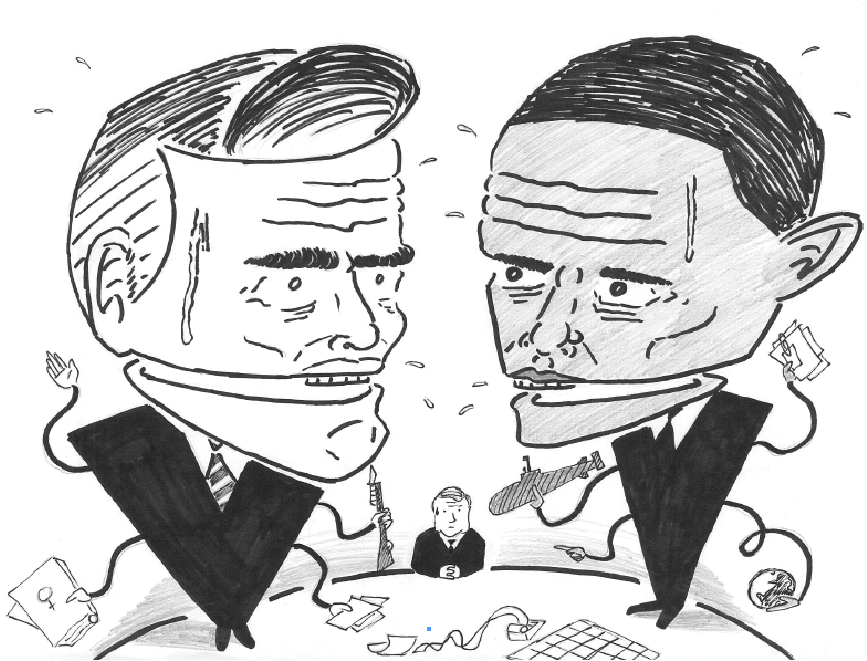
If nothing else, the debates are great at demonstrating what a waste of time the two-party system has become.
President Barack Obama and Republican presidential candidate Mitt Romney met for the third and final debate Oct. 22 to discuss foreign policy, but nothing worthwhile occurred. Rather, the two ended up awkwardly struggling to find a meaningful difference between them when it comes to U.S. foreign affairs.
There exists a few broad national security goals that most Americans agree on, such as keeping the U.S. safe from attack and maintaining diplomatic relations.
But since when did Republicans and Democrats agree on America’s role in the world? Historically, progressives have viewed America as an intervening force, as opposed to the John Quincy Adams view that “America does not go abroad in search of monsters to destroy,” but rather acts in the best interests of American safety and sovereignty. Monday night, America saw two progressives sling talking points at each other, without having a substantial difference in principle to debate.
This unison between Obama and Romney on America’s ongoing role in the world was obvious, and telling.
For Romney, “…Our purpose is to make sure the world … is peaceful” through nation building and US intervention.
For Obama, “America remains the one indispensable nation” due to its interventions, and nation building capabilities.
The idea of nation building is entirely progressive, as it is based on the idea that government can intervene in order to “build” and “educate” societies to achieve what it considers “progress.” Romney supports American intervention abroad, and Obama said, “Part of American leadership is making sure that we’re doing nation building here at home. That will help us maintain the kind of American leadership that we need.”
In the words of Robert E. Lee, a government which is overly large and intrusive on foreign affairs will be just as intrusive and despotic on domestic issues. So it should come as no surprise that between Democrats arguing for bigger domestic progress and the Republicans fighting for more foreign intervention, the result is big government in general and less liberty for America. This is why the practical differences between Obama and Romney were almost non-existent in a face-to-face debate.
Is there really nothing left to debate on foreign policy, aside from the tone of voice the president uses while sanctioning Iran, or how many times he ought to take the Israeli Prime Minister out to lunch?
In addition to this mess, Americans got an earful of political drivel. Moderator Bob Schieffer pointed out that Pakistan is responsible for hiding Osama bin Laden, lying to the US, and being a safe haven for terror groups that have the blood of American soldiers on their hands, yet the country still receives billions of dollars of American aid.
Americans are expected to tremble in fear at the thought of Iran obtaining nuclear weapons, but our leaders are relatively complacent about the fact that Pakistan, who harbors US enemies, lies to us, and impedes our efforts in the Middle East, has an enormous nuclear arsenal, which they are working to double.
But the candidates spent the vast majority of the debate arguing about who can be more aggressive toward Iran, a nation that doesn’t yet have nuclear weapons, but may be working towards them.
The presidential debates are doomed to disappoint when they only offer two— almost non-conflicting— points of view, with generic questions that pander to the candidates’ talking points. America deserves better from its leaders, and soon.
