
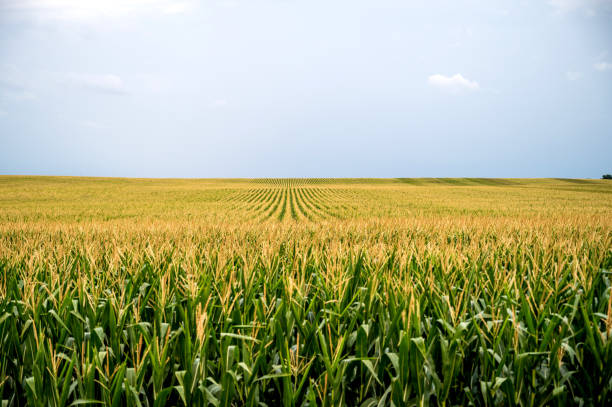
Detasselers work around 70 hours a week for four weeks of the summer.
Courtesy | iStock
Dawn had not yet broken at 4:45 a.m., but then-12-year-old Claire Pipher jumped out of bed. Pulling on layers of neon clothing and beat-up tennis shoes, she grabbed her lunch box.
She was not headed to school: It was July 15, and she was hopping on a bus for the day’s corn detasseling.
Pipher is one of several Nebraskan students at Hillsdale College who spent weeks of the summer detasseling corn when they were growing up. Students said doing the hard work of detasseling at such young ages taught them valuable life lessons.
“Oh my gosh, we were decked,” said Pipher, a junior, and current head RA of Olds Residence. “They are sending out children into literal cornfields, so they dress you in neon clothes so they can spot you, because the corn is taller than the children.”
Detasseling is when the stalk in the center of the corn that holds the pollen is removed. Farms use machines to detassel the majority of the corn, but it must be done precisely to avoid unwanted pollination. Therefore, detasseling crews manually go through the fields to remove any tassels the machine may have missed.
“Basically, detasseling is the process of making new hybrid corn,” said Josiah Manna, a freshman from Omaha, Nebraska. “There are four rows of female corn with one row of male that’s trying to pollinate the whole female. You want to get all the female tassels off, so then it can’t pollinate itself and will accept the male, making the new hybrid.”
For kids and teenagers in Nebraska, detasseling is a way to make some money over the summer, especially if you’re not of legal working age. Pipher remembers detasseling for four summers of her childhood, starting at age 12.
“It’s basically for anyone who is too young to get paid anywhere else,” Pipher said. “You get paid great money, and it is the greatest character building.”
Detasselers are often employed through a larger company, such as Not Afraid To Sweat Detasseling, Inc. According to Pipher, the kids hop on buses and are escorted to fields where they spend about a month of the summer on daily trips detasseling.
“I can see how some might view it as child labor,” said Nebraskan sophomore Joseph Bromm. “But I think it’s character building.”
Detasseling is unique to the Midwest, but the skills gained from it would be beneficial for any young adult, according to Pipher.
“It forces kids to spend their summers earning money for themselves, working hard and stepping outside of their comfort zones, and there’s no other legal way to do that as a 12-year-old,” Pipher said. “It’s really hard, dirty work and a really great opportunity to see what it’s like to work hands-on and be rewarded for it.”
The kids work about 70 hours a week for four weeks, often making thousands of dollars. Manna worked as a detasseler for four years, starting at age 15, before moving to a position as a bus leader taking other groups of kids detasseling.
“There were some days that we did corn-wrestling,” Manna said. “Other buses had a bounty on a person for the day. If you go and tackle that person you get a bag of snacks. It was kind of unofficial, but it was fun because when you fall on the corn, it kind of just breaks your fall. But as a bus leader, I couldn’t stand for corn-wrestling anymore.”
The kids would work in the fields in all temperatures, according to Pipher. The worst weren’t the days with 100-degree heat, but rather the freezing mornings.
“You have to wear glasses and gloves, and it’s recommended to wear long pants so your legs don’t get corn rash,” Pipher said. “And you wear shoes that you will never want to see again, because they will be so saturated with mud and dirt that they will expand and you won’t be able to fit your foot in halfway through the season.”
Pipher said the wet dew of the early mornings on top of the green corn stalks has a unique smell familiar to all detasselers.
“The first time I threw up in the field was because of the smell of the corn accumulating on my gloves,” Pipher said. “I got to the middle of the field and was just feeling nauseated from the smell and the heat and the walking, and I threw up but immediately felt better.”
Manna said as a team lead, he had to be aware of the possibility of kids passing out from the heat. They worked hard to keep morale up with chants and songs.
“Every once in a while there’s a nectar that we give out,” Manna said. “It’s super strong Gatorade that you give out when it’s really hot.”
While some kids quit after a day or two, most stayed and loved the opportunity.
“It’s hard, grueling work done in the dog days of summer, but I’d recommend it,” Bromm said.
Both Manna and Pipher agreed detasseling was formative in their lives.
“We are paid by the hour, not by the row. We don’t require people to work on Sundays, and the work environment there is really good,” Manna said.“You basically have all Christians running all the buses.”
Although intense, detasseling is rewarding and all about team work. If one bus is falling behind on a field, another will drive to help them finish on time.
“If pulling tassels doesn’t sound that hard, you probably haven’t done it thousands of times without a break,” Bromm said.
Pipher jokingly described detasseling as similar to the Hunger Games Reaping Day-style of child labor, but minus the death and plus money and character-building experiences.
“As soon as I turned 16 and was old enough, I was in a certified nursing assistant class, so I would never have to look at another field again,” Pipher said. “Detasseling made me appreciate school and everything in life more when I wasn’t detasseling.”
Both Manna and Pipher said they will be sending their kids to detassel when they have families in the future.
“I’m super pro-detasseling,” Pipher said. “My kids will be in the fields. My sons will be detasseling.”
