
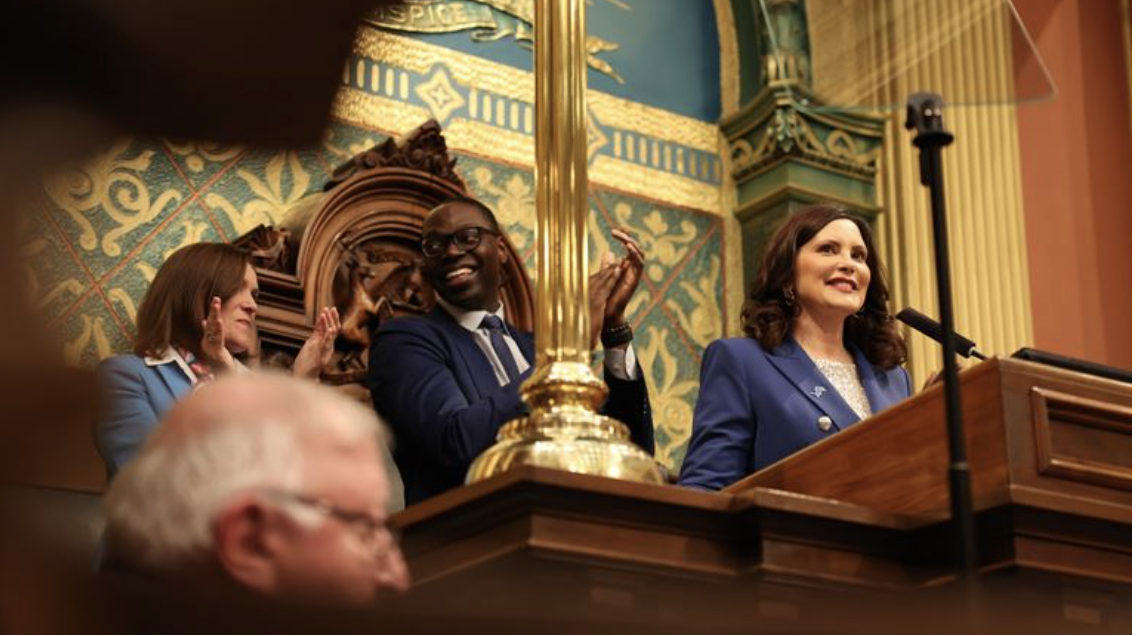
Gov. Gretchen Whitmer delivered her State of the State address on Feb. 25. Courtesy | Office of the Governor, State of Michigan.
One thing stood out in Gov. Gretchen Whitmer’s final State of the State address Feb. 25: The Democrat drew several standing ovations from Republican legislators.
As Whitmer celebrated her recent work to make pre-K education free across the state and announced an initiative to help every child read, legislators across the aisle rose to their feet.
However, the Republican lawmakers who applauded her seemed to have forgotten that the problems Whitmer is now addressing — especially literacy — accumulated during her seven years in office.
Praising the bipartisan cooperation between legislators and her office, Whitmer asserted that she is finally fixing Michigan’s literacy problem, which she claims is part of a larger national trend of students “falling behind.” Yet the problem is hardly a nationwide issue, and her recent work is only half-heartedly fixing a problem she contributed to herself. Until Whitmer fully decides to embrace the policy changes that have led to miraculous literacy improvements across the country, reading ability — and the future of Michigan itself — will continue on its downward trend.
In 2019, when Whitmer was first elected governor, Michigan ranked 32nd in the nation for fourth-grade reading proficiency, according to the National Assessment of Educational Progress. The same year, Mississippi witnessed “miracle” gains, rising from 49th in the nation to 29th in just six years. States like Florida and Tennessee had also already seen these gains in literacy.
They implemented policies that focused on science-of-reading training, dedicated literacy coaches, and accountability through mandatory retention. Teachers across their states were trained to teach using phonics and other proven methodologies. Students benefitted from specialized coaches solely focused on improving reading proficiency. If students could not read at grade level by the time they reached third grade, they were automatically retained until they could keep up with their peers. For a governor inheriting a literacy problem, the road to success was already trailblazed and paved. However, Whitmer took an alternate route.
For the first three years of her term, Whitmer primarily focused on increasing funding, especially to pre-K programs, instead of systematic policy change. Following the COVID-19 outbreak, extended school closures and Whitmer’s statewide mandates provided an obstacle to children’s education. By 2022, the state had fallen to 43rd in the nation for fouth-grade reading proficiency. In 2023, the “Read by Grade Three” law passed by her predecessor was repealed as soon as the Democrats gained full control of state government. This law ended the accountability mechanisms in place that required third graders reading below grade level to be retained. Halfway through her second term, the Whitmer administration had failed to adopt key literacy law changes with proven results.
Last week, Whitmer claimed that the recent improvements to the state’s literacy laws are a success and will continue to improve reading proficiency. Yet the governor has only implemented limited parts of the proven plan for achieving higher literacy rates.
Although Whitmer signed a law adopting the science-of-reading framework, uniform curriculum alignment, and statewide teacher training in October 2024, the full implementation of these policies is delayed to the 2027-2028 school year. She has also yet to fully scale or fund literacy coaches in a meaningful way like other states have. Additionally, she erased the very accountability mechanisms that forced schools in Mississippi to respond aggressively and with system-wide urgency.
Republican lawmakers in Lansing should forgo applause and call the governor’s actions what they are: inadequate solutions to a problem she both ignored and exacerbated.
Hinson Peed is a senior studying politics.
