
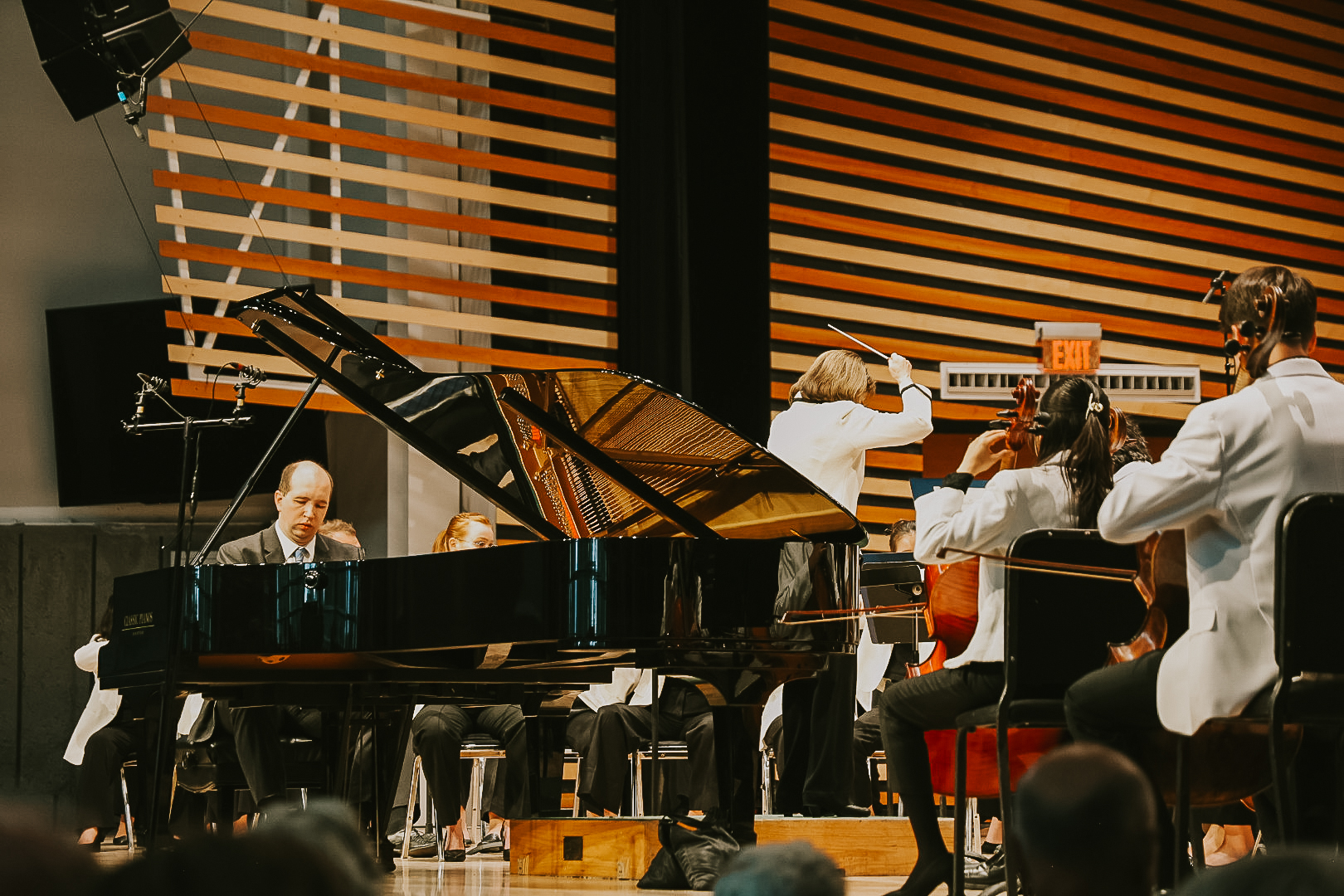
Ryskamp performing “Piano Concerto No. 4” by Camille Saint-Saëns with the National Repertory Orchestra in July.
Courtesy | Cat Scanlon
When Thomas Ryskamp ’19 was an undergraduate student, he thought being a concert pianist would be a miserable job.
“You sit in a practice room by yourself and don’t talk to anyone,” Ryskamp said. “You don’t see anyone. You just practice your music.”
After starting as a piano accompanist at Hillsdale in 2021, Ryskamp said his experience has been anything but lonely.
“One of the things I most enjoy about this job is I get to see so many people and do so many things,” he said.
Ryskamp said his experience as an undergraduate accompanying fellow student artists in their solos, fused with his post-graduate studies in collaborative piano, have prepared him for his work as an accompanist.
“It’s a combination of being very good at sight reading and being familiar with some of the repertoire already,” he said. “Plus, when I go to lessons week after week, that also is an opportunity to fix mistakes as they happen.”
Though the college has a large repertoire for its students, Ryskamp said his previous experiences have prepared him well for many musical challenges.
“It’s a lot of the repertoire I’m already familiar with at this point,” he said. “And the rest of it, I get familiar as we’re working on it. If I played it before, I remember it. And if I haven’t, it gets ready in time.”
Ryskamp studied at Hillsdale partly so he could continue accompanying.
“I actually had done some accompanying before that in high school and earlier, and it was the fact that I could do a lot of accompanying at Hillsdale that was
one of the deciding factors to come here,” Ryskamp said.
He played for voice lessons all four years as a student, always accompanying more students than the scholarship required. Although he enjoyed accompanying, it was not until Hillsdale College that he decided to pursue it as a career thanks to teachers of music Brad Blackham and Taylor Flowers ’16, a fellow student at the time.
“Professor Blackham had gotten a master’s degree in collaborative piano, and then when I was a freshman, a certain senior named Taylor Flowers went on to get a master’s degree in collaborative piano himself,” Ryskamp said. “That opened me up to the possibility.”
In 2021, Ryskamp graduated from the University of Cincinnati Conservatory of Music with a Master’s in Collaborative Piano before starting his work at Hillsdale.
Ryskamp said his schedule depends on the needs of the music professors. He accompanies a variety of music lessons, recitals, and choirs, as well as special rehearsals or music events throughout the semester.
“There are always different things happening,” he said. “In October, there are opera work- shops. In November and December, there are recitals. In January, there’s the concerto competition. In February and March, there’s the musical, and in April and May, there’s a lot more recitals.”
Throughout his career, Ryskamp has played for shows in places such as Miami Beach and Italy. Some of his favorite shows to accompany were the theater department’s “Bright Star,” which he helped direct in 2024, and Handel’s “Messiah,” in which he played the organ.
Ryskamp said an accompanist can often be misconstrued as someone who merely plays along with the singer, which can result
in a lack of respect in certain circles. However, he said accompanying forms a partnership between pianist and performer.
“To study collaborative piano, you’re not just playing the right notes at the right time,” Ryskamp said. “You’re also getting familiar with many more categories of repertoire, like songs for voice and piano, opera, sonatas for instrument and piano, and concertos for instrument and orchestra.”
When working with less experienced performers, Ryskamp said he helps them through their piece.
“That takes lots of different forms, sometimes just helping them with notes and rhythms, sometimes getting them mentally prepared for a performance, and often in the case of singers, helping them with their languages,” he said.
Ryskamp learned Italian, German, and French pronunciation in grad school when studying for his Master of Music in Collaborative Piano.
Professor of Music James Holleman works with Ryskamp on a number of musical performances and said Ryskamp brings many talents to the music department.
“I appreciate so many things about working with Thomas: his talent, sight-reading ability, kindness, and excellent musicianship,” Holleman said.
Ryskamp’s dedication to the music department makes him a great person to work with, Holleman said.
“He is completely engaged in the music department and college,” Holleman said. “He knows schedules and activities across the department and campus better than anyone.”
Senior Sophia Labonte, a mezzo-soprano studying with teacher of music Emily Douglass, performs in the Chamber and College choirs. She often works with Ryskamp, including with her most recent solo performance at the concerto competition. Labonte said Ryskamp does more than just accompany.
“He is specially trained in working with soloists and ac- companying them, so he knows the languages that the singers need to know and is able to help and critique them and not just play the piano for them,” she said.
Labonte said working with Ryskamp is beneficial not only because he provides an outside perspective on a performance, but also because of his skill.
“He’s always super well-prepared, and his sight-reading powers are formidable,” Labonte said. “He’s super easy to work with and always has really good diction critiques, and is, generally speaking, fantastic.”
Labonte said practicing with Ryskamp is a collaborative process with his help in areas such as phrasing and dynamics.
“Typically, I’ll set the rehearsal schedule of the pieces that I want to cover, and then we’ll run through it,” Labonte said. “Then we’ll both look back at the run-through and figure out things that we’d like to be better or to change slightly, and then we’ll work on specific passages.”
Labonte said his presence on-stage also has a massive impact on performers.
“A good pianist provides so much support on stage for the people they’re accompanying, and this is definitely the case with Tom,” Labonte said. “It’s like having a really stable foundation to stand on as you do your solo work, because you know that he’s always going to be playing the notes exactly the right way, the way that you rehearsed.”
