
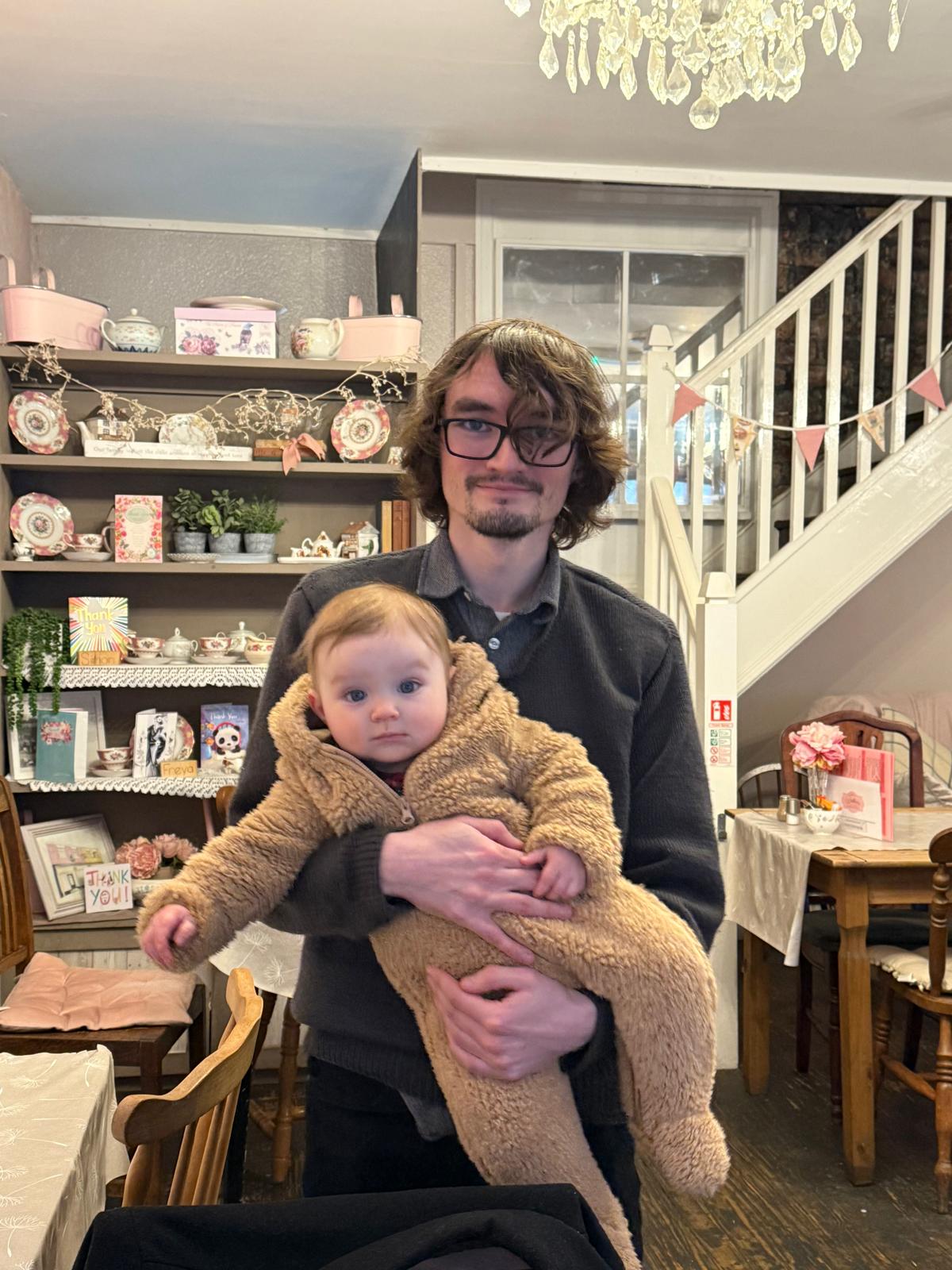
Goldsmith often plays banjo for his son Alfred.
Courtesy | Edward Goldsmith
Although he was born in London and raised in Cambridge, Edward Goldsmith thinks more fondly of America than his home country.
“England is a once-great country. America is a great country, and I think my personality aligns more with American culture than it does British culture these days,” Assistant Professor of Mathematics Goldsmith said. “America’s the country where you can trust the citizens to have a gun without the big man getting involved. That’s what I like about it.”
Goldsmith joined the department last fall after teaching at the University of California, Davis where he researched with fellow UC Davis mathematics professor Joseph Biello. At Hillsdale, Goldsmith has taught courses in Calculus, Differential Equations, and Mathematical Modeling.
Goldsmith said his research is mainly concerned with modeling the physical world through mathematics. He said his mathematical subfield is “geophysical fluid dynamics,” in which he models the physics of fluids to see how the earth’s fluid systems behave. Goldsmith also studies the Coriolis force, which affects the Earth’s atmosphere and weather patterns as a result of the Earth’s rotation.
Goldsmith said he’s found that clouds in the atmosphere increase the non-traditional Coriolis force in large scale weather patterns. This analysis contradicts the work of others in tropical meteorology who assume this non-traditional force can be disregarded. Goldsmith said he’s worked to make the inclusion of the non-traditional Coriolis force more mainstream.
“I’m interested in a model where the pattern uses mathematics to understand that the atmosphere is like a fluid that obeys Newton’s laws,” Goldsmith said.
Goldsmith said he doesn’t work in California in part because it’s difficult to work in his field without buying into climate change, which he considers nonsense.
“Most of the reason that we have the whole climate crisis being pushed on us at the moment is that meteorologists have models that are broken and they make stupid predictions,” Goldsmith said. “They say the earth is going to get really hot, and don’t factor in the fact that the atmosphere will basically turbulently diffuse almost all of its energy. They don’t include enough degrees of freedom that seem to restore everything to equilibrium anyway.”
Goldsmith said he loves the beauty of the American topography and the pride Americans express in their calling.
“I can see why most Americans don’t have a passport. Because why do you ever need to leave? You’ve got beaches, you’ve got wilderness, everything in between,” Goldsmith said. “Every country has its faults, but America has come up with the closest thing to perfection.”
In his English childhood, Goldsmith played the banjo, a hobby he said he started because he thought it would be fun to play a unique instrument. He continued while in college, where banjo playing became Goldsmith’s side gig.
Recently, he played the banjo with the band James White and the Wildfire, and recalled a time after a gig when a tire fell off of the band’s car while driving.
“We ended up just sitting in the middle of the motorway in the U.K. for six hours waiting for someone to come with a replacement tire for the car. And I think James wrote a song about it,” Goldsmith said.
These days, Goldsmith mainly enjoys playing banjo for his 8-month-old son Alfred.
Associate Professor of Mathematics Jacob Laubacher also joined the department last fall, the same time as Goldsmith.
“Math is kind of split into two worlds,” Laubacher said. “There’s applied math. That’s what Dr. Goldsmith does. I work on the other side of math, which is called pure math, and it’s theoretical. So it’s proofs and a lot of abstraction to verify why math works.”
Goldsmith, however, said he prefers applied mathematics to pure math.
“I find more satisfaction in asking what math can tell us about the real world than asking about what math can tell us about itself,” Goldsmith said.
Goldsmith said while computers can solve mathematical equations, they don’t express the underlying structure of equations.
“Often, the solution isn’t what we care about. Often, the structure is what we care about,” he said.
Goldsmith said that while a calculator will quickly provide a solution, it doesn’t tell anyone what it is doing.
“Sometimes we want to understand what the relevant physics is. We want to understand, ‘What are the dominant forces in the atmosphere? What is the most important balance?’” Goldsmith said.
He compared his studies to an experiment run in a hypothetical, perfect laboratory.
“I can’t have this laboratory existing in the real world, because the real world cannot operate like that. The real world always has some noise or some mess that you have to deal with,” Goldsmith said. “For applied mathematicians, the laboratory they use is a hypothetical laboratory that exists in the world of mathematics. We do our experiments using a theoretical framework that the pure mathematicians have established, and we can run our experiments by applying mathematical roles in an idealized situation.”
Goldsmith said his research has changed how he sees the world.
“I look out the window, and I see Michigan being extremely cold, and I say, ‘OK, I think that’s because the polar vortex is split,’” he said.
At Hillsdale, Goldsmith still spends time in research, because he thinks it is important to be aware of cutting-edge developments in the field while instructing students.
Junior Jonah Starr took Goldsmith’s Differential Equations course last semester. Starr said Goldsmith makes his Britishness a large part of his personality, which he finds amusing.
“He has a very dry sense of humor,” Starr said. “I think I’ve heard more laughs from the students in his class than I have in any other class that I’ve taken, and this is among math people and physics people in Dow.”
