

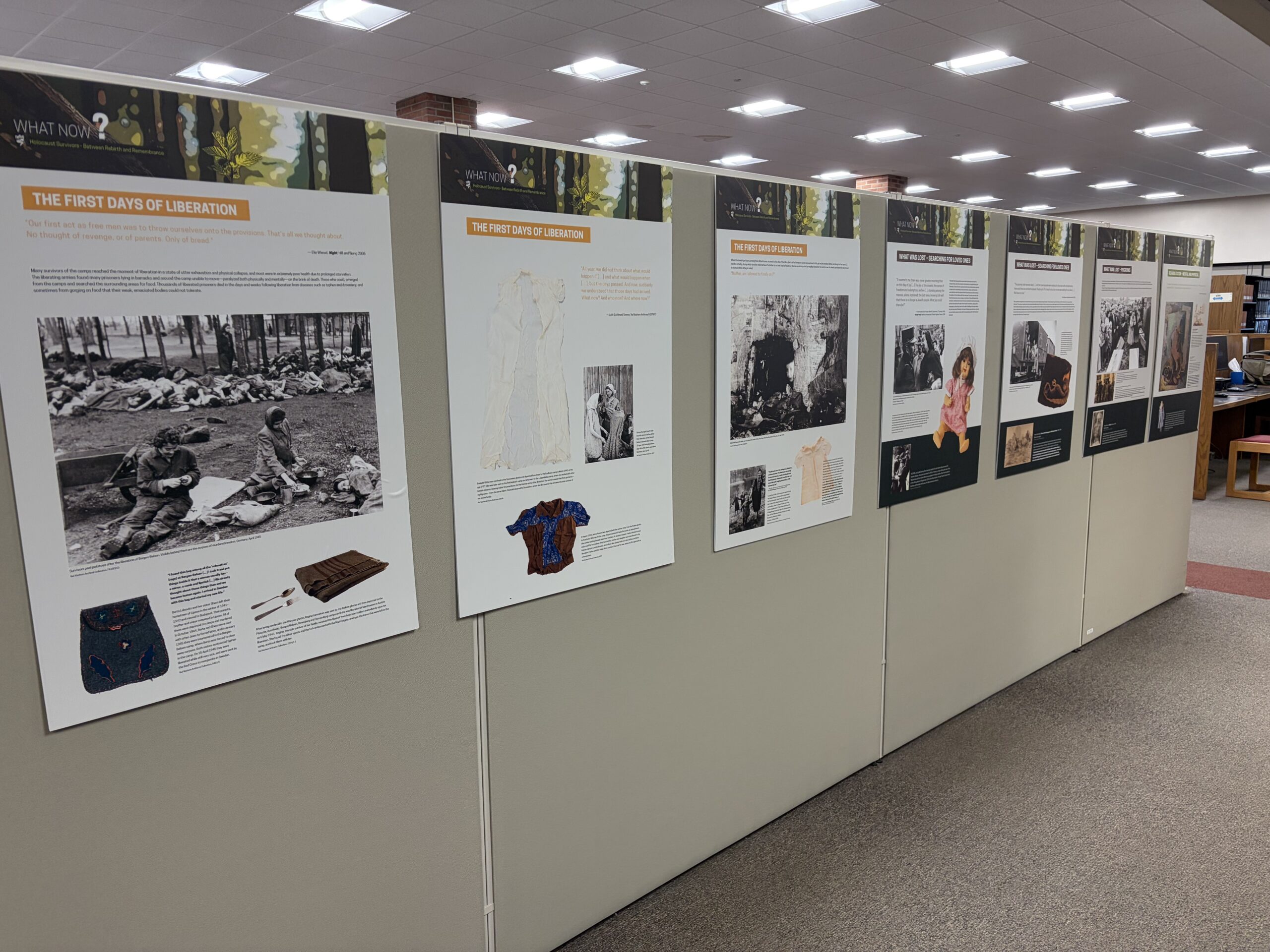
When patrons enter Mossey Library this week, they encounter a series of panels telling the story of the 6 million Jews murdered during the Holocaust. In commemoration of the 81st anniversary of the liberation of the Auschwitz-Birkenau death camp on Jan. 27, 1945, the exhibit highlights the years of reconstruction in which the Jewish people searched for loved ones, rebuilt communities, and looked to the future.
“In between classes, stop and just understand what happened,” Jewish Mishpacha president and sophomore Yahli Salzman said. “You can have your beliefs about Israel, you can have your beliefs about the Jewish people. But the fact of the matter is that 6 million Jews died.”
The Jewish Mishpacha student group, in collaboration with Mossey Library, organized the display. Faculty adviser and Associate Professor of French Anna Navrotskaya ordered the exhibit, titled “What Now? Holocaust Survivors – Between Rebirth and Remembrance,” from Yad Vashem, the world Holocaust remembrance center in Israel.
“It’s been only 80 years. Historically, it’s nothing. It’s a second,” Navrotskaya said. “We know that human beings are capable of the highest levels of heroism, and we also know that human beings are capable of the lowest levels of betrayal. And we need to remember our past, respect our past, and accept the fact that it happened if we don’t want it to happen again.”
An exhibit about the Holocaust would not be acceptable in many institutions in the United States and Europe at the current moment because it would be perceived as a political statement on the modern State of Israel, Navrotskaya said.
“We specifically did not want it to be a political statement. It’s about the Shoah,” Navrotskaya said, referring to the Hebrew term for the Holocaust. “We have to remember Auschwitz. We have to remember the victims so that they were not murdered in vain.”
Twenty panels offer information on the liberation of the Nazi concentration camps, the mental and physical challenges survivors faced in the aftermath, and the displaced persons camps and children’s homes they stayed in during rehabilitation.
But encountering the Holocaust has taken on new urgency in recent years, according to Visiting Professor of Jewish Studies Michael Weingrad, especially since the Oct. 7, 2023, attacks in which Hamas terrorists massacred more than 800 Israeli civilians.
“Our own country and the rest of the world are seeing a resurgence of violent Jew-hatred, threatening Jews and their non-Jewish friends alike, such as the young couple gunned down in D.C., the elderly woman, a Holocaust survivor, burned to death in Colorado, and the Bondi Beach mass murder in Australia, all in the last nine months,” Weingrad said. “We are unfortunately still contending with the dark forces that turned Europe into a death factory and snuffed out millions of Jewish lives.”
Remembering the horrors of the Holocaust is not about ideology, Navrotskaya said. Rather, we remember because we must recognize what we as human beings are capable of doing, both for good and for evil.
“We start feeling as if it were the distant past and no longer related to us,” Navrotskaya said. “But the people who went through it, some of them are still with us. And it’s not 80 years already, it’s only 80 years. Saying ‘Never again,’ of course it’s very important. But we also know that ‘again’ happens, and it happens all around the globe.”
