
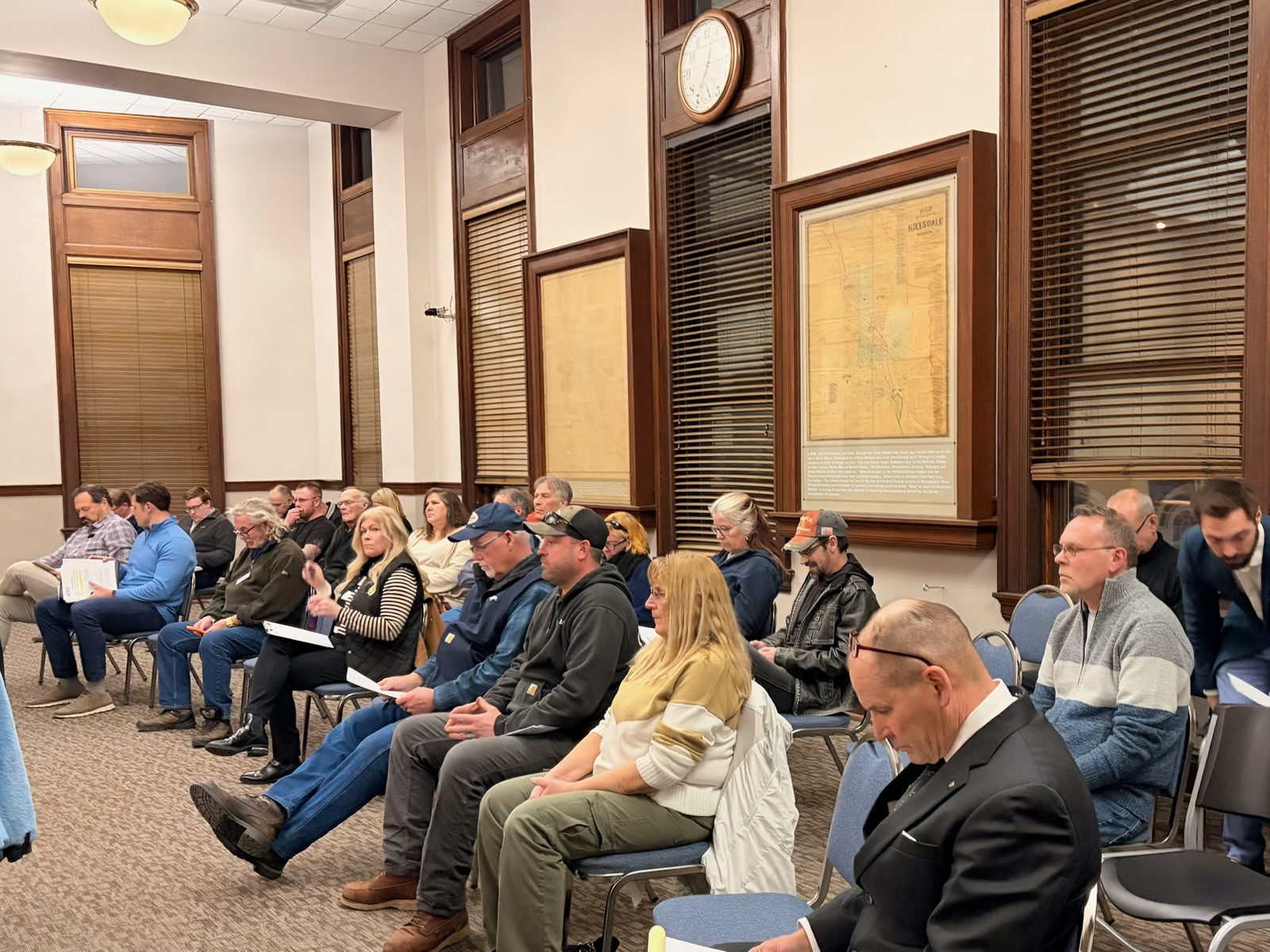
The crowded room at the special assessment district public hearing Feb. 16. Gemma Flores | Collegian
Residents in three proposed special assessment districts rejected road repair funding plans through citizen petitions during public hearings held at the Feb. 16 Hillsdale City Council meeting.
Property owners on Oak and South streets, as well as parts of Arch Avenue, Industrial Drive, and Proctor Drive, all submitted their respective petitions to the council.
The council can override the petitions with a supermajority of seven votes. When Mayor Scott Sessions asked if any councilmember would make a motion to vote on any of the three projects, no one raised their hands, effectively killing the projects.
A special assessment district designates roads for repair and funds the work by charging property owners in the specified district up to $5,000 each. If 51% of the parcel owners in a district sign a petition and submit it to the council, the SAD cannot move forward unless the council votes in a supermajority to override the petition.
“Hillsdale has used special assessments since its early days, even under the old city charter,” Assistant City Manager Sam Fry told The Collegian.
In 2021, Fry said, the council was approached by residents of Williams Court to create a SAD for their street. According to Fry, support for SADs among residents was high at the time.
“Even if we didn’t have a citizen-led petition drive to start it, for many of those projects, we had citizens that had come to the city and wanted road work done,” Fry said.
According to Fry, the council voted unanimously for the city’s current policy on SADs in 2025.
“Even as recently as February of last year, all council members serving at the time endorsed that current policy, which directed staff to use these for all of the road projects that we do,” Fry said.
Oak Street residents submitted their petition at the Feb. 2 city council meeting, and South Street submitted theirs Feb. 9, according to Elyse Apel ’24, a South Street resident.
After verifying the signatures, city staff advised the council against the projects in the introductions to the Oak Street and South Street hearings.
“Based on the written rejections received, which exceed 50% of owners of privately owned real property proposed to be assessed, staff does not recommend the establishment of the South Street special assessment district,” Fry said at Monday’s meeting.
Fry made a similar statement about the Oak Street assessment shortly after.
Matt Patillo, organizer of the Arch Avenue petition, presented the petition at the meeting, which included signatures from more than 60 percent of the district’s parcel owners.
“I have a packet here for each of the councilmen that shows you the signatures I’ve gathered,” Patillo said when addressing the council. “One hundred percent of the people I talked to signed.”
Numerous citizens stood up to voice their concerns about the road funding plans. Jill Hardway ’89, organizer of the Oak Street petition, said SADs aren’t fair to taxpayers.
“If you can’t afford to do this under your own budget and parameters, why do you think the citizens can?” Hardway asked. “As stated repeatedly tonight, we pay property taxes for essential services.”
Jonathan Meckle ’21, legislative director for State Rep. Jennifer Wortz and a Hillsdale resident, also spoke against the Oak Street SAD. Meckle said the city should work with the state and federal governments to ensure funding from other sources rather than relying on taxpayers.
“It’s really pretty easy for me to go and talk to my neighbors and say, ‘Hey, you know, the city is saying, “We can’t give up our special assessment districts because we’re not 100% sure that we’re going to get new money to cover the roads.’ And all these people are saying to me, and I’m saying to them, ‘Well, I’m 100% sure that I don’t have the money to cover this,’” Meckle said.
David Hambleton, a South Street property owner, shared his experience with SADs.
“My grandmother lives in that house at 65 East South. She’s a World War II veteran’s widow. Shall I raise her rent for you?” Hambleton asked.
Ward 4 Councilman Robert Socha said the SAD decisions are not made lightly.
“Nothing has been shown to me in our city budget to make headway on the crumbling infrastructure without these terrible special assessments,” Socha said. “And my hope was that we might, as a community, bite the bullet today so that our children don’t have to do it in the future.”
Fry said the public hearings served their purpose by allowing the citizens of Hillsdale to make their voices heard.
“I’m certainly glad that people come out and voice their opinions. That’s the purpose of holding these public hearings. It’s to give residents an opportunity to say whether they’re in favor of these projects or they oppose it. That was a process that our charter set up,” Fry said. “We do the engineering, we do the reviews, and we identify these projects, but ultimately, it’s up to the neighborhood.”
Fry, along with other members of the city staff, worked to secure state and federal funding for Arch Avenue and Industrial Drive, which receives a lot of traffic from the Hillsdale Industrial Park. Now that the future of the road work is less certain, he said he worries they may have to return the funding.
“It’s funds that myself and others, took a lot of time with the applications to get that money, to return those funds to our community,” Fry said. “I think it would be a shame if that money goes to waste and we have to give that money back.”
Fry stressed that city staff members have one goal: to serve the Hillsdale community. Though their projects may seem overbearing, Fry said it’s both necessary and time-sensitive.
“Ultimately, we want to do projects for the community,” Fry said. “A lot of these roads, South Street, Oak Street — you get about 25 years average life out of a road. Many of these we’ve pushed two or three times. You can only patch your pothole road so many times, and then it needs a full reconstruction.”
