
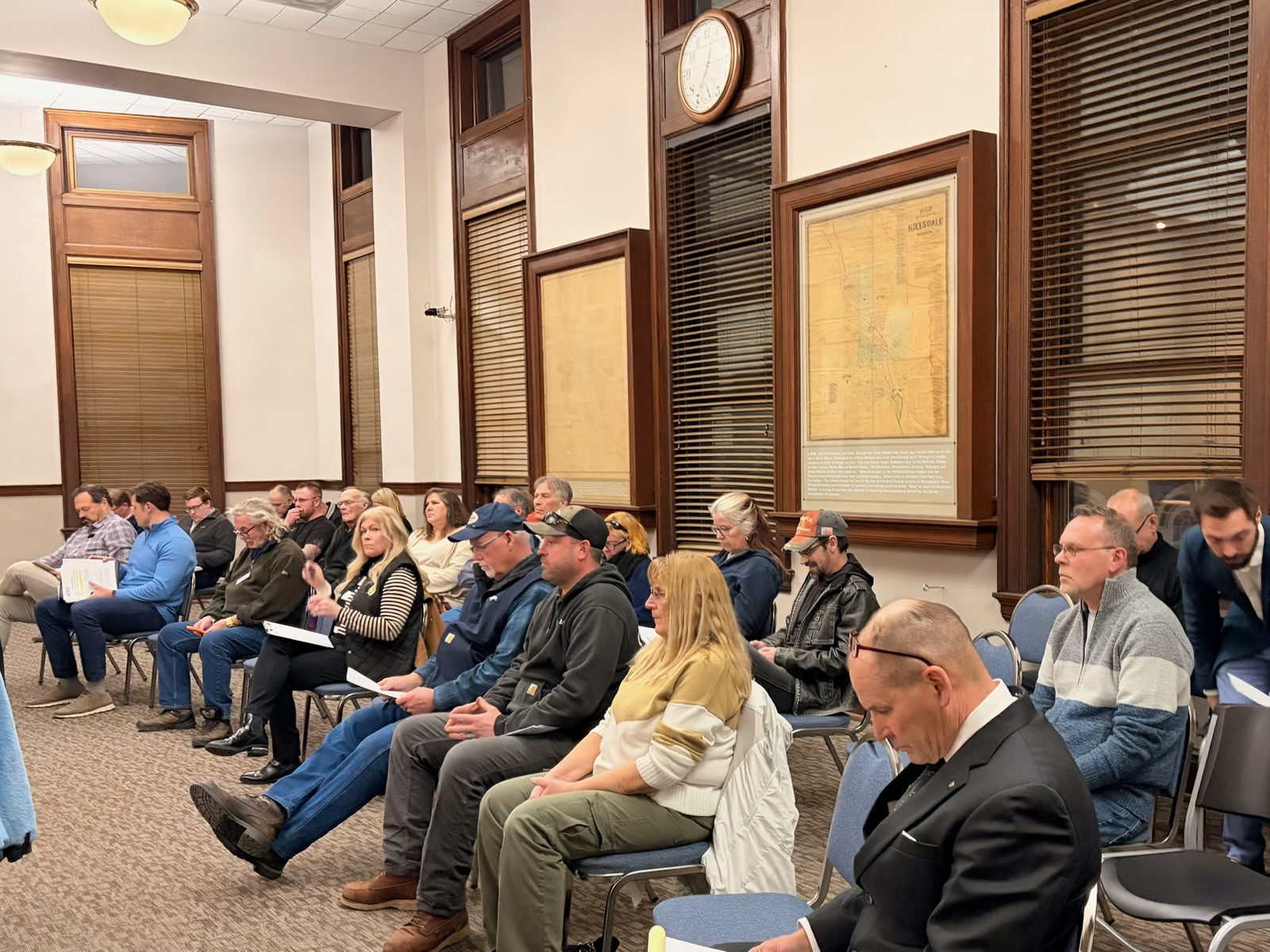
The crowded room at the special assessment district public hearing Feb. 16. Gemma Flores | Collegian
When Hillsdale residents unanimously opposed special assessment districts for road repairs during the Feb. 16 city council meeting, they delivered a clear verdict. Yet last week’s Collegian article, “Residents reject road repair plan at public hearing,” reflected a City Hall perspective that mischaracterized SADs and ignored real alternatives available for fixing our roads.
Under state law and Hillsdale city charter, special assessments are meant for “public improvements” — not for repairing infrastructure that has crumbled after years of neglect. Calling long-overdue maintenance “improvements” shifts responsibility from the city and onto residents, even though maintaining streets is one of local government’s most basic duties.
An essential part of governing is choosing policies that citizens will consent to — or, at the very least, will not actively oppose. In the case of SADs, the last four have all been soundly rejected by the people of Hillsdale, reflecting a clear indictment of a policy that imposes a steep cost above existing property taxes.
Compounding the problem is a lack of imagination in how the city approaches road funding. This fiscal year, the city is set to receive a substantial increase of about $400,000 in state road funding, while SADs accounted for only about 25% of total funding in the proposed 2026 projects. The city council majority also refuses to seriously examine budget cuts, reallocations, or reprioritization. Instead, city officials continue to portray SADs as unfortunate but unavoidable.
In a further failure of leadership, the city council refused to compromise despite multiple good-faith efforts by residents. In October, despite believing SADs were fundamentally unfair, South Street residents proposed a compromise capping assessments at $2,800. When the city refused to even consider it, the citizens’ complete rejection of SADs was a foreseeable consequence.
When citizens object to special assessments, they are disciplined with the ongoing neglect of their roads. Instead of funding the projects the city previously deemed most urgent, the city leaves objecting streets in disrepair and moves on to new neighborhoods they hope will shoulder a $5,000 special assessment. When those residents inevitably object, the pattern repeats.
Unfortunately, the city’s cycle of avoidance became even clearer at the Feb. 16 council meeting. Rather than treating public opposition to SADs as a mandate to rethink policy, Councilman Robert Socha called the public backlash “insulting,” complaining, “I think we deserve better from the community.”
Meanwhile, mayoral candidate and Councilman Bob Flynn proposed an explicitly pay-to-play system.
“Has staff ever, for lack of a better phrase, thought about asking somebody? Is there somebody out there who would like to do special assessments?” Flynn asked.
In response, City Manager David Mackie suggested the city see whether residents want to “move their streets up” before scrapping SADs.
The implication was clear. If this vision prevails, functioning roads in Hillsdale will be relegated to the few with residents willing to pay $5,000 above and beyond their current taxes.
Hillsdale’s road problem is not just a funding challenge, but a failure of governance. When residents reject a policy four times in a row, the correct response is not to search for more compliant neighborhoods. City leaders must change course, or Hillsdale voters will force them to come November.
Jonah and Elyse Apel are 2024 graduates of Hillsdale College and residents of South Street. Jonah is a current Ph.D. candidate at the Van Andel Graduate School of Statesmanship.
