
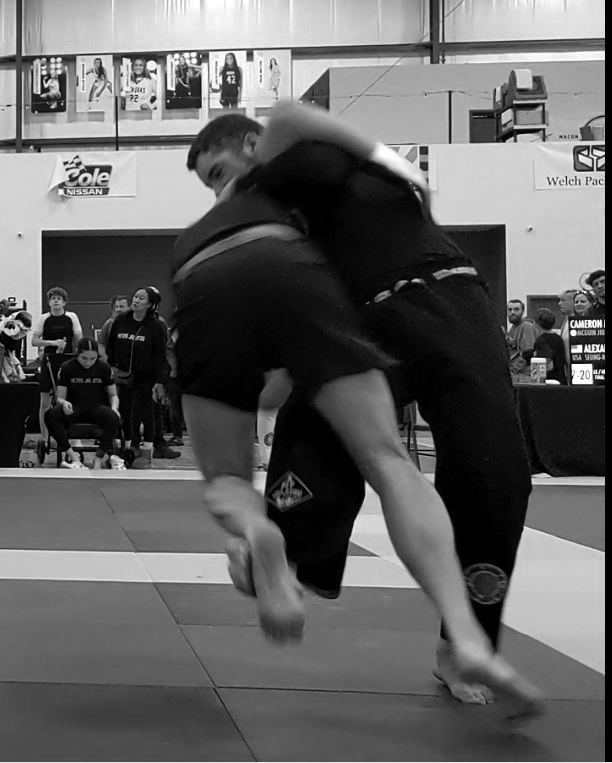
Junior Andriy Pasichnyk beat his competitor last year
Courtesy | Frederick Woodward
The Hillsdale Brazilian Jiu-Jitsu Club returned to campus last fall after a yearlong hiatus.
Club President and sophomore Finnian Macaulay said he restarted the club with two other students after taking a one-credit course on Brazilian Jiu-Jitsu from the Sports Studies department.
“I saw that there was so much interest,” Macaulay said. “Many people in the class expressed the desire to participate in a jiu-jitsu club.”
Macaulay said he was also encouraged by Mike Cantrell, lead instructor of the class.
“I want jiu-jitsu to be a thing on campus,” Cantrell said. “I expressed that I wanted it to be happening outside of me, and not just a class that I teach. But the student who originally started the club stepped down from running it, and nobody else stepped up, so the club sat dormant for two semesters.”
Macaulay said he wanted to introduce jiu-jitsu to more people on campus and establish the sport on a more solid footing.
“Coach Mike does so much for jiu-jitsu on campus, and he heads all the classes,” Macaulay said. “But I wanted to set up something that could survive beyond one or two individuals. Coach Mike agreed that he wanted a club or some sort of organization that could popularize jiu-jitsu as a skill and an art on campus, and enable it to survive beyond us.”
According to Macaulay, another motivation to restart the club was the desire to compete in tournaments, which the one-credit class does not do.
“Tournaments are like a piano recital for somebody who plays piano,” Macaulay said. “You might know a piece, but performing in front of people is a whole different ball game, and it helps you test your skills and courage. You get to test that against new people when you go to a tournament, you get documented recognition, and it’s a great way to improve.”
Junior Andriy Pasichnyk, the club’s vice president, said the sport is a great way to become more physically fit and agile.
“That’s not something that you really get from weightlifting,” Pasichnyk said. “All you get from that is big muscles and tight muscles. You don’t learn how your body moves, and you don’t really learn the limits of your mobility.”
Macaulay said the objective in jiu-jitsu is to submit or incapacitate the opponent entirely through grappling.
“When you watch a UFC fight — when they’re not striking each other — they’re grabbing each other’s arms and trying to take each other to the ground,” Macaulay said. “They’re choking each other and doing locks and submissions. That’s all jiu-jitsu.”
Macaulay said jiu-jitsu does resemble wrestling, but it also incorporates judo and other martial arts.
“It’s more universal,” Macaulay said. “It’s all grappling technique, with no striking. It’s a very sustainable way of practicing martial arts without frequent injuries or concussions, and it’s a fun and competitive sport.”
Pasichnyk said the relatively low level of injury risk distinguished jiu-jitsu from other sports.
“You’re not getting hammered in the head like boxing,” Pasichnyk said. “Besides that, it’s just cooler. It’s cool to choke people and threaten to break their arms. You might get pinned in wrestling but that’s it. A wrestler won’t threaten to put you to sleep.”
According to Macaulay, jiu-jitsu could help students become more capable in self-defense situations.
“There’s so much strategy and technique that is applicable and transferable to self defense,” Macaulay said. “While not everything you learn in jiu-jitsu would be useful on the streets, much of it would be helpful to know if you happen to find yourself in a fight.”
Cantrell and Pasichnyk both recommended that interested students with no martial arts experience either audit or take the introductory one-credit SSD class before joining the club.
“You need that time,” Macaulay said. “You need that experience. Join the club after you hop in the one-credit. You shouldn’t rely on the club to teach you the most basic fundamentals.”
“Having a little experience is enough that you can go and learn and improve and contribute to the level in the club,” Cantrell said. “If you wrestled in high school, good enough. You did two months of jiu-jitsu back home, good enough. The club’s happy to have you. But if you expect to be taught from scratch, that’s not what the club is doing. For the first timers’ class, you don’t need anything — except some courage.”
Cantrell stressed that no level of experience is required for the one-credit introductory class.
“We have every body type, and we start all the way from the beginning,” Cantrell said. “So there’s basically no prerequisites except the willingness to try at something that’s unapologetically difficult.”
Macaulay said the goal of the club is to survive past the current crop of students.
“We want to grow and to help more Hillsdale students gain a foundation for fitness and self-defense,” Macaulay said.
