
A mathematics education requires cultivating intellectual virtues, according to Francis Su, professor of mathematics at Harvey Mudd College in Claremont, CA.
“Some people experience mathematics like a place of joy, a place of wonder and excitement,” he said. “For others, mathematics is like the dark night of the soul.”
The mathematics and education departments hosted a lecture titled “Building Virtues, not Just Skills,” by Su on Feb. 5, who was president of the Mathematical Association of America from 2015 to 2017.
Su began by asking why some people enjoy math while others find it devoid of delight.
For Su, the answer hinges on what mathematics is.
“One way I like to think about mathematics is seeing the unseen,” he said. “Mathematics equips us to see, to think about and understand unseen possibilities.”
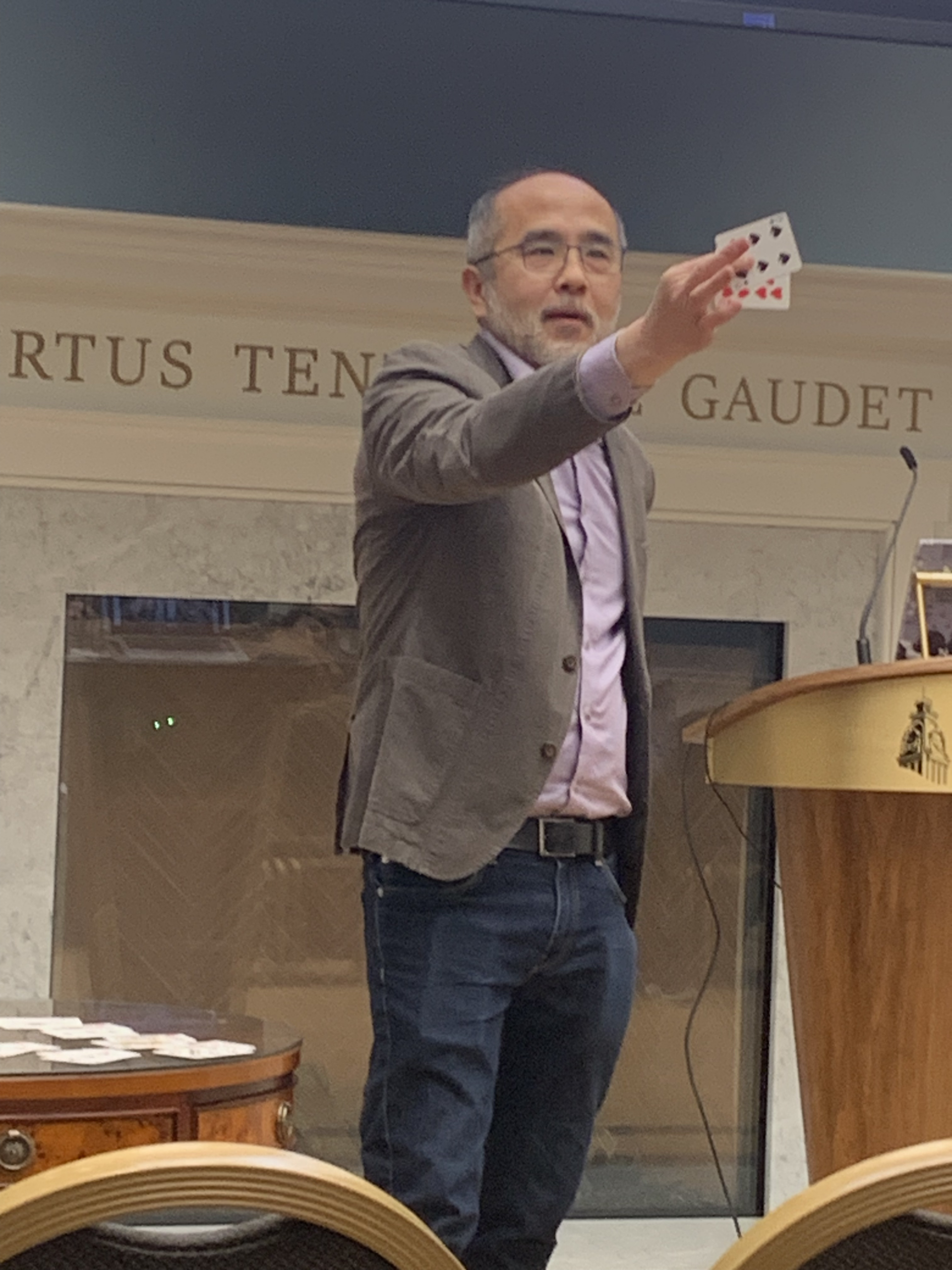
To illustrate, Su performed a magic trick with a deck of cards. According to Su, the audience’s astonished response demonstrated intellectual virtue.
“You’ve just seen something weird, strange, and amazing, and you are engaging in a process of thinking through what happened,” he said. “This is a virtue to have this disposition to ask why.”
But, as Su noted, education exists precisely to cultivate virtues, including intellectual habits like curiosity.
“Education is not just a transaction. It’s a process of transformation,” he said. “Part of the way that formation happens is through changes in character, attitude, habits of mind, and dispositions.”
Mathematics can encourage pursuing beauty, according to Su.
“One of the important aspects of mathematics is the disposition to look for beauty in places you might not expect it,” he said.
Su also said that mathematics’ close attention to detail is the key to awakening this disposition.
“By opening up your students to notice things, you’re having them look for unseen details,” he said. “It leads to transcendent awe when you’re able to experience it.”
Su also says mathematics can help cultivate the desire to learn.
“The expectation of enchantment is what provokes awe. It’s what compels you to look closer,” he argued. “I’m always thinking about having at least one thing during the class session that evokes awe.”
The final virtue Su considered was looking at problems differently.
“Another virtue built by great math education is the ability to change perspectives,” he said. “This idea of changing perspectives is a huge idea in mathematics.”
After a few examples of how mathematicians practice this, Su reflected on why mathematics education often focuses solely on training skills.
“Skills are easier to measure,” he noted. “It’s easy to see if someone got a bunch of problems right or wrong. It’s hard to assess whether they’re being creative.”
Second-year classical education graduate student Kevin Franco welcomed Su’s focus on mathematics as a tool for cultivating virtue as a return to historical notions of education.
“Dr. Su is advocating for a revival of a much larger scale of what we consider to be mathematical study than anything we’ve had in modernity, roughly from the Industrial Revolution onward,” Franco said. “That’s a very good thing.”
Associate Professor of Mathematics and Department Chair David Gaebler found Su’s lecture a refreshing reminder as well as a defense of math’s value.
“He did a great job of presenting a vision of math that’s compelling, both to mathematicians and the general public. For those of us who already love math, I think it was helpful in taking a step back and asking, ‘Why do we love it?’” Gaebler said. “Math should be an essential part of human culture.”
