
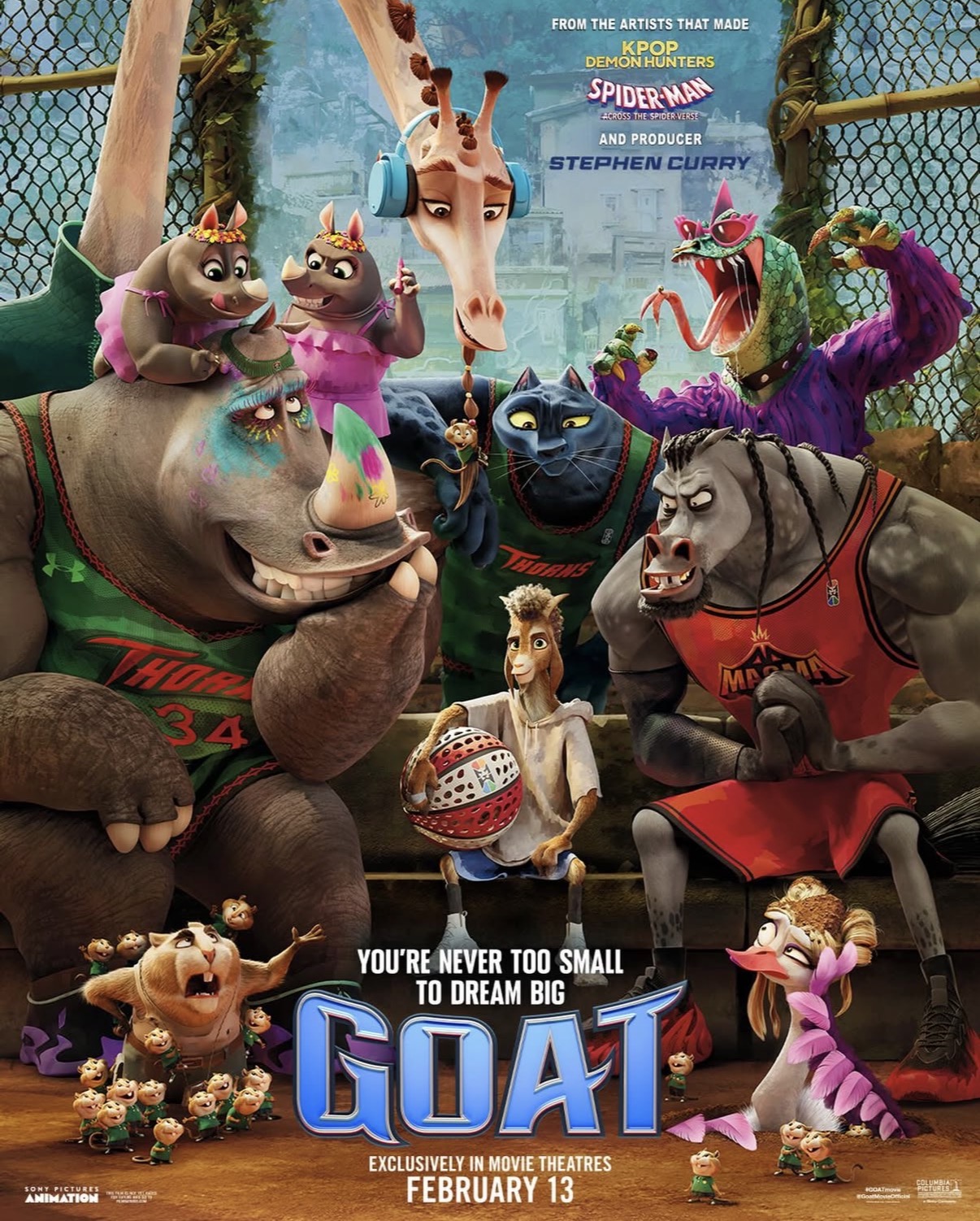
The poster for “GOAT.”
Courtesy | GOAT Movie Instagram
If you want to succeed, you’d better count on getting lucky and going viral. That’s the underlying premise to the 2026 animated film “GOAT,” produced by and starring Steph Curry. It’s a little disconcerting.
The movie follows Will Harris, a medium-sized ungulate who dreams of becoming a professional “roarball” player, the co-ed, co-species perversion of physics that substitutes for basketball in the movie.
Will’s life at the beginning of the film is simple: He misses rent on a one-room pad owned by a rodent with hundreds of children. He delivers food for a sports bar fallen on hard times since their home team, the Vineland Thorns, stopped winning games. He idolizes the one-time star of the Vineland Thorns, Jet, the black panther whose skill he dreams of imitating.
When a meme edit of Will playing a pickup game of roarball against a professional roarballer, a horse called Mane Attraction, goes viral, the warthog owner of the Vineland Thorns signs him onto the team as a media gimmick.
Using inter-species conflict as a stand in for America’s racial tension –– a tactic also used in Disney’s 2016 “Zootopia” –– “GOAT” presents a world of sports defined by the phrase “smalls don’t ball.” In Will’s case, the freakishness of watching a goat play roarball against polar bears and Andalusian horses boosts the financial valuation of the team.
This publicity stunt, its fallout, and Will’s eventual triumph form the body of the movie, which follows the fairly predictable beats of an underdog story, culminating in a big game.
The movie stands out for its visual effects, but its near-constant use of phones and technology to drive the plot falls flat.
The impressionistic art style, which is satisfyingly pastel and textured, gives the picture a special feel: The way characters move and interact with the world distinguishes it from most other animated movies in recent years.
The Gen Alpha-esque dependence on the digital is less appealing. There aren’t many other animated films with this much of an in-world phone addiction, whether that’s Will watching an ad for “Big Bronco Crypto” or an audience of would-be animal influencers livestreaming his pickup games. GOAT takes place in an attention economy where every hometown hero, spunky underdog, or amateur game is just another opportunity to generate clicks.
Will’s character, rather than resenting or escaping this world, merely plays into its twisted reality. He is essentially without agency, a memetic creature who brings no particular talent to the game of roarball other than making trick shots and monologuing his dreams. He’s part of the team because he makes for good content, and even in the final game, the film never concretely establishes Will’s contribution to the team.
The mechanics of the sport are left completely ambiguous. The games are a hallucinatory vision of hundred-foot leaps, falling stalactites, and raw physical violence.
When the team is saved from being sold out of Vineland by an inexcusably bad deus ex machina, there’s a collective cheer that “roots run deep,” but it’s a Pyrrhic victory: Even in Will’s victory against the naysayers, his talent never seems to outweigh his luck. Roarball, it seems, is doomed to be relegated to mere content.
Visually satisfying but with an insipid message that never rises above the cliche “follow your dreams,” the persistent pattern of digital addiction and the siren song of virality and content creation makes “GOAT” an eerily relevant movie for America that bet $1.76 billion on the last Super Bowl and dreams collectively of rising above the monochromatic drear of student debt, loneliness, and high interest rates with one perfect viral moment or lucky parlay.
