
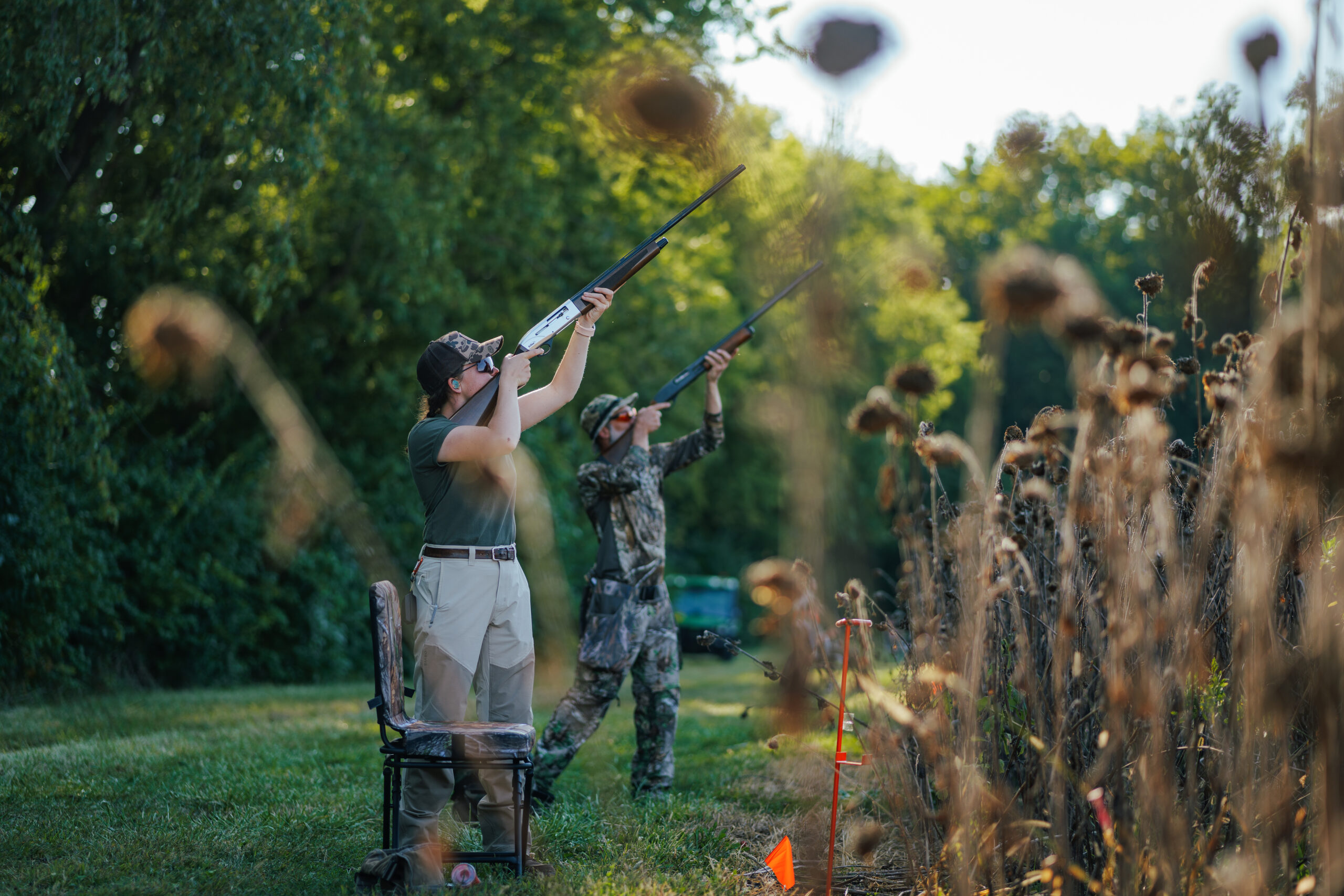
Senior Madeline Corbin hunts doves on the Drummond Fellowship’s hunting trip to Indiana in September.
Courtesy | Madeline Corbin
The graying stalks of sunflowers rattled in the late September wind as senior Madeline Corbin nestled the butt of her gun into her shoulder. She breathed in, out, and shot. Dove feathers fell from the sky.
In front of her, her family’s pointer dog zigzagged through the canes, the dove securely in his mouth. He laid the bird down on the ground as other students and friends of the college began emerging from their spots along the edge of the field.
“A lot of people think of hunting as just killing animals, which it definitely is, but what people don’t know is that the funding for conservation of wildlife and land actually comes directly through sportsmen,” senior Drummond Fellow Michael Angelbeck said.
Rather than funding coming from public taxes, Angelbeck said, money for wildlife conservation comes from taxes on hunting and fishing gear.
Corbin and Angelbeck are part of the Drummond Fellowship, a group of 12 individuals who work with the Nimrod Education Center. The fellowship’s initiative is to teach Americans about wildlife conservation, hunting, fishing, and the Second Amendment.
The center’s new facility, the Nimrod Complex, will open on the grounds of the John A. Halter Shooting Sports Center in early March, according to Alan Stewart, Director of the Nimrod Education Center. It will house new indoor and outdoor archery, shotgun, and pistol ranges, according to the Halter Center’s website.
The Drummond fellowship began in 2022 because of the vision of friends of the college Alan Taylor and Brian and Melody Drummond. They hoped to continue the hunting tradition that the early founders of America practiced. Students of all classes and majors with an interest in hunting, fishing, and conservation may apply to spend their time shooting and fishing on hunting trips, taking classes in wildlife conservation and law, and learning from the various speakers that the Nimrod Education Center invites to campus.
The fellowship hosts hunting trips in the fall and spring semesters, which range from dove and quail hunting to deer and most recently, antelope, according to Stewart. In the fall, the fellows travel to Indiana to hunt doves in sunflower fields. The birds feast on sunflowers while the friends of the college use dogs to sniff out the fowl. These highly trained dogs are called pointers.
Pointers are trained specifically to smell out birds and hold the fowl in place while the hunters get into position. Stewart described their technique of weaving back and forth as “a sort of ballet.”
Once the hunters are ready, the dogs “flush” or spook the birds so they fly up and out of the field, allowing the hunters to aim and fire. According to Stewart, it is important that the pointer dogs not flush the doves too early so that the birds are not unfairly spooked.
Hunting trips host between eight and 70 guests, according to Corbin. She said she has enjoyed talking with the people who attend.
“You get to sit with the friends of the college right out in the shooting post for a while because obviously hunting is not a lot of action all the time,” Corbin said. “We spend a lot of time enjoying nature and God’s creation. Then there is the excitement of when you get a chance to shoot.”
Corbin has been able to connect with alumni during her time on the shotgun team. She said friends of the college are eager to hear about the shooting teams or life on campus.
“You really get to know the guests,” Corbin said. “Some of them are experienced hunters so you’ll hear stories about the adventures that they have gone on. Some of them are new to hunting, which is a really unique experience because those of us who are more experienced in the fellowship can help educate others.”
In the Nimrod Education Center, there is a large culture of teaching and training others through the youth hunts that they host and the hunting trips themselves, according to senior Drummond Fellow Leif Andersen.
Angelbeck said he shared his passion for fishing with friends of the college on one of the quail hunting trips to Southwind Plantation in Georgia.
“I was able to lead a night fishing session on a couple of the nights during that trip,” Angelbeck said. “They had a pond on site, and I had brought a lot of fishing gear down there. We would go hunting for quail during the day and then in the evenings after dinner and a speaker, I invited anyone who was interested to go fishing.”
The Nimrod Education Center focuses most of its efforts on hunting, but it is working toward making fishing trips for friends of the college to attend, according to Angelbeck.
Stewart said he allows the fellows to take home most of the game they catch and shoot on the trips. He saves the rest of the meat for Nimrod’s yearly wild game feasts. Students process and prepare the game for each dish with recipes passed back and forth between donors and fellows. Stewart said the meal gives the fellows a personal connection to their food and an understanding of where it comes from.
In various off-campus houses, the fellows host their own feasts, including fish fries with walleye caught in Lake Erie, and quail roasts from the Southwind hunts.
“After our Lake Erie fishing trip we had just dozens and dozens of walleye,” Angelbeck said. “We flayed those up and invited a bunch of our friends over and had a big fish fry. We made fish tacos and just had a blast.”
The fellows are also involved with Nimrod’s speaker series which brings in specialists in conservation and other hunting topics. Most recently, Nimrod hosted a two-day lecture series on Art and the Sporting Tradition, which highlighted duck decoy sculptures, a collection of wildlife paintings, and lectures from an award-winning duck stamp painter. Duck stamps are duck hunting licenses that are skillfully painted and often collected because of their beauty.
The Nimrod lectures often center around conservation, which is the backbone of the center’s work. These lectures are important to Nimrod’s work because it is common for Americans to confuse conservation with preservation, according to Andersen.
“Conservation is how humans interact with nature and the utility that humans derive from it because we are a part of nature,” Andersen said. “Preservation is more about setting aside land or a certain species or population for the sake of returning things back to the time of Lewis and Clark.”
Stewart said people often don’t see the value of shooting and fishing sports or believe that hunting and fishing are harming natural resources. He said Hillsdale shows how hunters support conservation.
Most of this support comes financially through an act called the Pittman-Robertson Wildlife Restoration Act, which uses the money from licenses, gear, and firearms, and distributes it to help monitor conservation on the federal level. States also regulate conservation through deciding the prices of licenses and the amount of game each hunter can catch or shoot, according to Angelbeck. The money from the licenses goes back to the state to manage game.
“Through some of our lecture series, as well as through the classes we offer at Hillsdale like Wildlife Conservation, and Wildlife Law, we as fellows have been able to become more educated about the actual mechanics of how wildlife conservation is funded,” Angelbeck said. “It has allowed us to be good spokespeople for the outdoors and for the importance of hunting.”
While fellows learn to be spokesmen for the outdoors through Hillsdale’s classes, their knowledge is often passed down through generations. Most of the Drummond Fellows have grown up hunting and fishing from when they were very young. Through the tutelage of their parents and grandparents, the fellows have learned to appreciate the natural resources of American land and the gift of game to hunt.
“Hunting is a genetic hand me down,” Stewart said.
For Stewart, the Drummond Fellowship feels like a family that he is able to mentor.
“We are a family,” Stewart said. “We observe and believe in the tradition of passing these things on. That commitment that I see from our students as they hold through this process and just seeing them recognize the experience they are having and seeing value in being able to pass on the tradition that our country was founded on is in the fabric of who we are as people in this nation.”
Applications for the Drummond Fellowship will open in early March.
