
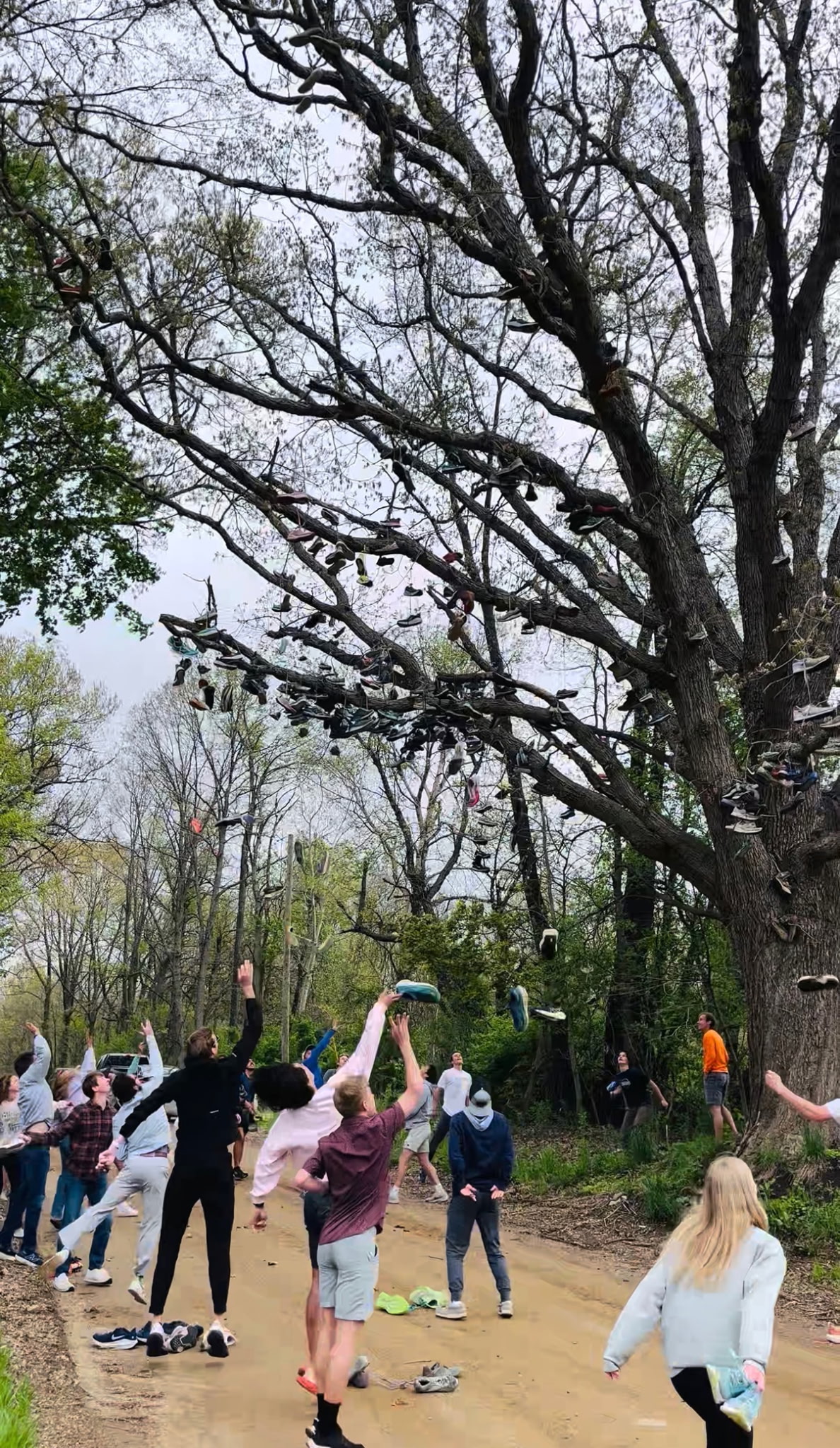
Old running shoes are thrown to their final resting place.
Courtesy | Anna Roberts
It was early spring when junior Ted Fehringer first saw the shoe tree.
“It’s creepy as hell,” Fehringer said. “I feel like all those shoes belong to dead people.”
Out for a run on Half Moon Lake Road a few miles from campus, Fehringer noticed the aged tree’s bowers coated with pieces of modernity: running shoes.
As he stared apprehensively, a pair of shoes plummeted from the tree.
“I looked at it for a minute, felt creeped out, and turned around,” Fehringer said. “The tree is surely demon-possessed.”
Fehringer’s superstitions are not isolated. Shoe trees can be found across Michigan, often surrounded with sinister folklore. In Salem, Michigan, a shoe tree is widely rumored to have started when a serial killer threw the shoes of his first victim into its branches.
At the corner of Half Moon Lake and Ball Road, Hillsdale’s shoe tree sits on the Cook family property, land that has belonged to the family for generations.
“It is at least 200 years old,” Dennis “Gate Guy” Cook said. “When my dad was a kid, it was already large.”
Cook’s father grew up on the property with his siblings. Today, Cook’s uncle owns the land and the shoe-laiden white oak on it.
The beleaguered giant is a survivor from the 1800s. Cook said other large trees once stood near it, but when some of the land was sold they were cut down to make way for farming.
In the 1950s, long before footwear adorned its branches, the tree had witnessed college parties permitted by Cook’s grandfather.
“He was quite welcoming,” Cook said. “He would let students come and party. They had a piano and a bonfire one year.”
Eventually the parties came to a stop, but the college would soon revisit the tree in an unexpected way.
In the early 2000s, something strange began appearing on the tree: shoes. Each year the crop multiplied until dozens of shoes nested in the tree’s canopy.
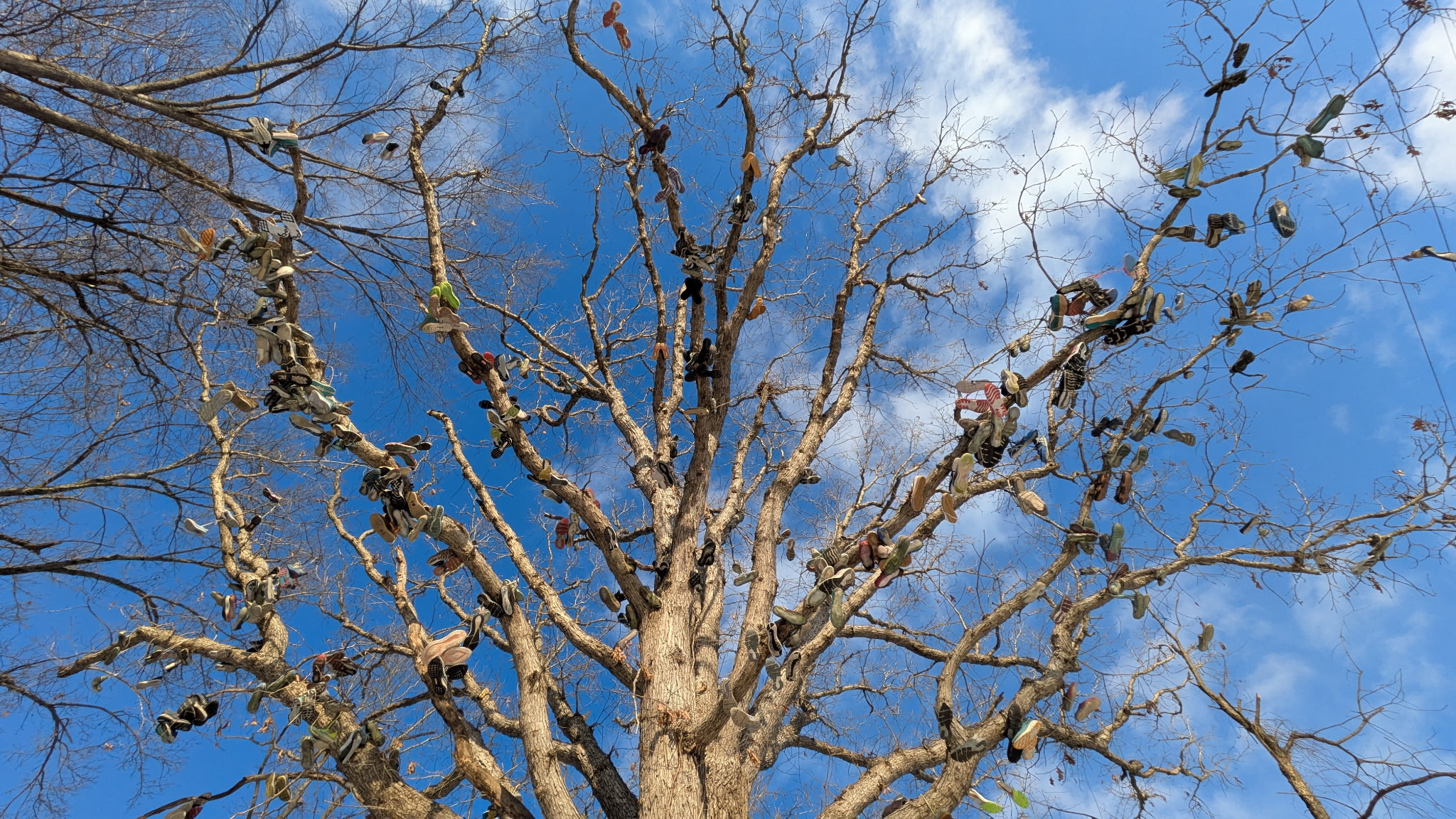
James Joski | Collegian
One day, Cook decided to investigate the tree while with some friends. He ascended the weathered titan to find a pair of shoes marked with a state and year. Looking into a second pair, he found a very different surprise: a bird’s nest. It was puzzling.
“We wanted to find out more,” Cook said.
And so one question remains: whose shoes are these?
The answer can be seen on nearly any fall or spring day. On a quiet afternoon you might hear their pattering steps or see their bobbing forms coming up the road. It’s the Hillsdale Cross Country Team.
“The shoe tree has been a big part of team culture for a long time,” said senior Nathaniel Osborne, captain of the men’s cross country team. “We go and tie up our old running shoes and we toss them up into the branches.”
But what about getting back? Cook’s mom had mused they did so barefoot.
“No,” Osborne said. “We will have a group that runs out there and maybe one person who is injured has a car with the shoes in it,” Osborne said.
Getting there isn’t the hard part. It is getting the shoes to stay in the tree that requires some strategy and a bit of luck.
“Some will tie the shoelaces together, hold both shoes together, and throw them up into the tree,” senior Emil Schlueter said. “I don’t think that usually works. I like to tie my shoes together and then spin it like a windmill so that when it hits the branch it will wrap all the way around and stay on.”
One way or another, the shoes eventually fly up into the tree to nest within its broad branches.
In winter they hang in clear view like strange Christmas decorations that were never retrieved.
It is a sight that begs for an explanation, yet the team has none. The shoe tree is one of many traditions they observe whose roots have been lost to time.
“The stories about them change and no one on the team knows how it started,” Schlueter said. “But there is sort of a reverence for it that keeps going as well as a mystery because no one knows how it started.”
It’s not for the team to know the tree’s history, senior and women’s cross country team captain Anna Roberts said. Instead, it’s to follow in the footsteps of tradition.
“We respect the tradition that has been there, we don’t question it, so we continue with that tradition out of respect for those that have come before just like students at Hillsdale,” Roberts said. “They may not know the exact origin of the traditions here and how traditions that have come to be were founded, but they respect it out of that tradition.”
The tree’s location on Half Moon Lake Road is familiar to the team.
“We run out on that road more often than any other road,” Schlueter said.
For Roberts, the road is an intimately familiar place.
“I’ve spent so much time out there,” Roberts said. “It’s like your daily commute.”
But runs on Half Moon Lake Road are no joy rides for the teams.
“Oftentimes our progression runs will go out there and it starts to get tough right when you get to the shoe tree,” Osborne said.
Yet, Roberts said, should runners look up, they will find inspiration.
“It’s hard. You’re running; you see it. You look up and you’re like ‘I can do it,’” Roberts said.
Although the tree may look creepy to those passing by, for the cross country team, it carries the memory of those who came before.
“You see all of those shoes and there are so many of them and you know that ‘this many people have gone before me,’” Roberts said. “They have done the same things and there is a lot of pride in that pursuit.”
