
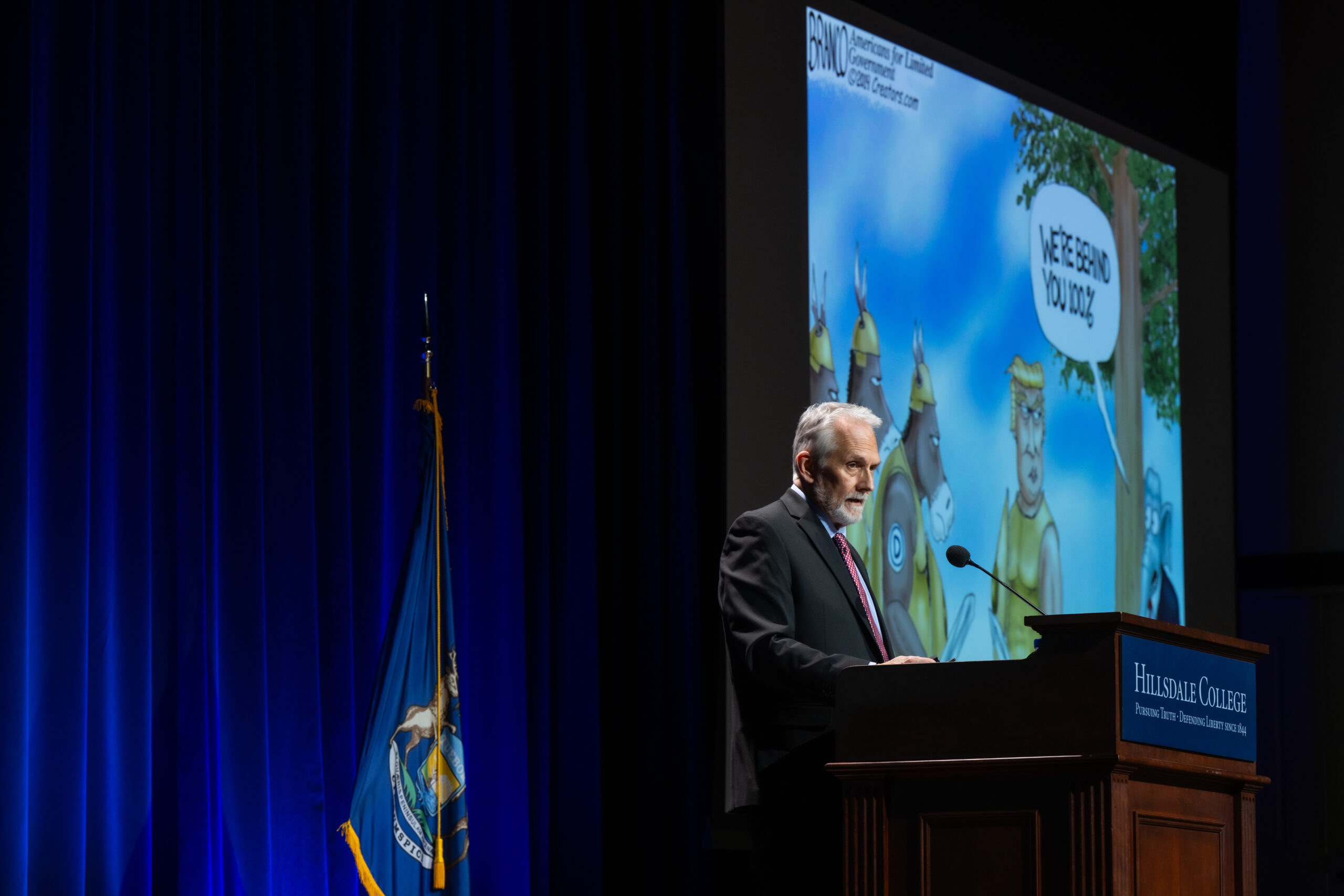
Political cartoonist A.F. Branco presented his cartoons during his speech at the CCA.
Courtesy | Austin Thomason
A free people needs a free press, not censorship, speakers said at this week’s Center for Constructive Alternatives seminar on “Journalism and American Democracy.”
“The Founders never tired of affirming that the free press was one of the great bulwarks of liberty,” Hillsdale College Professor of Politics Thomas West said. “The danger, as Tocqueville wrote, is when many members of the press come to take the same line.”
The college hosted its third CCA of the academic year Feb. 1–4, featuring West, Professor of Politics at Claremont McKenna College and Editor of the Claremont Review of Books Charles R. Kesler, former columnist for the Chicago Tribune and host of “The Chicago Way” John Kass, Host of “Next Up With Mark Halperin” Mark Halperin, political cartoonist Antonio F. Branco, Daily Caller Senior Editor Amber Duke, and a Hillsdale faculty panel, in Plaster Auditorium.
West opened the conference Sunday afternoon, speaking on the historic role of the free press in American democracy and criticizing the censorship of political discourse by progressive elites during the last century.
West contrasted the decentralized, vigorously partisan newspapers of America’s colonial era with the oppressive control of a few major media outlets that dominated America after the institution of the fairness doctrine and the Federal Communications Commission by Franklin D. Roosevelt.
“In the 1930s, President Roosevelt hounded the broadcast industry, and to some extent the newspaper industry, to the status of willing minions of the Democratic party. For the most part, they have remained so ever since,” West said.
The drive to censor conservative speech comes from the progressive understanding of justice, which is based on equity between groups instead of objective principles, according to West.
“Many liberals will openly defend the point of view that you absolutely have to shut down and silence conservatives to have anything close to a just society,” West said.
On Sunday night, Kesler reflected on William F. Buckley Jr.’s role in bringing conservative voices into the media.
“What he was about was really finding a way for Americans, and particularly the American middle class, to come together in a new conservative movement ambitious to reverse progressivism, and to sort of resume traditional and patriotic American principles going all the way back to the Declaration of Independence,” Kesler said.
Kesler emphasized Buckley’s role in fueling American conservatism by founding National Review magazine in 1955.
“Without Bill Buckley, there would have been no National Review,” Kesler said. “That would have meant no Goldwater candidacy and in all probability no Reagan. If there were no President Reagan, there may have been no victory in the Cold War, and we might be sitting in a very different America today.”
In a speech titled “The Decline of Trust in the Legacy Media,” independent columnist John Kass attributed American’s disillusionment with the legacy media to the loss of one key trait.
“Journalism lost something irreplaceable,” Kass said. “The one thing a journalist needs to do his job: Curiosity.”
Kass highlighted mainstream media’s coverage of former President Barack Obama’s campaign as a turning point for the mainstream media.
“I was there when it went bad,” Kass said. “We opened the newsroom wide to the American left, and we manufactured demigods like Barack Obama to lead the country where it did not want to go. When the media tried to create a myth, they lost themselves.”
Despite this shift away towards myth, Kass expressed some optimism for the future of journalism through alternative media and open-forum media, such as X.
“They hate Elon Musk because he saved X,” Kass said. “We have a chance now, so there’s journalism to be done. This is Hillsdale’s time. The path is well lit, but it’s not easy to carve your own way. All you have to do is take that first step.”
Mark Halperin, founder of the live video platform known as 2WAY, argued President Donald Trump is playing an important role in challenging the mainstream media system and restoring a healthy and free press.
“Donald Trump understands the press, and he understands what’s wrong with the press,” Halperin said. “He understood how angry tens of millions of Americans were about what was wrong with the media.”
Halperin presented his platform as a model for restoring the free press.
“2WAY uses virtual technology to create an authentic community around a shared belief in America,” Halperin said. “The point of 2WAY is to put all voices under one shared roof and to have a civil conversation. And my community members love it.”
Political cartoonist A.F. Branco, in a talk titled “Make America Laugh Again” Tuesday afternoon, used his cartoons to echo earlier criticisms of legacy media outlets.
“MSNBC, ABC, CBS, PBS, NPR, The New York Times, and the Washington Post, with their liberal bias, are absolutely the reason we have a very vibrant alternative media today,” Branco said. “Legacy media just isn’t trusted anymore.”
Duke spoke on the rise of alternative media platforms in the internet age, contrasting it with the elite-dominated media landscape of the 20th century on Tuesday night.
“In broadcasting you need access to a finite number of licenses that actually are doled out by the government,” Duke said. “That scarcity created a kind of structural gatekeeping on behalf of these corporations.”
Duke emphasized the role of digital technology in the rise of the new media.
“Then the internet came along and did something pretty radical,” Duke said. “It broke the bottleneck. All of a sudden, anyone anywhere could be a publisher. And when people realized they had this power, they used it.”
West said the rise of the internet has made the American press more free, closer to the Founding ideal.
“Much has changed since the internet became widely accessible,” West said. “Here’s now an alternative news source that’s free. If you dig around enough, it’s competent and informative. The phenomenon of going viral has allowed long-suppressed facts to reach the national consciousness.”
At a faculty roundtable event held Feb. 4, Director of the Dow Journalism Program John J. Miller said journalism today is a paradox, emphasizing the need for a discerning citizenry.
“It’s never been worse, and it’s never been better,” Miller said. “What we need now, more than ever, are readers and consumers of the news who are discriminating and intelligent, and who know how to take advantage of this moment where we can get the best news and information ever available to us.”
According to sophomore Thatcher Debowski, the CCA deepened his understanding of the media in America.
“I enjoyed learning about the historical progression of the media, how it’s changed over the last 40 years,” Debowski said. “How there’s not only more polarization, but less of a concern with the true nature of the situation.”
