
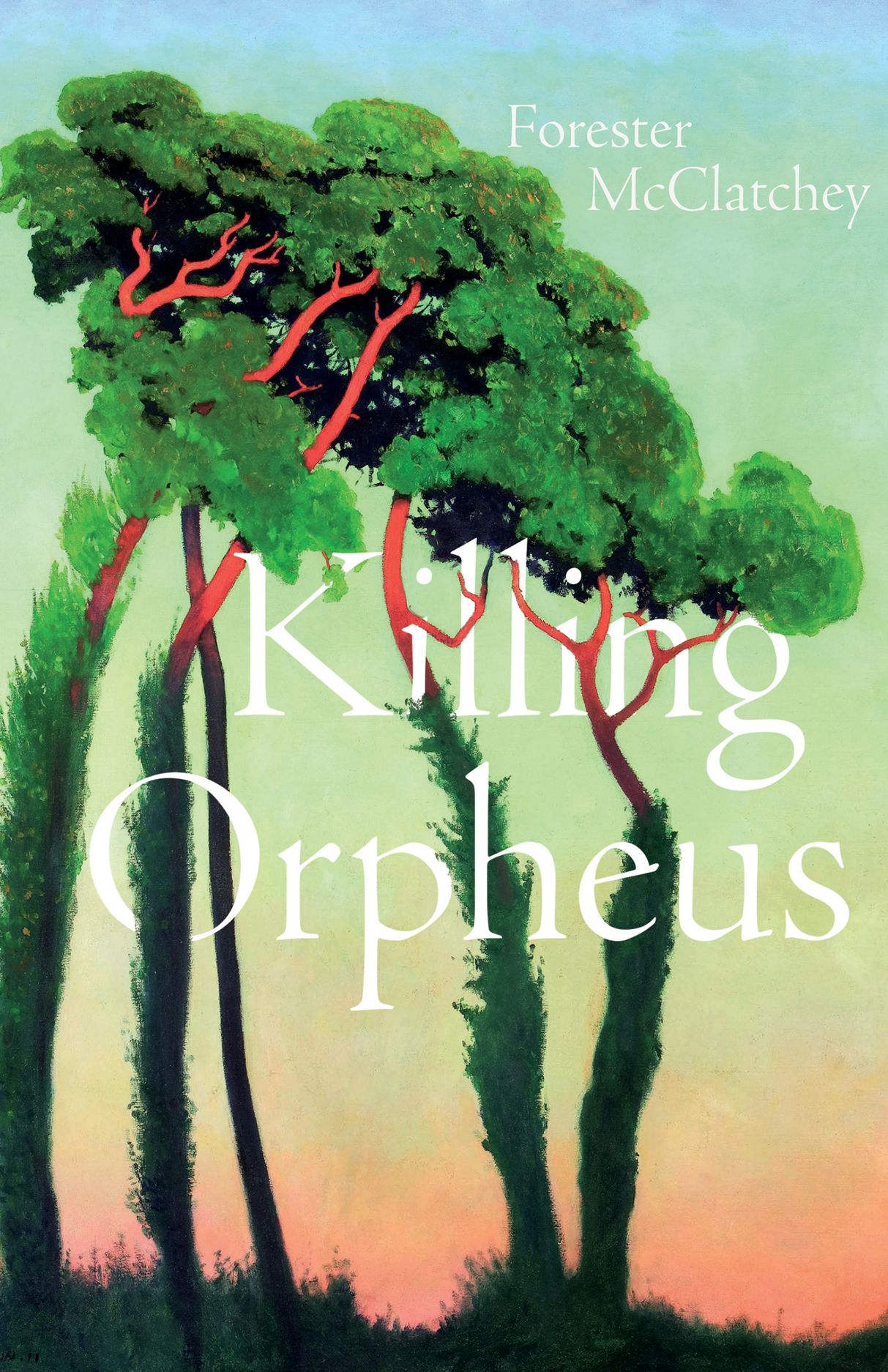
The book cover for “Killing Orpheus” by Forester McClatchey.
Courtesy | The University of Chicago Press
Dog carcasses, bad paintings, and hiccups: Everything is game for poetry to Hillsdale alumnus Forester McClatchey ’16.
After years of teaching poetry in the classroom and publishing his own in journals, McClatchey released his first volume of poetry, “Killing Orpheus,” this month.
Associate professor of English Dwight Lindley, who taught McClatchey while he was at Hillsdale, said he has enjoyed reading the collection.
“The guy’s got a great ear and also just a fascinating imagination,” Lindley said.
McClatchey chose the title of the collection, which includes newer poems as well as some composed during his time at Hillsdale, to express a major theme of his work.
“Beauty is always a little bit dangerous or terrifying, even on the micro level,” McClatchey said. “I hoped that the title would evoke the beauty of Orpheus singing, but also the kernel of violence that’s always tucked inside beauty.”
McClatchey attributes his love of poetry to his high school English teacher, Maggie Blake Bailey, who was a poet herself.
“She was very much into the contemporary scene and experimental poetry,” McClatchey said. “So that kind of poetry was probably my first love, in an un-Hillsdale way.”
McClatchey said reading through the core at Hillsdale introduced him to some of his current favorite poets.
“I really fell in love with the more bombastic formal poets like Hopkins and Tennyson,” McClatchey said. “I found their music drunken and ridiculous, but also sort of intoxicating. There was something wonderfully ludicrous but also wise about it.”
McClatchey never intended to write formal poetry, he said — though the majority of poems in “Killing Orpheus” are sonnets. Rhyme and meter seemed to him rules he needed to learn before he broke them.
“Then I found it kind of turbocharged what I was writing,” McClatchey said. “I still have an instinctive tug toward something more experimental and something that breaks the rules, but I find that writing formal poetry gives me something to push up against, in a way that gives the language energy.”
According to McClatchey, his writing process begins in reading. Then, when he has an idea, he said he tries to write an entire first draft. Next comes editing.
“I mostly write sonnets, so the predictability of the form helps compress what I want to say,” McClatchey said. “You have certain rules that are hemming you in and pressurizing language. And so even if you have no idea what you want to say metaphysically or how to phrase a description, you know that this line has to rhyme with this line, and that’s a provocation that’s helpful.”
According to McClatchey, his experience of marriage and fatherhood has altered the way he writes.
“Having a child forces you to understand that you’re not the center of the universe,” McClatchey said. “I’ve heard having a kid compared to the Copernican revolution. You have a kind of geocentric, self-centered worldview inevitably before you have kids. And then when you have a kid, there’s something — maybe theological, maybe biological, maybe both — that happens where suddenly, your life and your imagination no longer revolve around yourself.”
At Hillsdale and in graduate school, McClatchey said he had trouble finding intense and ambitious subjects for his poems.
“Then when you get married and have a kid, certain facts like mortality or sacrificial love become so obvious and embedded in your body that you don’t have to hunt for them anymore,” McClatchey said. “So maybe there’s something poetically helpful about that, but it also reminds you that you can’t really build your life around poetry.”
McClatchey, whose wife is also a poet, said the two of them at times considered ordering their lives to serve art, but concluded it should work the other way around.
“We both found something sickly and hollow and sad about that,” McClatchey said. “We agree that poetry should be the overflow of a full life.”
After five years teaching at the University of Florida, McClatchey moved to work at Atlanta Classical Academy, where he teaches American and British literature to 10th and 11th grade students. McClatchey works alongside friends and fellow alumni Joshua Andrew ’14, Garrett Holt ’14, and Aaron Schepps ’14.
“Teaching high school is unspeakably more intense than teaching college,” McClatchey said. “You form deeper bonds with your students, and it’s very clear that what you’re doing matters whether or not you want it to.”
According to McClatchey, teaching has forced him to deconstruct poetry better.
“I have to be able to explain everything in such a way that an 11th grader who doesn’t want to be there can understand and process it,” McClatchey said. “If you can’t explain something to a ninth grader, you probably don’t understand it yourself. So I find that strangely helpful, even though teaching kind of feels like getting a concussion every day.”
McClatchey says he is surprised by how much his students enjoy memorization.
“There’s something very communal and also bodily and ritualistic about memorizing poems together,” McClatchey said. “So even if they have very little interest in English as a subject, they get excited about it, almost like they’re at a sports game.”
“Killing Orpheus” has received positive reviews online, as well as from McClatchey’s former professors.
“He’s clearly just going through the sonnet form and trying to explore all these different ways to do the sonnet,” Lindley said. “It feels fresh, even though it’s an old form that he’s working with.”
According to Lindley, McClatchey’s poetry feels very natural.
“That’s the fruit of a lot of labor, but also good taste,” Lindley said.
Associate professor of English Dutton Kearney said he is impressed by “Killing Orpheus.”
“His poems linger in your mind like Raphael’s voice must have lingered for Milton’s Adam,” Kearney said. “One of the volume’s most defining features is that each poem knows when it is complete. Craft and intuition come together for Forester in ways that are always unexpected, yet always fitting.”
According to Kearney, McClatchey was one of the best students he ever had.
“I remember asking him to rewrite his freshman Great Books paper and remove all adverbs, adjectives, metaphors, and similes,” Kearney said. “Many of his classmates wrote in a similarly overwrought style, but where they resented my audacity, he embraced the challenge. Now he writes circles around me, which is what education is all about.”
