
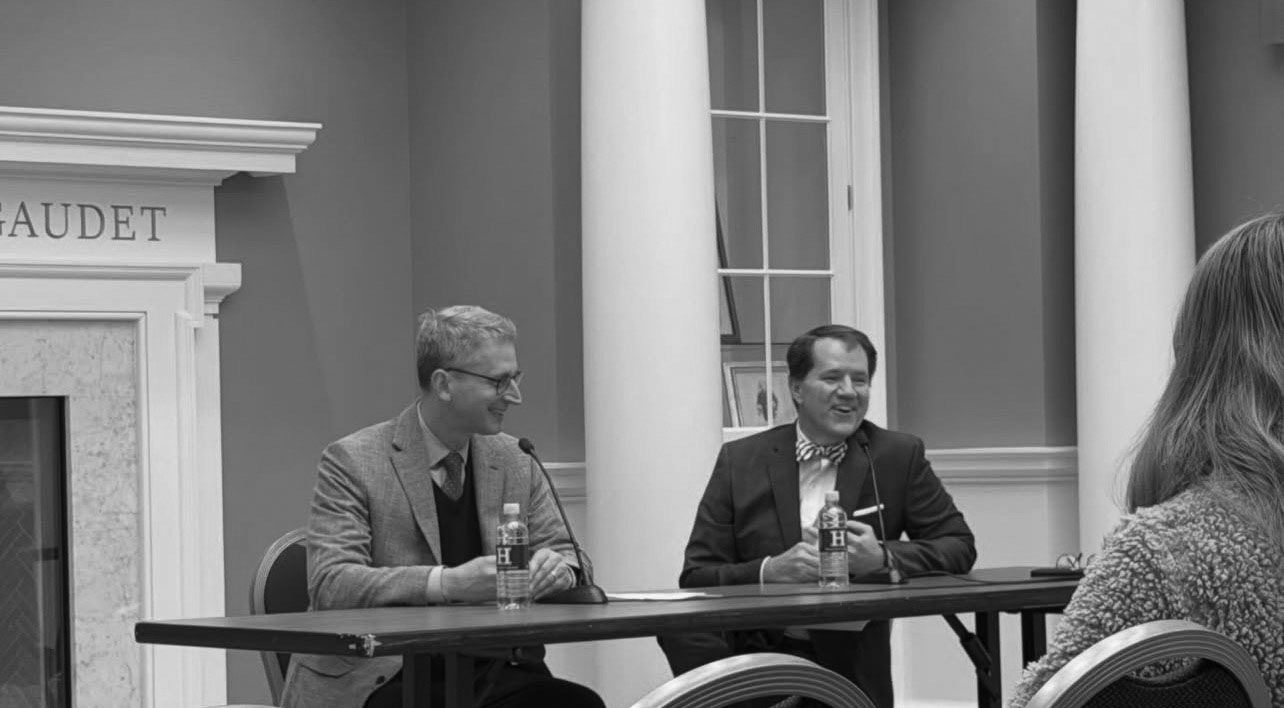
The federal bench is not a career path one can choose, according to two judges on the Fifth Circuit Court of Appeals.
Stuart Kyle Duncan and Don Willett joined the Hillsdale College chapter of The Federalist Society Feb. 20 for a panel titled, “Lives in the Law: Becoming — and Being — a Federal Judge.”
Both Willett and Duncan began by recounting the stories of how they became federal judges. Willett spent only two-and-a-half of his 34 years in law in private practice. The rest of the time was spent in government. He then entered the judiciary at the state level before joining the federal bench.
“I spent about a dozen years on the Texas Supreme Court, and then came over to the federal bench,” Willett said.
Duncan said he did not set out to become a judge.
“I went to LSU law school because I couldn’t get a job with my English degree, and I had no plans to be on the bench,” Duncan recalled. “I thought, ‘Wouldn’t it be nice if I could be a lawyer in Baton Rouge and make partner one day?’ I had no ambitions in that regard.”
After stints in state government and at a nonprofit, Duncan ran a firm taking constitutional law cases — something he thought would keep him away from the bench.
“I had my law firm, and we handled cases about transgenderism, about abortion. I handled a bunch of gay marriage cases, and every time I would get one of these cases,” he recounted. “I would tell my wife, ‘Well, we’ve taken another one, and now I’m sure that I’ll never be a federal judge.’”
Yet, under President Donald Trump, Duncan’s record became an asset rather than a liability.
“In the old days — especially under Republicans — you’d want to have no paper trail at all,” Duncan said. “Trump, as he does in many things, goes the opposite direction. He sought out people, as I understand it, who were out there on the front lines.”
On the other hand, Duncan said joining the federal judiciary is not something one can plan on.
“You can’t set out to become a judge,” Duncan said. “It’s so few people who get to do this.”
Willett agreed, saying that much of the process depends on unmanageable factors.
“It really is divine happenstance. It is absolute serendipity,” Willett echoed. “There are 1,000 stars that have to align, and roughly 999 of them are utterly beyond your control.”
However, both also noted that there are ways to set oneself up well. Willett, for instance, focused on reputation.
“Try to be a really good lawyer, a really versatile kind of top tier lawyer, who has a reputation for being a credible candidate,” Willett advised.
Duncan stated that government work can be helpful to acquire that reputation.
“One way to put yourself in a position to do that is to go to work for the government,” Duncan said. “You get to be involved in cases that are quite consequential. They’re often in the public eye.”
For Duncan, this helped him practice handling politically charged cases as a judge.
“Being in the public eye as a lawyer kind of prepares you for being in the public eye as a judge,” he said.
Senior Hugh Macaulay said he thought that getting the judges’ perspective was novel.
“I’m very grateful both distinguished judges could come and speak,” he said. “It’s very interesting to hear them speak about questions surrounding public policy.”
Macaulay said the discussion around faith life as a judge was a key takeaway for him.
“It was interesting to hear them talk about praying while considering their role in relation to the news,” he said. “Their emphasis on staying grounded in Scripture was very striking to me.”
Senior Marc Ayers also said he enjoyed the opportunity to hear from federal judges.
“I really enjoyed the talk,” Ayers said. “It’s always so valuable in any profession as secluded from the public eye as federal judges to get their opinion on things.”
Ayers particularly enjoyed the emphasis that the judges placed on the difficult task of placing the law above personal values.
“The judges are focused on the law,” Ayers said. “That’s what’s important to them, and that’s what they’re deciding, not feelings, not emotions, not opinions.”
Willett said that despite the lower pay of being a judge, he wouldn’t have it any other way.
“Duncan and I could leave the bench and go to private law firm life, and multiply our salaries by a very large number,” Willett said. “But in terms of satisfaction, in terms of difference making, in terms of how consequential it is, it’s really hard to beat.”
