
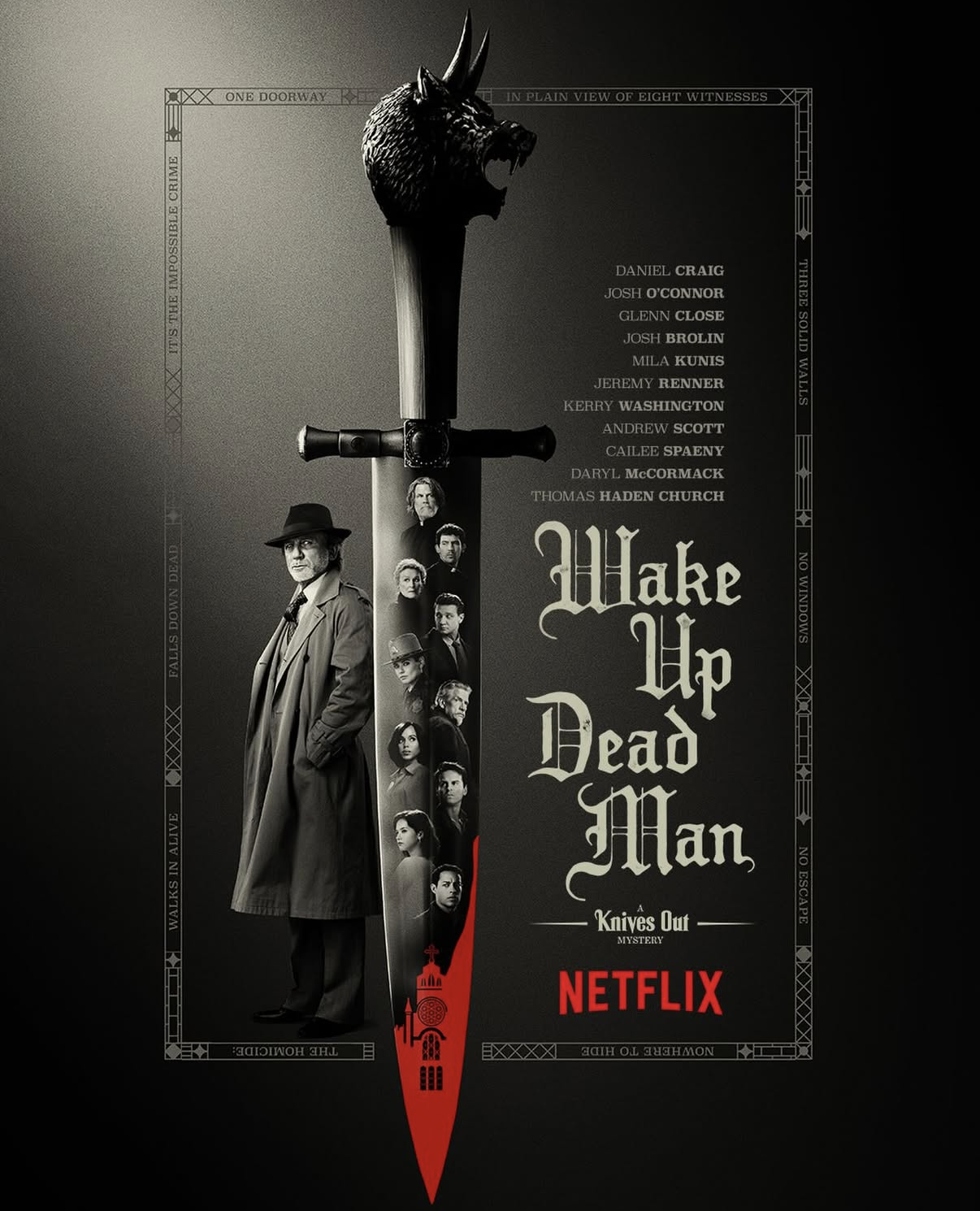
The poster for “Wake Up Dead Man.”
Courtesy | Wake Up Dead Man Instagram
A good priest is hard to find — that is, if Hollywood has anything to do with it.
As a cradle Catholic, I’ve learned to be wary of media depictions of Catholic liturgy, clergy, and belief. Even works made with good intentions have a tendency to distort key aspects of what is, admittedly, a complex and counter-cultural religion. So when I learned the latest installment of Rian Johnson’s “Knives Out” series would be set in a Catholic parish and star a Catholic priest, I rolled my eyes.
And then I watched “Wake Up Dead Man.” Twice. And I can’t wait to see it again. This secular film by a secular director is better Christian storytelling than explicitly Christian media.
Unlike most detective films, the most interesting part of “Wake Up Dead Man” wasn’t the whodunnit. Private investigator Benoit Blanc (Daniel Craig) delivered his usual drawling magic, but the mystery plot quickly became far-fetched. Instead, Johnson beckoned the audience to detach themselves from the puzzle to examine a different question, using the one character with the most at stake in the investigation.
Fr. Jud Duplenticy (Josh O’Connor) arrives “young, dumb, and full of Christ” to his first parish assignment, where before long he becomes the primary suspect in the Good Friday murder of his superior, the charismatic and twisted Monsignor Jefferson Wicks (Josh Brolin). Blanc materializes to sort things out, but just as he is about to make a breakthrough, Jud stops cooperating with the investigation.
It starts with a scene many Catholic viewers would find familiar. Fr. Jud is about to hang up on a mystery-related phone call when the woman on the other end of the line asks him to pray for her.
At first, Jud tries to hurry her along — he and Blanc have a mystery to solve and his name to clear. But as the woman unfolds her heart to Jud over the phone, the impatience drains out of his body. He sits down to pray with her, while Blanc fidgets in the other room.
“I’m done,” he tells the detective soon afterward. He’s spent days chasing down clues with Blanc instead of tending souls.
“We’re looking for a murderer,” Blanc retorts. “This is not a game.”
“It is a game. Solving it, winning it, getting your big checkmate moment,” Jud says. “You’re setting me against my real and only purpose in life, which is not to fight the wicked and bring them to justice, but to serve them and bring them to Christ.”
Here is where “Knives Out” goes from a good to a great movie — not just because it gives a priest awesome lines, but because it examines modern secularity and Christianity with equal honesty and refuses to give a pat answer to the question of belief.
Blanc, the atheist, isn’t a caricature of his kind. The more advanced Biblical references he makes reveal what is today a common story: a Christian upbringing that gave way to adulthood skepticism. Yet Blanc engages Jud with respect and openness, soon becoming an affectionate friend of the desperate young man.
Johnson consulted with a real-life Catholic priest in the making of “Knives Out,” as the National Catholic Register reported. Jud’s shortcomings, Wicks’ failures, and the parishioners’ eccentricities expose the uncomfortable reality of a Church made up of sinners, and Johnson asks hard questions about the role of such a religion in the modern world.
What he doesn’t do is go the way of most “Christian” movies and deliver trite victory to Jud and the Catholics. Declining Jud’s invitation at the end of the film to stay for Mass, Blanc remains the kind-hearted atheist he was at the start of the film, albeit perhaps with more wonder and appreciation for Jud and his ilk.
The film is colorful, in more ways than one. Though they serve a central purpose to the plot, several scenes involving sacrilege, sexual immorality, and murder are a lot to stomach. The gritty moments, though, are redeemed by the sheer splendor of the cinematography, which is vivid and deeply intentional. Though not a Catholic himself, Johnson translates to the silver screen a Catholic appreciation for imagery — “storytelling,” as Jud puts it.
“Knives Out 3: Wake Up Dead Man” is a masterpiece: entertaining, bold, and gorgeously shot. It’s been lingering with me ever since I saw it, as great movies do. Watch it, if nothing else, to see a secular film accomplish what Christian media constantly fails to: good storytelling.
