
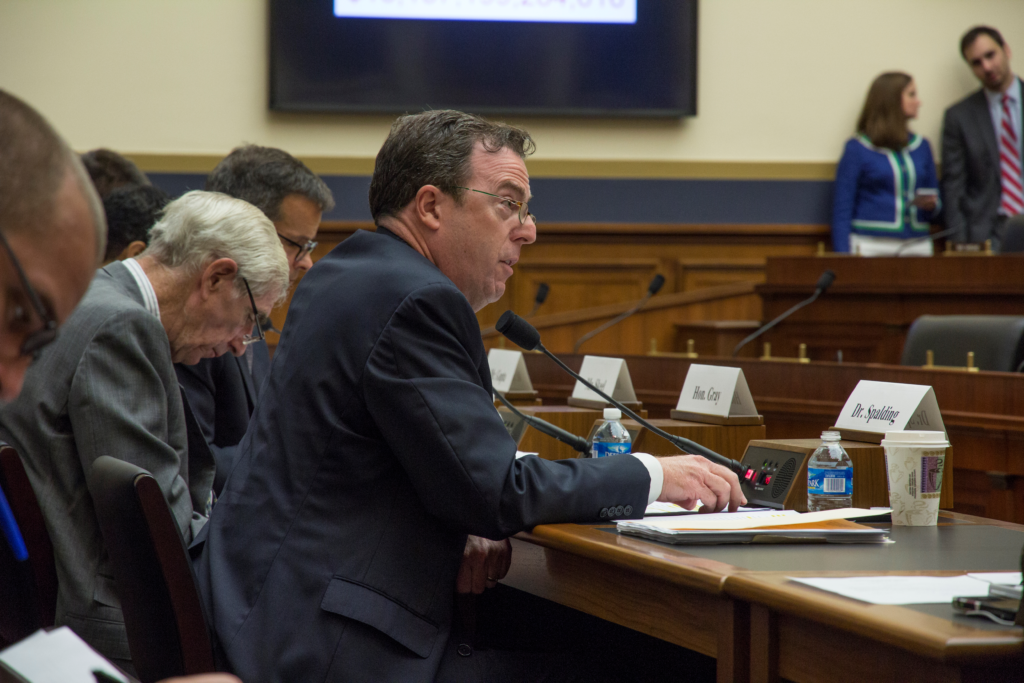
As Americans begin to celebrate the 250th anniversary of the Declaration of Independence, Matthew Spalding, dean of the Van Andel Graduate School of Government, released his latest book in December. His book, titled “The Making of the American Mind: The Story of our Declaration of Independence,” aims to teach readers the creation and consequences of the declaration.
“I’ve been studying this and teaching this for a long time, going back to my time as an undergraduate and a graduate student, and now teaching regularly for Hillsdale,” Spalding said. “So it’s been on my mind for quite some time.”
The book aims to educate readers on the process and thoughts found in the Declaration of Independence, Spalding said, adding that at the time of its signing, the concept of a “gothic” document was widely accepted, but modernity has rejected this. A “gothic” constitution is one where the writers recognize that it cannot be perfect because its writers are not perfect.
“We expect history to live up to our standards, not only the standards of perfection, but also according to our current opinions,” Spalding said. “And so we look backward when we study history. And I think that’s just incorrect. It’s not fair to them. We should study history and try to understand what they were doing. But the more general point is that man is an imperfect being. We’re human beings, after all, and so that’s our lot.”
College President Larry Arnn praised Spalding’s book.
“Matthew has prepared all his life to write this book, and it comes at just the right time,” Arnn said in an email. “It will be important.”
Spalding, who is also Hillsdale’s vice president of Washington operations, said this book was especially important to him because America is celebrating the 250th anniversary of the signing of the Declaration of Independence this year.
“I have great memories, very vivid memories, of being a child in 1976, and so there’s a really unique moment to learn about these things again, given this anniversary,” Spalding said. “I wanted to write a book for that moment, but also one that really captured the full story and made a case for the Declaration. But that is also done in a way that was a story to draw people in and then teach them something in a way that inspires a sense of patriotism.”
Wilfred McClay, Hillsdale’s Victor Davis Hanson Chair in classical history and Western civilization, has known Spalding for 30 years. He credited Spalding’s book with presenting an account of not only the formation of the Declaration, but its effects.
“Spalding shows how the Declaration was the crowning expression of the West’s long tradition, beginning with its roots in the teachings of Judaism and Christianity, as well as classical roots in Greece and Rome, going on to absorb key elements of the English constitutional tradition, and culminating in the best ideas of the Enlightenment,” McClay said in an email.
While Spalding has spent years studying and teaching this subject, he said he was surprised by some of the research for this book, such as the question of religious language in the declaration.
“There’s always been the debate about where the declaration fits in terms of America’s religious heritage, or in the history of religion in the American colonies in the United States,” Spalding said. “I found, by kind of working through that and working through the declaration, that indeed there is a powerful theology of the declaration, as I put it in my book, that is even more powerful than I thought before, despite the fact that my own professors and teachers had often kind of broadly referred to it. I think it’s actually more substantive than I previously thought.”
Spalding’s favorite part of his book is Chapter Five, which explains the list of grievances against King George III.
“It’s never taught. It’s largely ignored,” Spalding said. “Well, I spent a long time on that. Probably the longest segment of my book research was going through those in detail, trying to figure them out. I would say that was probably the most rewarding in terms of a scholar, kind of digging into those and trying to find a pattern.”
Spalding will give a lecture at Hillsdale College on Feb. 9 at 7 p.m. in the Searle Center about the book.
“He is a lifelong student of the career of George Washington, and we’re very fortunate to have him as an integral part of our Hillsdale community, in which he serves as both professor and dean at the College’s Washington, D.C. campus,” McClay said in an email. “Few people have done more than he has to remind Americans of the significance of their Declaration of Independence, and now, on the eve of the 250th anniversary of that great document’s emergence, he has published a wonderful account of its formation and its effects.”
