
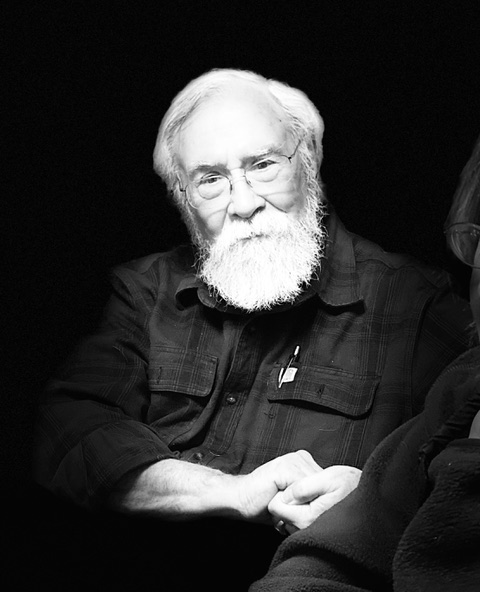
James “Jim” Stephens, former professor of philosophy at Hillsdale College, died Dec. 23 at age 76 in Hillsdale.
“He was a splendid teacher and a productive and insightful scholar,” Hillsdale College President Larry Arnn said in a statement. “He wanted to teach in a place like this so badly that he actually managed to trade with a loved one, teaching here, for his job at a large university. We gained in the bargain.”
Stephens taught philosophy at Hillsdale for more than 30 years. While a beloved professor, Stephens also enjoyed theater and the outdoors, according to George Angell, Stephens’ friend and emeritus professor of theatre.
“We camped, fished, and celebrated holidays and other events together,” Angell said. “We acted in plays together, and he acted in several plays I wrote or directed while I was the principal director for the Tower Players.”
Stephens was born in Seattle, Washington, and studied at Yale and Princeton universities, according to his obituary. After working at the University of New Hampshire and Purdue University, he moved to Hillsdale College, where he taught philosophy for more than 30 years, specializing in Ancient Greece.
Don Westblade, assistant professor of religion, said Stephens was one of the first people Westblade met when he interviewed at Hillsdale in 1988.
“He modeled, himself, the lifelong learning that he inspired in his students,” Westblade said. “When I taught a course in Gnosticism in one of my early semesters, he sat in the class with the students and eagerly did all the reading. When we team-taught a seminar on Augustine, he was as ready to absorb the theological perspectives of my contributions as I was to grasp the philosophical perspectives he brought.”
Westblade said Stephens could make any subject deeper and more interesting.
“And every quirk — his smoking, abandoned cold-turkey when illness struck, his color-blindness, the chalk and erasers in a room — became a philosophical object lesson in his hands,” Westblade said.
Stephens’ office was right next to Westblade’s for decades, Westblade said.
“I could regularly observe how he drew students like a magnet to his office for spirited conversations,” Westblade said. “Calm discussion would occasionally get interrupted by the sudden banging of a book he would slam down on the desk for emphasis.”
Lee Cole, chair and associate professor of philosophy, said he met Stephens while earning his undergraduate degree at Hillsdale College.
“He spoke in a voice that was often barely above a whisper — possibly as a result of his fondness for cigarettes — but that voice also carried with it the intensity of his thinking,” Cole said. “There was something dramatic about his class sessions, and I always found myself a bit on edge, as you never quite knew where the conversation might turn — and you had the sense that there was some big ‘reveal’ toward which Dr. Stephens was slowly prodding the students.”
Stephens revealed the existential significance of philosophy both for “thought problems” and “life problems,” Cole said, even from texts written hundreds or thousands of years before.
“On a somewhat lighter note, he was often in the habit of smacking the back of his hand against the lectern, either as an act of self-correction or as an occasion for asking how he could be deceived, even regarding his own experience of pain,” Cole said. “I sometimes do the same thing in my classes as a silent — if painful — homage.”
Stephens also loved the theatre department, both watching and acting with the Tower Players, according to Angell. He played Lord Montague in “Romeo and Juliet,” the first production in Markel Auditorium; King Duncan in “Macbeth”; Uncle Jack in “Dancing at Lughnasa”; King Cymbeline in “Cymbeline”; and multiple roles in “Iron Bird,” a musical Angell wrote about the Dalai Lama.
“We acted together in the Michigan Shakespeare Festival production of ‘The Merry Wives of Windsor’ in the summer of 2004,” Angell said. “Jim was a member of the theatre honorary Alpha Psi Omega and always attended every production.”
Stephens also went on multiple trips with theatre students to the Shakespeare festival in Stratford, Ontario. He also visited Edinburgh, Scotland, during one of the years the department performed at the Edinburgh Festival Fringe.
Angell and Stephens took multiple camping and fishing trips together, including two to three weeks during the summer at Hog Island in the Upper Peninsula.
“It is not surprising that many of the most indelible memories I have of Jim are connected to these activities, like being attacked while canoeing on the Jordan River by an angry swan,” Angell said.
Eventually, Angell’s children joined the trip.
“He always slept in his own tent on the other side of the campsite because he was such a prodigious snorer,” Angell said. “His snoring would shake the campground. In the morning, it was my little daughter Rhiannon’s task to ‘wake up the tent’ when the coffee was ready.”
One morning, Angell said, Rhiannon, then 4 years old, greeted Stephens by asking, “Jim, what is truth? My dad says you’re the best person to ask.”
“Jim just blinked, turned around, and said, ‘I’m going back to bed,’” Angell said. “He was an integral part of the growing up of both of our children from their births through their graduations from Hillsdale and beyond into their professional careers.”
Angell said he will honor Stephens by visiting their favorite camping spots.
“Sometime this coming spring, I will take a trip up to our old fishing and camping spots on the south branch of the Au Sable River in Grayling and scatter a small portion of his ashes in a place I know he loved,” Angell said. “If you happen to go canoeing there in the future, do as we always did, and pour out a small libation to the river gods in his memory.”
In addition to theater and the outdoors, Stephens loved bagpiping, according to Westblade.
“He helped organize bagpipers in the area, and they even had a house on Union Street where they could meet and practice,” Westblade said.
Stephens also loved jazz music, Cole said. A class assignment required students to choose pseudonyms, and Cole picked “Jaco Pastorius,” a famous jazz bassist from the ’70s who Cole enjoyed.
“This provided an occasion for discovering that Stephens was a fan of Pastorius and also played bass himself,” Cole said. “He seemed to be dumbfounded that any current student would know anything about one of his jazz heroes from earlier days.”
After Stephens retired, Cole said he visited him at Drew’s Place, the assisted living facility where Stephens lived.
“His living room was completely unadorned, but his bass guitar was resting in the corner,” Cole said.
Stephens spent the last two years of his life battling Alzheimer’s disease, according to Angell. Stephens’ brothers live in Nashville, Tennessee, and Seattle, Washington, so Angell and his wife supported him.
“I was taking him to his many doctors’ appointments and providing most of his social connection during his decline, along with visits from colleagues,” Angell said. “The last time we saw him was for Thanksgiving dinner this year. When I took him back to his assisted living facility, I asked him if he had had a good time at dinner. He said, ‘I’d do it again in a heartbeat.’ I like to imagine this would have been his answer if my question had been, ‘Did you have a good life?’”
