
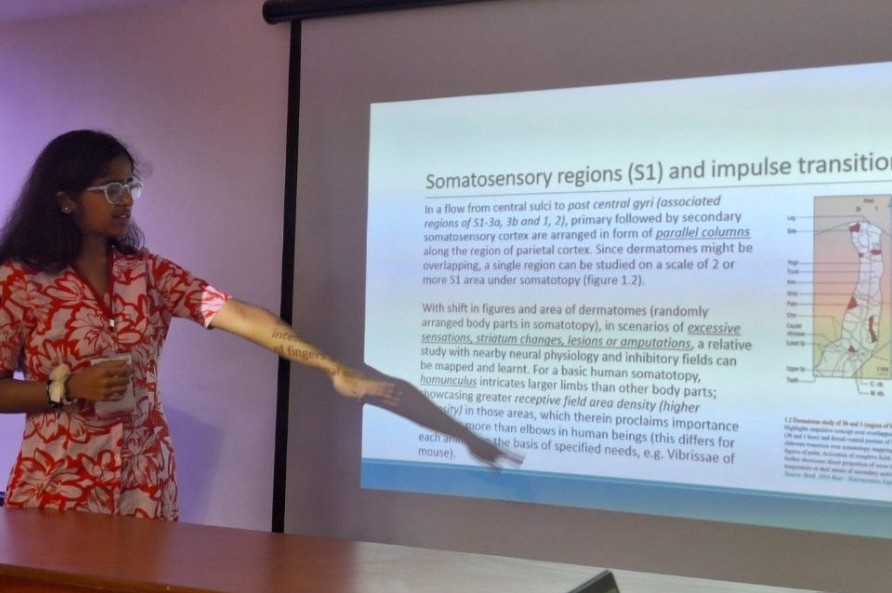
A Hillsdale College freshman was one of 131 international medical students to have her research abstract accepted by Brown University’s eighth Annual Student Neurology & Neurosurgery Research Conference. The results were announced on Nov. 27, 2025.
“It was a very mixed feeling,” said Samiksha Yadav, who intends to major in biochemistry. “I was not laughing. I wasn’t smiling. It was just a very big shock I got, and it took two weeks to recover.”
Yadav’s abstract, titled “Discipline of Neuroinformatics in Somatotopy: Diffusion Tensor Imaging in Region of Postcentral Gyri and Nerve Pathways,” was published in Brown University’s Warren Alpert Medical School’s digital repository. Normally, applicants for the conference are already Ph.D. and M.D. students. Yadav said that for her, the conference made an exception. Her abstract summarized research she had made in neuroscience.
Yadav said her earliest experience conducting research focused on cancer genetics while still attending high school in India. At 16, Yadav was already doing part-time research in university. After graduating from high school, Yadav came to Hillsdale College.
“I became the youngest researcher to get my work published at Jawaharlal Nehru University,” Yadav said.
Adding to her accomplishments, Yadav said she has been nominated twice for India’s Young Scientist Award and scored 94% on the American Chemical Society’s General Chemistry 1 exam in her first semester at Hillsdale.
Unbeknownst to her, at a conference where Yadav had the opportunity to celebrate her accomplishments in New Delhi, College President Larry Arnn was among those in attendance. When Arnn heard that Yadav wanted to become a medical professional, he encouraged her to attend Hillsdale College.
“Things happen like that,” Yadav said. “And then when I came here, my mom and I formally met President Arnn.”
Yadav said she was first exposed to neuropsychology while dual-enrolling in college classes, and she spent over a year studying neuroanatomy in preparation for the project.
“Neuroinformatics is the study of understanding the brain from the perspective of imaging,” Biology Core Lab Manager Kayari Suganuma ’25 said. “So the tensor diffusion imaging that she’s talking about, that tracks the water molecule within the brain, and it allows you to track how different components of the brain are moving.”
The brain’s white matter is comparable to a leg that sticks out and connects to other neurons, allowing for communication, Suganuma said. By mapping white matter, researchers can determine how the brain’s neurons communicate with one another.
“With the brain, you would have a region that controls movement, that controls thought process, that controls emotion,” Suganuma said. “And the study that she’s doing is specifically on sensory regions. Different receptors can process different information. But I think she’s specifically looking at how those pathways — like pain and touch sensors — are different.”
Suganuma said the brain has different components controlling different parts of the body. The somatosensory cortex focuses on sensations like touch, heat, and pain. This sensory information is processed in the somatosensory cortex, which Yadav’s study analyzes. In addition, Yadav’s use of dermatome mapping studies how each region of the brain controls different parts of the body.
Yadav said her research on genetic mutations at Jawaharlal Nehru University introduced her to radiation, and how radiation causes environmental mutations. There, she studied how midbrain regions are affected by radiation from sources like mobile phones and internet networks.
“Once I studied radiation as a mutant, I got to know about DTI, or diffusion tensor imaging,” Yadav said. “It is like a very colorful graph or map where you will see green, pink, yellow, all different strands correlate with white matter and DTI.”
Yadav said she realized that fMRI, a type of MRI brain scan that tracks the most active parts of the brain by measuring blood flow, could be correlated with DTI.
Yadav said she was nervous for the first time while presenting her work at Brown, thinking her topic was small in comparison to other medical students’ work.
“I saw a very good debate between medical students. Everyone was an elder, everyone was either MD or at least had a Ph.D., and I was a pre-med freshman,” Yadav said.
Ultimately, Yadav said she thought her presentation went well.
“I’ve always wanted to be a neurology professional,” Yadav said. “I’ve always found a keen interest in oncology and neurosystems. Cancers and nervous systems are two things I really like studying. That’s why I’m taking genetics as my subject in my second semester as a freshman.”
Freshman Marisol Saez said she befriended Yadav after living in the same hall in McIntyre together during her first semester at Hillsdale where they quickly became friends. Saez said she loves hearing Yadav talk about neuroscience.
“It’s exciting to see how much she knows about this thing that is completely foreign to me,” Saez said. “I could never do that, but hearing her talk about it brings me joy.
Saez remembers when she and Yadav first began walking to the dining hall together. She said that, while waiting for cars to pass, Yadav told her that because of India’s busy traffic, this was the first time in her life that she could safely cross the street by herself.
“I thought it was funny that she was so shocked at the idea of crossing the street here,” Saez said. “I’m just really glad to have her as a friend.”
