
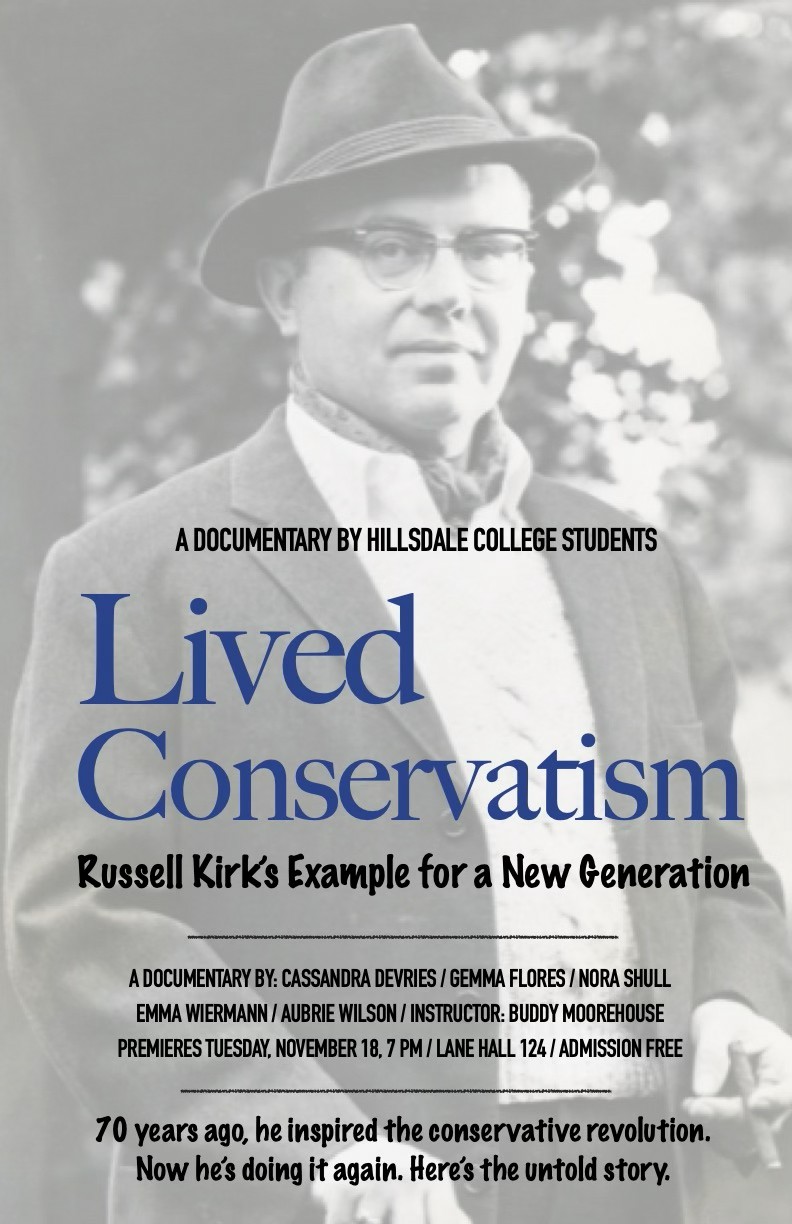
Students in the documentary filmmaking course premiered “Lived Conservatism: Russell Kirk’s Example for a New Generation” Tuesday night.
The documentary covers the life of prominent conservative thinker Russell Kirk and his affiliation with Hillsdale College. At the end of the documentary, junior Gemma Flores — the film’s narrator — revealed herself as Kirk’s granddaughter.
“It was really cool to see it all come to life,” Flores said. “It was really nice to reflect on my grandpa’s legacy, especially here at Hillsdale.”
In addition to Flores, four other students worked on the film — seniors Emma Wiermann and Cassandra DeVries, sophomore Aubrie Wilson, and freshman Nora Shull.
Kirk was a political philosopher and is often called one of the fathers of modern conservatism. His conservatism was not just political, but a moral and religious foundation that governed his way of life, according to the documentary.
The film told stories centered on Kirk’s home in Mecosta, Michigan, where he and his wife, Annette, would host visitors and guests. In some instances, Professor of Economics Ivan Pongracic pointed out, they hosted guests at their home for years, including Pongracic himself.
Pongracic and his family fled communist Yugoslavia, and found a temporary home in Piety Hill, Kirk’s Mecosta home.
“Kirk certainly practiced what he preached,” Pongracic said. “Over the course of his lifetime, he and his wife took in refugees from Vietnam, Ethiopia, unwed mothers who had nowhere else to go, and a homeless man named Clinton Wallace, who lived with the Kirk family for six years.”
Students interviewed Annette Kirk for the documentary, in which she reflected on Kirk’s legacy, values, and his love for Hillsdale College.
“Hillsdale has very much been a player in our lives,” Annette Kirk said in the film. “At Hillsdale, he saw a continuation of his philosophy. He saw students who believed in the preservation of the permanent things.”
The students came up with the title “Lived Conservatism” after hearing how his wife responded to interview questions. Kirk demonstrated what it meant to live out a conservative life, Wiermann said.
“A lot of anti-communists didn’t really know what they stood for,” Professor of History Bradley Birzer said in the film. “They knew what they hated, but they didn’t know what they stood for. Kirk was not like that.”
Kirk was not a reactionary but a conservative who articulated a positive vision of conservatism, Birzer said.
Flores encouraged young conservatives to carry on Kirk’s legacy, and live out conservative values with confidence and poise.
“Remember that doing the right thing doesn’t mean that you’ll win,” Flores said. “In fact, you’ll probably lose, but as Kirk tells us, we can’t give up hope. We, as young conservatives, must bear our crosses humbly and take up our torches courageously.”
Lecturer in Journalism Buddy Moorehouse said he chose the subject of the documentary both because Flores was in the class and because there were not yet any documentaries about Russell Kirk.
“There’s a lot of videos out there of people giving talks about him at lectures or panel discussions, but not a true documentary,” Moorehouse said. “So we figured there was a need to have the story told, and it made sense to have it be told by Hillsdale College students.”
The class also premiered the shorter film “The Long Run” by DeVries and Wilson, about Associate Professor of Economics Charles Steele and his 24-year-long tradition of running Le Grizz, a 50-mile ultramarathon.
After the showing of the documentary, Steele told the audience that anyone can be a runner, insisting that he could coach anyone in the room to run an ultramarathon.
“I guess if Dr. Steele can run 50 miles, then I can do two miles around the track,” Wilson said.
