
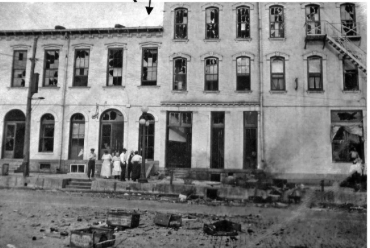
The Cascarelli fruit store after the bombing in 1923.
Courtesy | Hillsdale County Historical Society
In the early hours of June 24, 1923, a violent boom rocked the town of Hillsdale.
A bomb blew up at the back of the Cascarelli fruit store, destroying windows all along the Broad Street side of the Waldron Block, the triangular building in downtown Hillsdale.
Some alleged eyewitnesses said they saw a car speeding out of town. The June 25 Hillsdale Daily News story said others insisted Peter Cascarelli, the owner of the store, knew more than he let on, claiming they’d seen an Italian man speaking with him before the attack. That rumor sparked the most popular theory: The Italian mafia had reached small-town Hillsdale. Specifically, people suspected La Mano Nera — the Black Hand — a group from Naples known for extorting shopkeepers and active in cities like Detroit and Chicago.
According to the Hillsdale Historical Society, the sound of the explosion woke Hillsdale’s sheriff, W. H. Bates, who was at the nearby jail, which used to be on the courthouse square. The sheriff initially thought the explosion came from someone attempting to rob the First National Bank, but when he walked outside, he saw the chaos outside the Cascarelli store.
The Cascarelli fruit store was located on Broad Street, and Peter Cascarelli lived in the apartment above the store with his family. Peter, his son Joe, and his nephew Frank were upstairs when the bomb went off just below them.
Someone had hidden an explosive — likely on a timer — between cases of empty glass bottles in front of the store, according to a June 25, 1923, Hillsdale Daily News article. The blast tore holes in the stone wall, blew out the doors, cracked the back of the building, and ripped off a water pipe. Peter told the sheriff he had no idea who would target him.
Peter’s young cousin, Don Cascarelli, later shared the family’s version of the story. In his telling, the Black Hand had approached Peter for money. Peter refused, prepared to resist, and he and Joe supposedly waited in the store with rifles in case the mafia returned. But that story contradicts what Peter told the sheriff: He, Joe, and Frank had all been upstairs during the explosion, according to the historical society.
Other residents thought the Ku Klux Klan, who had built a presence in Hillsdale according to the historical society, were behind the crime.
While Italian immigrants worked to create a neighborhood in Hillsdale, the KKK’s arrival in 1923, the same year as the bombing, led to a growing fear in the community, according to the historical society. The KKK’s presence in Hillsdale prompted the pastor of College Baptist Church, W. H. Roberts, to denounce the KKK and its violence in October 1923.
Not only was the KKK thought to be behind the Cascarelli store bombing, but the group was confirmed to have held a cross-burning in the front yard of another Italian immigrant family, the LoPrestos.
The LoPrestos came to the United States around the year 1900 and ended up in Hillsdale while working on the railroad.Sam LoPresto and his family owned and operated a small store that sold fruits, vegetables, ice cream, and candy. They also owned a bar next to the family’s home on West St. Joe Street, but Sam’s wife made him close the bar after the KKK burned crosses on their front yard.
A June 26, 1923, Hillsdale Daily News article described local tensions with Italians in the aftermath of the bombing. The article said some residents were worried that if the sheriff arrested an Italian, the jail could be blown up. The sheriff said he would make arrests if he had any leads on specific people involved.
Despite all the rumors and conflicting accounts, no arrests were made in the Cascarelli case.
“Even if Mr. Cascarelli knew, he might not tell, fearing that greater vengeance might be wreaked upon him,” Bates said in a 1923 Hillsdale Daily News article.
