
Filmmaking class celebrates 180 years of Will Carleton
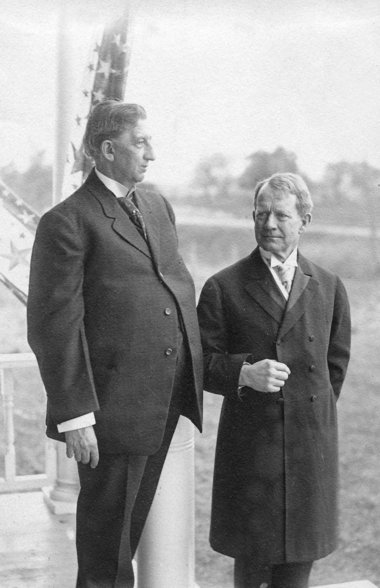
Carleton stands with former Hillsdale College President Joseph Mauck (left to right).
Courtesy | Mossey Library
For several decades, every teacher in Michigan was required to read at least one of Hillsdale alumnus Will Carleton’s poems to their students on Oct. 21. The students of the documentary filmmaking class, led by Adjunct Instructor of Documentary Journalism Buddy Moorehouse, brought that tradition back this year with a celebration of Will Carleton Day on Wednesday.
Carleton, arguably the college’s most famous alumnus, has his name on road signs, town entrances, and in the name of a charter school, but on the very campus where he studied, his story is elusive.
“Carleton was an absolute rock star in the world of poetry 150 years ago,” Moorehouse said. “Will Carleton Day used to be a huge event, both in Michigan and in Hillsdale. They had big parades and readings of his poetry and all this other stuff, and to my knowledge, nothing has ever happened at Hillsdale in the last however many decades.”
Carleton was born in Lenawee County, Michigan, in 1845 and graduated from Hillsdale College in 1869. His birthplace marker now stands near Hudson on West Carleton Road. Known for his rustic poetry and lectures, he started his own literary magazine called “Every Where.”
“Carleton wrote poetry that celebrated the everyday lives, hardships, and joys of Americans,” senior Cassandra DeVries said in her introduction of Carleton at the celebration this week. “Despite his widespread fame, Carleton never forgot his roots in Hillsdale College and even supported the college financially.”
Senior Emma Wiermann gave background to Carleton’s most famous poem, “Over the Hill to the Poor-House.”
“The poem powerfully tells the story of an elderly woman who, after a lifetime of work and caring for her family, finds herself abandoned and forced into the poor house,” Wiermann said. “It resonated in the late 19th and early 20th century as a moral appeal to recognize the dignity of older people and to emphasize the ethical duty children and families and by extension, society, have towards their elders.”
Sophomore Aubrie Wilson, freshman Nora Shull, and junior Gemma Flores then took turns reading sections of the poem aloud.
Moorehouse said Carleton’s poems are not like reading 16th-century English poetry, but are rather “common sense, homespun, and just wonderful.”
“He wasn’t just an incredible poet — he was a remarkable person, and he was Hillsdale’s own,” Moorehouse said.
Every year, the students of the filmmaking class create a short documentary of Carleton. When Olivia Hajicek ’24 took the class as a student, she researched Carleton’s lesser-known sequels to “Over the Hill to the Poor-House” and “Betsey and I Are Out,” another one of Carleton’s famous works that describes a husband and wife deciding on a divorce.
“The sequels change the endings. In ‘Over the Hill From the Poor-House,’ one of the woman’s children comes from across the country to bring her home, and in ‘How Betsey and I Made Up,’ the husband and wife are reconciled and fall in love with each other again,” Hajicek said. “The sequels give us a more complete picture of Will Carleton. He had compassion for the struggles of ordinary people, but he also filled his poems with hope and even redemption. I think that alone makes him worth reading 180 years later.”
Hajicek said she is inspired by Carleton’s care for ordinary people.
“He went on to become famous, but he was always humble and never forgot where he came from,” Hajicek said. “Also, his poems are beautiful and wholesome — the kind of thing I would want to read to my own children someday.”
Professor Emeritus of English Michael Jordan said some magazine editors thought Carleton was uneducated because he used dialect in his poetry.
“One editor actually tossed Carleton’s poems into the trash can, not realizing that Carleton was practicing a form of realism in accurately reflecting the way his rural characters spoke,” Jordan said in an email. “In ‘Over the Hill to the Poor-House,’ the old lady who speaks drops her g’s in all her gerunds. She even tells us she has not had an ‘edication,’ and then shows us by using this imaginative figurative expression: ‘I never swallowed a grammar, nor ’et a ’rithmetic.’
Carleton allegedly roomed in Jordan’s house on Fayette Street, built in 1848, as a Hillsdale student.
“The family that owned our house for about 90 years told us that the plaster wall in Carelton’s bedroom upstairs, now covered with old wallpaper, once had some of his verse written on it,” Jordan said.
A year before he died, Carleton read his poems at the Howell Opera House, the center of activity in the town of Howell in the 1800s and early 1900s, according to Moorehouse.
“He delighted the audience for two hours with the history, interpretation and recital of his various productions published and unpublished,” wrote a review published in the Livingston County Press in Howell after the talk. “Will Carleton, unlike most authors, has the faculty of making his own productions interesting. Come again.”
“I like to think that Will Carleton, wherever he is, is looking down, very happy that some students at his college, 180 years after he was born, decided to read one of his poems on the campus where he went to school,” Moorehouse said. “This was a very small and humble celebration, just like Will Carleton was a humble and wonderful person, but I think we made him proud.”
