
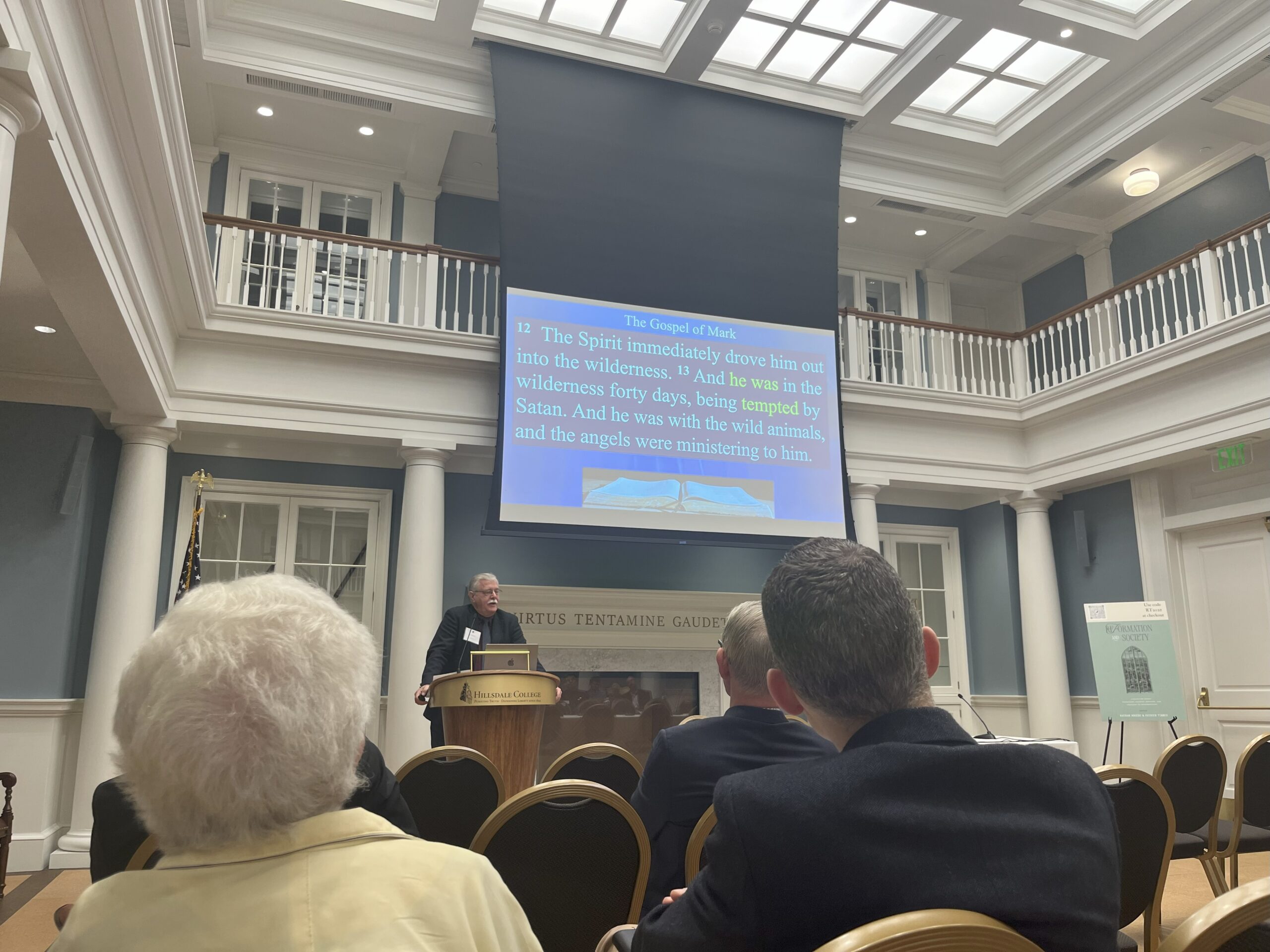
After centuries of division, most of the global Christian Church still holds to the 1,700-year-old Nicene Creed, said Jerry Timmis, president of stewardship at Westminster Seminary and father of Assistant Professor of English Patrick Timmis and at a Sept. 26-27 symposium on the Reformation and Nicene Creed.
The Westminster Theological Seminary and the Hillsdale College English, history, and theology and philosophy departments hosted the symposium to honor the Council of Nicea. Fifteen speakers presented papers on topics related to Trinitarian theology and Christology in the Nicene Creed, sacred Scripture, and the Christian Reformation.
“We are here for an auspicious celebration of a 1,700th anniversary of a creed and a confession that has stood the test of time in ways that most haven’t,” Jerry Timmis said. “Over the course of the fourth century, Christian leaders came together to define what it is that the Church believed clearly in the face of mostly Christological heresy and fortified what it is that we believe. It is still, even after the Reformation, for the church in the West and mostly even the global Christian Church, what we hold true and believe.”
The first day of the symposium was titled “Reformation and Society,” and the second day was “Reformation and Tradition.”
Among the speakers were Professor of Theology Mickey Mattox, Assistant Professor of Theology Don Westblade, Associate Professor of Theology Cody Strecker, Associate Professor of History Matthew Gaetano, Visiting Assistant Professor of Classics Joshua Benjamins, Assistant Professor of English Patrick Timmis, and Associate Professor of Music Derek Stauff all presented papers at the symposium. There were also professors from Westminster Theological Seminary, the University of Cambridge, the University of Notre Dame, and Calvin University.
This was the second symposium held by the college and the seminary after last year’s symposium, also titled “Reformation and Society.” These symposiums were meant to be alternative platforms for academics to present papers and research on 16th-century theology, according to Mattox.
“It’s almost impossible to get your work published in the journals of these professional organizations because they don’t want to publish theology,” Mattox said. “So when we talked about this, a few friends and I, we thought, ‘Well, we need to start some kind of alternative thing.’ And we came up with the idea of having a Hillsdale conference of some kind.”
Alumna Stella Webster ’24 said she found early Christology and Trinitarian theology fascinating.
“Random theological controversies that don’t have super high stakes are more fun to think about because there’s less human conflict and suffering involved,” Webster said.
Westminster Seminary Press will publish all this year’s papers in the second volume of the seminary’s book “Reformation and Society” next year, according to Timmis.
