
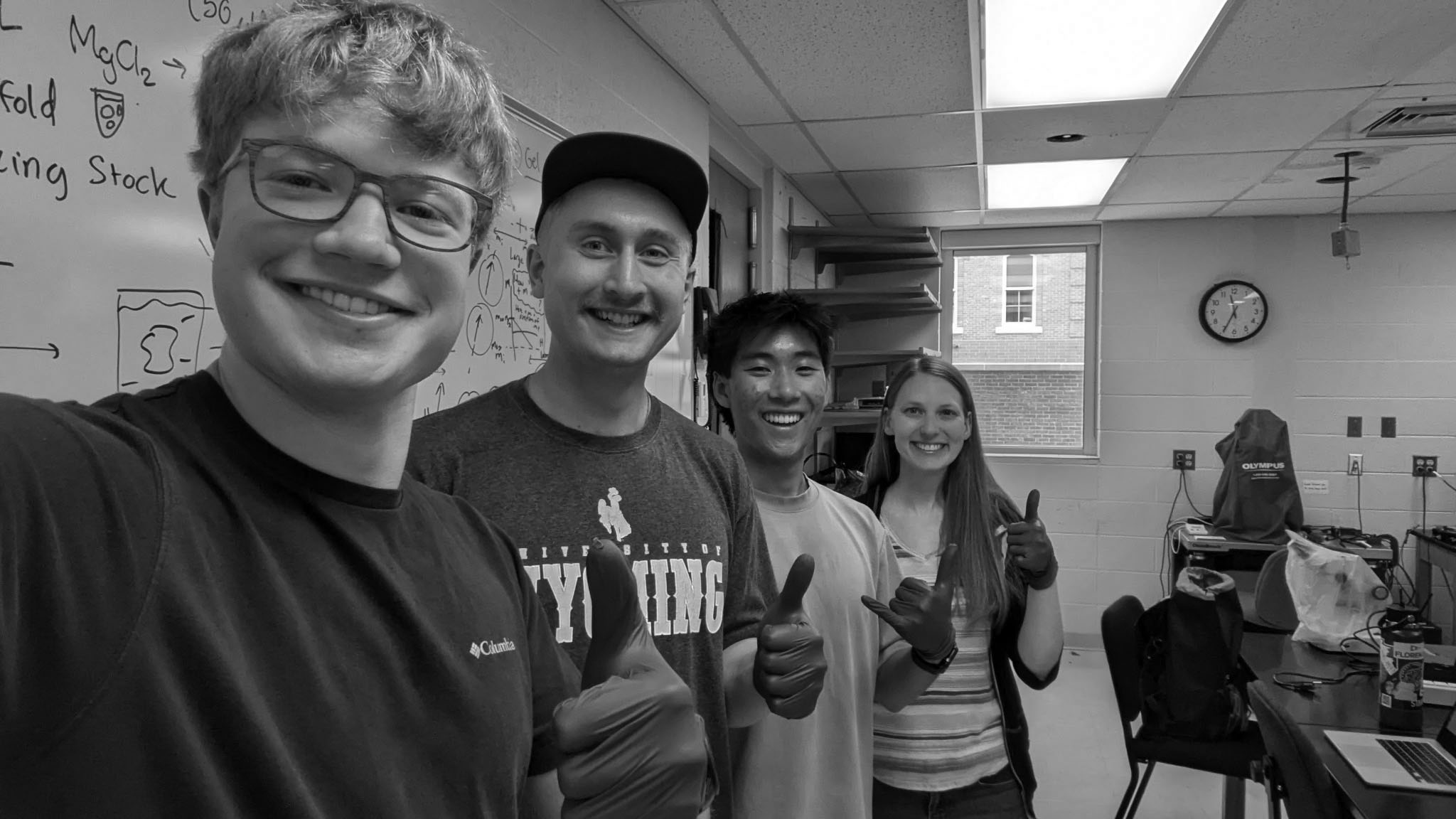
Three students researched DNA nanotechnology and magnetism last summer with Assistant Professor of Physics Stephanie Lauback.
Senior Michael Bogumill, sophomore Thatcher Debowski, and sophomore Daniel Lo presented their work Sept. 18. Their research opportunity was part of the LAUREATES program, a paid, six-week internship, to which any Hillsdale student majoring in a STEM field can apply.
Lauback said she and the students studied how to use magnetic fields to operate DNA nanomachines. Scientists build these structures, which are often a mere 10 to 50 nanometers long, to serve various functions in the body.
A strand of hair is generally about a tenth of a millimeter thick, Lauback said. Nanometers, meanwhile, are a millionth of a millimeter, or 100,000 times smaller than the diameter of a strand of hair.
The implications for DNA nanomachines include targeted drug delivery, where a nanomachine would transport a drug through the body until it encountered a specific type of cell, such as a cancerous cell, and then release it, according to Lauback.
This could be especially useful in the treatment of superbacteria, which are bacteria that have built up a resistance to antibiotics.
Nanomachines are already found naturally inside the body in the form of proteins, according to Lauback. These natural nanomachines are just three to six nanometers long.
“You have millions of little, tiny nanomachines operating, keeping your cells alive all day long,” Lauback said. “They’ve been working very hard today; that’s why you’re tired at the end of the day.”
The nanomachines Lauback and the students used were made of DNA rather than proteins, because there are only four base pairs in DNA, making it much easier to program and engineer the structures to form.
“There are people working on making these same structures using amino acids and proteins,” Lauback said. “But no one is close to being able to figure out how to do it.”
Their research studied two different types of magnetic beads, MyOne Dynabeads and PrecisionMRX Nanoparticles. The beads respond to magnetic fields because they have an iron core.
When the beads are connected to the DNA nanomachines, the magnetic fields can be used to turn the beads into “magnetic tweezers,” which can move the DNA nanomachines around with a precision of one or two nanometers, Lauback said.
Debowski said he and his fellow students studied both types of beads.
“Michael and Daniel focused more on the analysis of the Dynabeads data, while I was doing a lot of experimental work, trying to understand how these Nanoparticles behave,” Debowski said.
The Nanoparticles’ advantage lies in their being a thousand times smaller than the MyOne Dynabeads, operating on the nanometer scale rather than the micrometer scale. This makes them much simpler to connect to the DNA nanomachines. Although the concept is exciting, the work can often be tedious, according to Lauback.
“When I started doing this work, no one had nano-sized beads that would be a strong enough magnet to respond to the really weak magnetic fields we were applying,” Lauback said.
When recounting his proudest day of research, Bogumill remembered the pain of watching an experiment for hours only to have it fail just before completion.
“At one point we had an experiment where we were three videos away from completing the whole thing [before it got stuck], and so that was a bummer. But then the next day, we had an experiment that went all the way through. We had maybe two experiments that went through that day. And that was a very happy day,” Bogumill said.
Lo said they took turns working in shifts of several hours at a time.
“You literally just sit there and watch the beads rotate and take videos,” Lo said. “All day, we set a computer and just let it run. Whenever it would run successfully, which is every couple of days, it was very satisfying.”
Lo said that, although he had little previous experience with coding, part of his job was developing a computer program that would review hundreds of videos and accurately track the movement of the beads.
“We understand visually, if the bead moves, it moves, and that’s the flip, but the computer just sees ones and zeros,” Lo said.
Lo said he and Lauback spent hours discussing how to write a program from the computer’s point of view.
“I’m using what I learned a lot this semester, so I’m very grateful for that,” Lo said.
While Bogumill will continue to analyze the data he and his fellow interns gathered this summer, all three students said they enjoyed their experience and were grateful for the opportunity.
“Just to get an idea of the massive scale of what’s going on in the nano-scale world is pretty incredible,” Debowski said.
