
An old landfill has been seeping “forever chemicals” into the City of Hillsdale’s groundwater since the early 1970s, according to the Michigan Department of Environment, Great Lakes, and Energy.
The contamination was discovered three years ago when a resident’s water tested positive, according to EGLE. Since then, the state has identified one other city resident whose water tested above safe levels for perfluoroalkyl and polyfluoroalkyl substances, or PFAS.
State officials put the landfill, named Lucas Landfill, on its official watch list in May 2025. But the state is still investigating how these toxic chemicals have affected residents’ drinking water and the local environment.
PFAS are a group of man-made chemicals that are found in manufacturing waste, firefighting foam, food packaging, and more, which can be dumped into the environment by industrial companies. The chemicals are called “forever chemicals” because they are difficult to remove from the environment and don’t decompose. If ingested by humans, PFAS can decrease fertility, cause developmental delays, and increase cancer risk, according to the Environmental Protection Agency, although the EPA says more research is needed.
Clay Joupperi, Jackson district geologist and Lucas Landfill site lead at EGLE, said EGLE first identified Hillsdale as an area of concern when a resident self-tested their water and found positive results. Over the next few years, Joupperi said, more state tests identified the source of the PFAS as an old landfill.
Although EGLE knows the contamination is coming from the landfill area, Joupperi said tests could not demonstrate exactly what type of material is excreting PFAS into the ground.
“We really don’t have good records of what was dumped there or who dumped trash there, but obviously, there’s some contamination there that was not properly handled,” Joupperi said.
The property of the former landfill, named Lucas Landfill, is now privately owned at 2200 Mauck Road, just one mile northeast of Hayden Park. Lucas Landfill was in operation from 1972 to 1983, until it was shut down due to poor environmental practices, according to Joupperi.
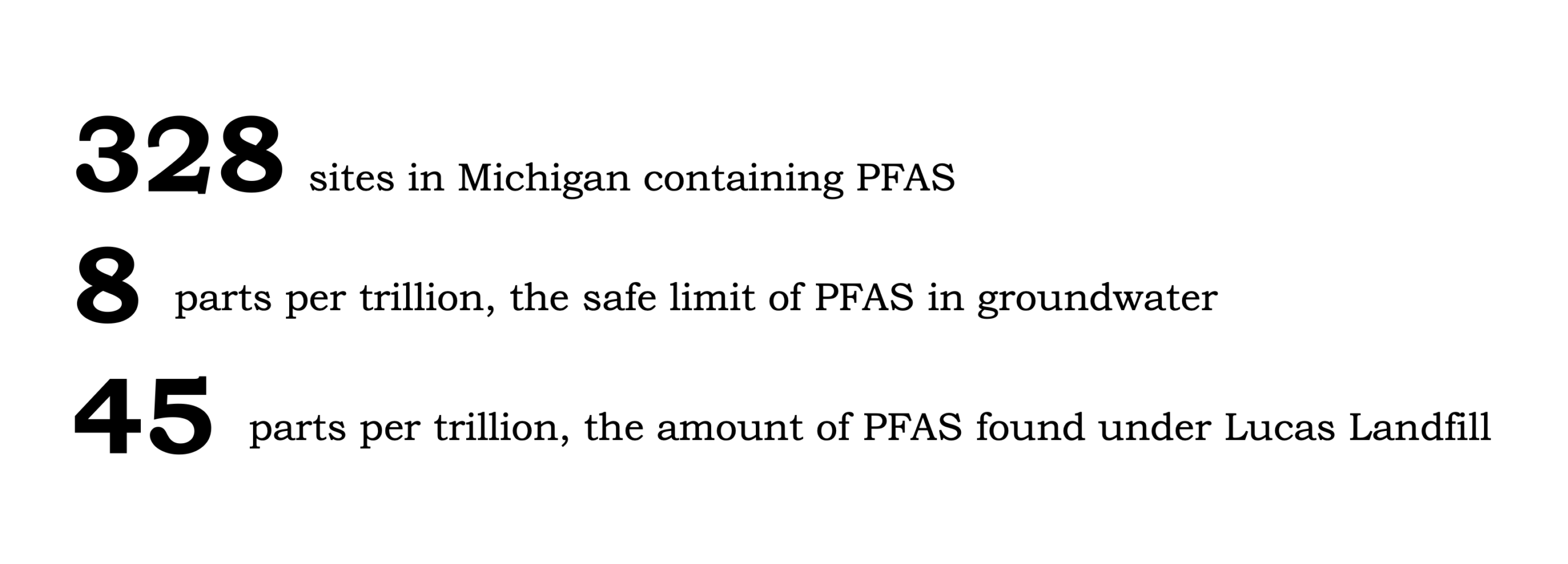
Between 2022 and 2024, EGLE tests at the landfill site reported PFAS concentrations in the groundwater beneath the landfill exceeding safe levels. They found the water contained 45 units of PFOA, a specific type of PFAS, for every trillion units of water, or 45 parts per trillion. This is well above the safety criteria of 8 parts per trillion set by EGLE.
But EGLE only found two nearby homes whose drinking water tested above safety standards, despite testing many wells in the area. The state provided the residents who tested above safety levels with bottled water.
Joupperi said the groundwater is not affecting many homes because the subterranean water appears to be flowing north-northwest, away from the highest concentrations of people.
However, Joupperi said the team still has a lot to learn about the exact location of the groundwater.
“We want to ensure that we know where this plume is, where it’s going, and where we could find safe water for these houses — that’s the ultimate goal,” Joupperi said.
Hillsdale’s municipal water tested negative for all types of PFAS in 2024.
But compared to drinking water wells, the contamination of local streams and rivers is more concerning to Geoff Rhodes, a toxicologist at the Water Resources Division at EGLE. Rhodes said EGLE has not yet completed surface water tests around the landfill, so the landfill could be affecting local fish and wildlife populations.
“We don’t have any surface water data for this PFAS site,” Rhodes said. “The data we do have for the Hillsdale area is relatively low, but given this new PFAS site, that’s something we need to go back and revisit.”
Two Hillsdale College staff members own property close to the former landfill.
Calvin Stockdale, senior director of institutional advancement, lives two properties down from the former landfill. He was not informed of the contamination site while purchasing the property. Soon after, he was told that he lives near a toxic location and would need to have his water tested every year.
“The week after we took possession of the property, we had a knock at the front door,” Stockdale said. “We were working on stuff, and they said, ‘Yeah, I’m here from the state EPA, and I don’t know if you know this, but there’s a contamination thing in your area, and we want to test your water.’”
Stockdale’s water sample tested positive for PFAS but below the level of concern. Stockdale said that although the state isn’t worried about this amount, he wants to take precautions through water filters.
“Our family put in a water softener and a reverse osmosis filter, and those both help to reduce contaminants in the water, especially the reverse osmosis filter for drinking water,” Stockdale said.
David Diener, assistant professor of education, owns property south of the landfill, but his water always tested below safety criteria for PFAS.
While he does not think the situation is ideal, Diener said people take risks all the time for what they love.
“We live in an age in which we’re surrounded by toxins and contaminants,” Diener said. “So I wouldn’t change anything about living here. If I had known that there was this problem before purchasing the home, I still would have purchased it. We love where we live and are happy to live in the country. If we lived in a city, we would have more air pollution issues.”
The owner of the former landfill property could not be reached by The Collegian for comment.
The Lucas Landfill site is one of 328 PFAS-containing sites in the state of Michigan. Rhodes said St. Clair County has the highest concentration of PFOA, the most dangerous type of PFAS to humans. Although some manufacturing plants are beginning to use effective filters for their wastewater in Michigan, Rhodes said it is still extremely difficult to remove existing PFAS from the environment.
“Even the best source reduction efforts can’t entirely clean up a watershed,” Rhodes said. “Once it’s in the environment, it’s very hard to get out of the soil. It is just going to take quite a lot of time.”
EGLE will continue to report on PFAS levels in the area and increase the number of samples in the surrounding water, Joupperi said. The updated data for PFAS sampling and a map of all testing locations are available at Michigan PFAS Action Response Team’s website under “PFAS Sites.”
Send tips to the City News team: collegiancitynews@gmail.com
