
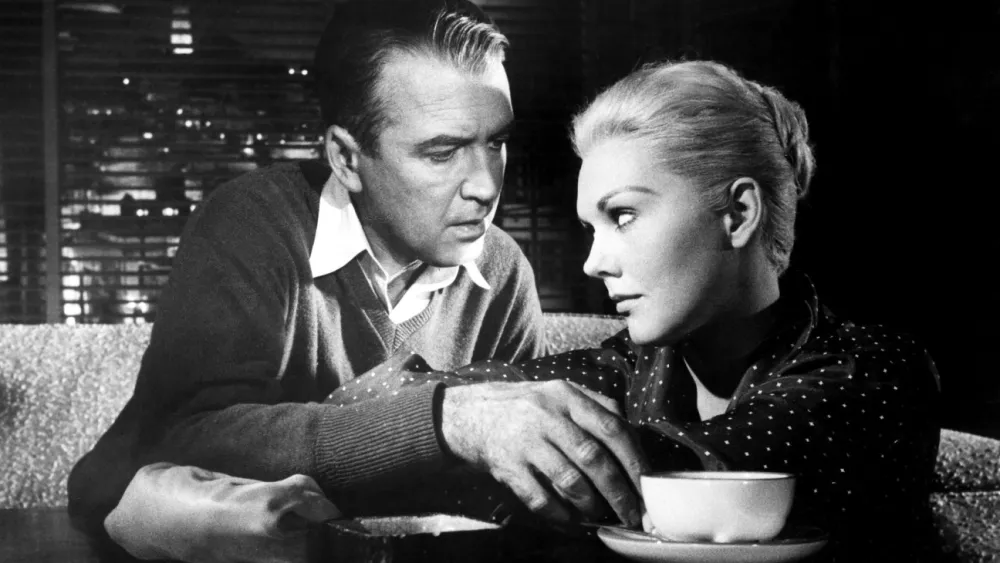
James Stewart and Kim Novak in Alfred Hitchcock’s “Vertigo” (1958). Courtesy | Everett Collection
When I was growing up, Halloween meant free Snickers bars, jack-o’-lantern carving, and a neighborhood costume contest. But it also evoked images of birds crashing into a glass telephone box, Cary Grant fleeing a crop duster through a cornfield, and one uncanny line: “A boy’s best friend is his mother.”
Filmmaker Alfred Hitchcock shaped my artistic taste. I remember sitting on the floor in my pilgrim Halloween costume when I was 9, just home from trick-or-treating, and watching “Vertigo” for the first time. The image of Jimmy Stewart’s face when he sees his love interest fall to her death is seared into my brain. From that moment, I tried to check off every movie in the Hitchcock canon. My brothers and I even ventured into “Alfred Hitchcock Presents,” a series of quirky television-length films from the late 1950s.
If you’re looking for a movie to watch with friends this Halloween, try the master of suspense.
The highest-grossing of Hitchcock’s work, the 1960 film “Psycho,” is the artist at his best. Probably the most parodied film in the horror genre, the movie inspired sequels and prequels, a TV movie, and a scene-by-scene remake in 1998. But just like “Rocky” and “Jurassic Park,” the original is the only one worth your time.
Based on the 1959 Robert Bloch novel of the same name, the film follows an encounter between Marion Crane (Janet Leigh) and motel proprietor Norman Bates (Anthony Perkins), who has an unusual relationship with his mother. Crane checks into the Bates Motel, but she doesn’t leave alive.
The film — like all of Hitchcock’s work — succeeds because the creator understands the psychology of suspense.
“I believe in putting the horror in the mind of the audience, and not necessarily on the screen,” Hitchcock told the BBC in a 1964 interview.
Mimetic rivalries and Oedipus complexes give an intellectual depth to the “Psycho” script that would make any Girardian or psychoanalyst proud. It’s the kind of movie that will live in your brain hours and days after the credits roll.
On an artistic level, Hitchcock’s form communicates his meaning. Rather than shocking his audience with gory body parts or child-eating animatronic teddy bears, he plays subtle games with the unseen.
Closely cropped cinematography limits the audience’s knowledge to the scope of the camera. Sparse dialogue and black-and-white film build the feeling of isolation. Slowly, the master peels back the layers.
Mother remains off screen until the final moments of “Psycho.” Viewers only hear her voice as she argues with Norman from the house, building questions around her motive for the murderous sprees.
The iconic shower scene of “Psycho” is case in point.
As the killer approaches to stab Crane, the camera sees the dark figure through the shower curtain before she does. All the audience can do is yell at her to turn around.
Like a rollercoaster operator, Hitchcock builds an impending, unknown threat to a climax just enough to thrill his audience but pulls back before the cart veers off the tracks. The close-up shot of Crane’s horrified face is all Hitchcock needs to make his audience scream.
Anything that happens in a Hitchcock movie could happen in real life. Most of us don’t look over our shoulders for creepy clowns offering red balloons, but you’ll probably lock your bathroom door after watching “Psycho.”
If you want to watch your friends scream at a 60-year-old movie next weekend — or if you just want to know how many cultural references you’ve been missing out on all these years — pull up a Hitchcock film. I welcome you to the world of my childhood trauma.
Moira Gleason is a senior studying English.
