
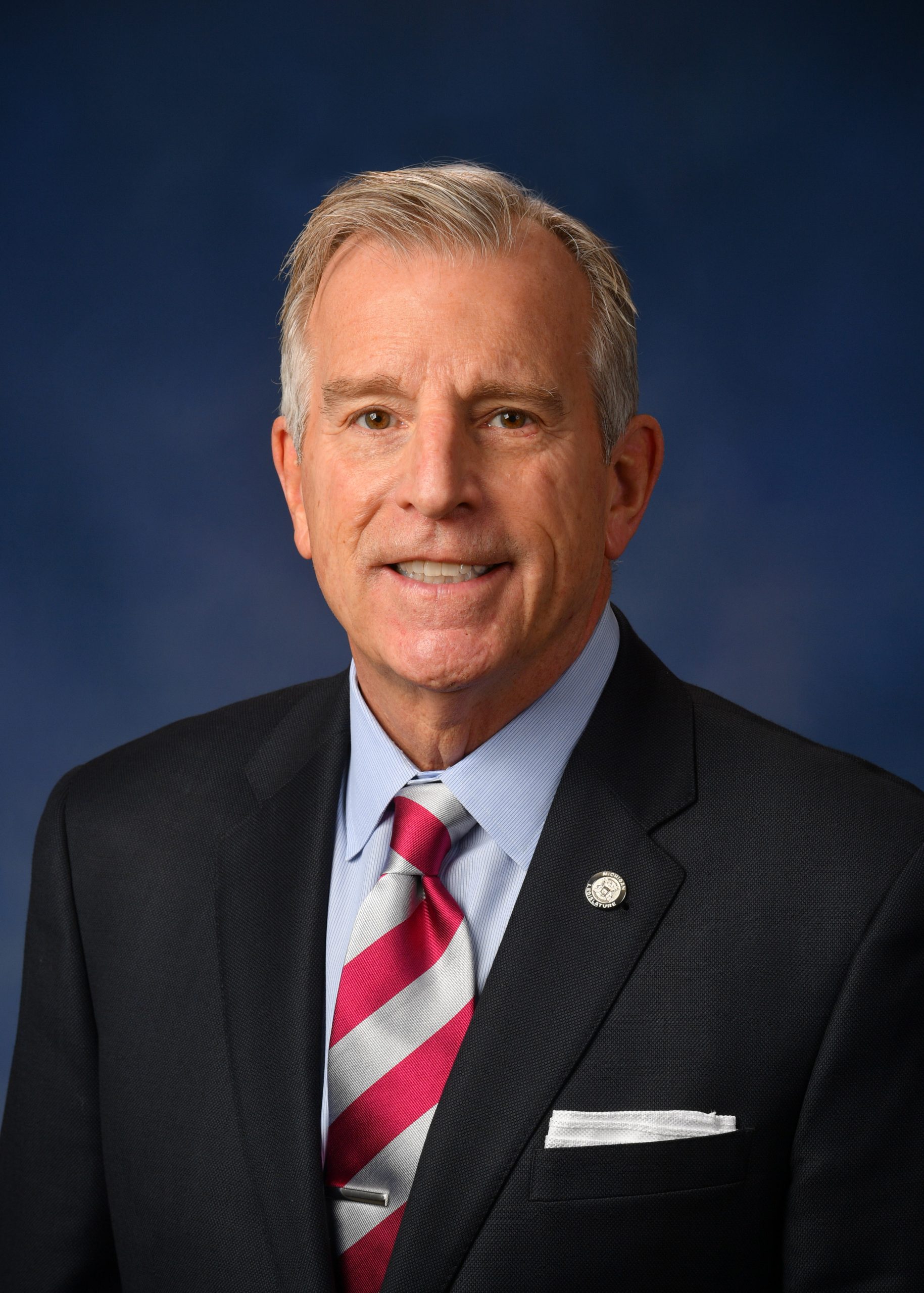
Rep. Mark Tisdel. Courtesy | Michigan House Republicans Website
As Lansing lawmakers debate smartphone use among K-12 students, Ted Davis, the superintendent of Hillsdale Community Schools, said he would “strongly support” additional restrictions at the state level.
“Every student in our district has access to a Chromebook, which provides all the tools they need for learning while also ensuring a safer, more controlled online environment through district internet filters,” Davis said in an email. “This setup allows us to meet students’ educational technology needs without the risks that come with unrestricted smartphone access.”
Rep. Mark Tisdel, a Republican who represents Rochester, introduced House Bill 4141 on Feb. 26. This was his second attempt to pass legislation that would limit students’ use of cellphones in classrooms.
The bill would prohibit smartphones in K-12 instruction time unless the teacher allows them for specific assignments, according to Tisdel.
“The internet is the world’s single greatest entertainment medium, and it’s very difficult for teachers to compete,” Tisdel said. “If you do have that kind of distraction, even just an app notification going off, research shows that it can take five to 15 minutes for a student to recollect their attention back on the lesson that’s being presented in front of them.”
Davis said one of the most concerning issues with smartphones is their connection to social media.
“We see a clear link between social media use and discipline problems in our schools,” he said. “Reducing student access to smartphones during the school day would not only minimize distractions but also create a healthier, more focused learning environment.”
The bill would prohibit students in K-6th grade from taking out their phones for the entire day because they are not changing classes, Tisdel said. Students in 7th-12th grade could use their phones in the hallway, while changing classes, as long as they are not taking out their phones during instruction time.
In Gov. Gretchen Whitmer’s 2025 State of the State address, she called for bipartisan collaboration to limit phones in classrooms. Despite this, no Democrats voted for the bill.
“This defeat had nothing to do with the merits of the bill,” Tisdel said in a July 28 press release. “We tried working with Democrat lawmakers, made changes to accommodate their concerns, even used language provided by the governor’s office. We had an agreement with the governor and Senate Democrats, but the House Democrats decided to play games and vote no.”
Republican Rep. Jim DeSana, who was absent during the vote, said a statewide ban on cellphone use is not necessary because every school already has the power to limit students’ use of electronic devices.
“Every time we pass a law in Michigan, there’s costs associated with that,” said DeSana, who represents portions of Monroe and Wayne counties. “I’ve heard upwards of $400,000 to $500,000 for every law we passed through, instituting, changing, publishing, recording, all that stuff. We don’t need more laws. We need less laws, and we just need to enforce the laws we have.”
Although DeSana agreed that students should not use electronic devices in schools, he said the bill would be an unnecessary law.
“We have way too many mandates in government, and another mandate, albeit maybe something good — we’re trying to create something good in the schools, but we’re doing it from a centralized location, a state government,” DeSana said. “And, whenever you follow that route, it tends to be a one-size-fits-all approach, and I just don’t think the state should be telling a school what to do. I’m even against the state telling a local school district anything. I think we should abolish the State Department of Education.”
Rep. Jennifer Wortz, a Republican who represents Hillsdale and Branch counties and part of Lenawee County, voted in favor of the bill and said she has “mixed feelings” about the legislation.
“Schools have the capabilities, and they’re required under the law already, to have a cellphone policy,” Wortz said. “Unfortunately, it’s a situation where a lot of superintendents and principals have told us, ‘It’d be really nice if you just ban them at the state level, it would make our job easier.’”
Wortz said superintendents see the bill as a “safety net.”
“When you’re the superintendent of the district, it kind of falls on you and your school board to make those decisions,” Wortz said. “And if they’re not popular, then you take a lot of heat, whereas if that decision is made at the state level, and well, the state made that decision.”
If parents acted like parents and school boards and administrators worked locally to craft cellphone policies, then legislation at the state level would not be required, according to Wortz.
“Parents need to step up and be parents, and staff rely on the government to enforce rules that they should be enforcing as parents,” Wortz said.
Assistant Professor of Education David Diener said classrooms are “sacred spaces” in which teachers and students together pursue the activities of learning and lives of wisdom and virtue.
“From practical issues like distractions and inappropriate content to more theoretical issues like the brain’s neurological development and the very nature of teaching and learning, student cellphones bring a host of unnecessary problems into the classroom while providing zero net educational benefit,” Diener said.
During Diener’s time as headmaster at classical Christian schools, he said students were not permitted to use cellphones during the school day.
“As a professor at Hillsdale College, I am grateful that students recognize the importance of being fully present in class and focusing on the noble task of learning together,” Diener said.
Send tips to the City News team: collegiancitynews@gmail.com
