
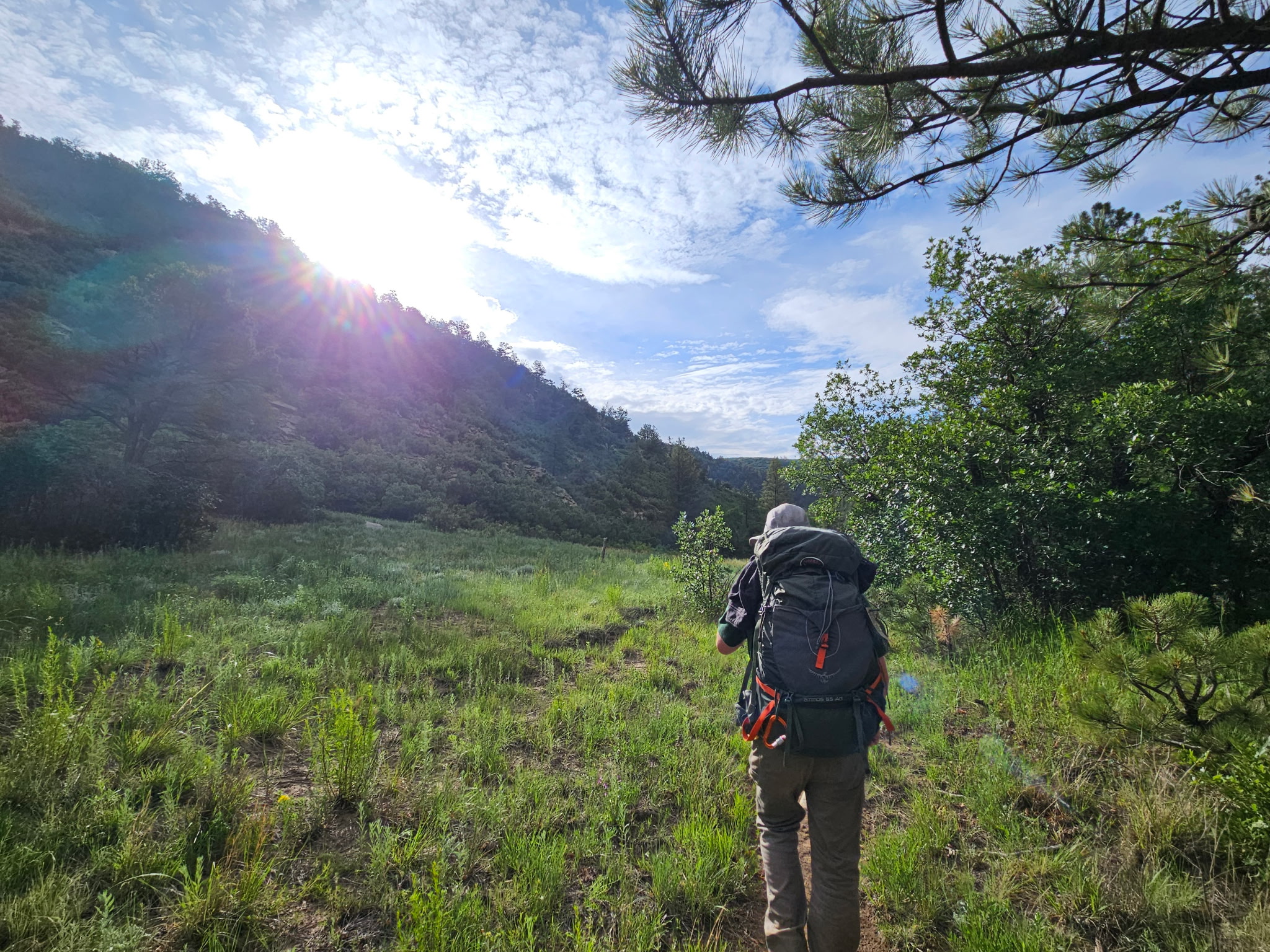
Enman hikes through the backcountry of New Mexico in full gear.
Courtesy | August Enman
Hours away from civilization, sophomore August Enman spent his summer in the rugged and mountainous backcountry of New Mexico.
Enman worked as a counselor at Philmont Scout Ranch, the world’s largest youth camp, which spans 140,177 acres of mountainous terrain. His particular campsite, Whiteman Vega, was the northernmost camp at Philmont, located in the Carson National Forest. Whiteman Vega is one of around 35 staffed campsites that offer lodging and programming for visitors.
New groups of mountain bikers passed through the campsite every day. As a counselor, Enman took them on bike rides through the backcountry. Because Enman’s camp was far away from the ranch’s home base, most people stopped at Whiteman Vega while on 12-day treks.
Enman’s job also included preparing trails for bikers to ride on, which took hours of physical labor.
“Trail maintenance was the most physically demanding part of my job,” Enman said. “We chopped a lot of trees, moved boulders, raked the trail, repaired holes, and moved fallen trees off the trail whenever there was a storm.”
Camp Director Thomas Frazier, Enman’s supervisor, said the trails that Enman helped repair had fallen into disrepair in recent years.Whiteman Vega had been closed for approximately five years until this summer, making maintenance on the trails incredibly time-consuming.
Enman and his colleagues helped conserve the bike trail near the ranch and did stream restoration for McCrystal Creek, a stream that flows adjacent to Whiteman Vega. The U.S. Forest Service allows the ranch to use the land in exchange for these conservation efforts.
“Over 750 Scouts and advisors were able to enjoy all that the Whiteman flow trail has to offer,” Frazier said. “August did four miles of raking and helped with the reconstruction of multiple beams. Six fallen trees and countless overgrown scrub oaks were all removed from the trail in part due to August’s efforts.”
Frazier said Enman had a “work hard, play hard” mentality all summer, even while performing difficult physical labor.
“He would go out of his way to get the physically demanding chores done that nobody would want to do, often without being told,” Frazier said. “His engagement with the Scouts was above reproach. He had a special way of being able to connect with each Scout ensuring no one felt left out in both his individual interactions and leading group rides.”
Enman said his work at the camp was difficult but rewarding.
“The biggest thing I learned was the importance of taking initiative,” Enman said. “Things started working so much better when everyone started getting things done rather than waiting for someone to ask us to do it.”
Since Whiteman Vega was one of the most remote camps in the area, counselors had to communicate with family and friends through mail. Enman said he had a hard time adjusting to life without cell service.
“Contact with anyone outside of the camp was almost impossible,” Enman said. “It was really hard to keep up with my family and keep up with world events. There’s isolation that comes with being in such a connected world and not having that anymore.”
Enman said his time at the camp was fulfilling and he plans to return to the same location next year to do the same job.
Enman said his favorite part of the job was helping campers have enjoyable experiences on the trails.
“A lot of them had never mountain biked before,” Enman said. “You get to introduce them to the hobby in such a cool way. I mean, it’s the mountains of New Mexico. They’re beginner trails, so they’re very safe.”
When they weren’t taking bikers on rides and doing maintenance, counselors at Enman’s location completed daily chores like fetching water from the well, making breakfast, and cleaning up around the campsite.
“I’d wake up a little before eight in the yurt, which was our common area,” Enman said. “I’d get my daily chores out of the way.”
One of Enman’s coworkers, Aidan Lutrell, said part of the job included handling unexpected emergencies, including bicycle crashes.
“The hardest part of our job was dealing with injuries when participants would crash and get hurt,” Lutrell said. “We would have to perform first aid on them in the backcountry, hours away from the nearest city or cell service.”
As he settles back into campus life, Enman said the values he learned — hard work, leadership, and dedication — will stick with him beyond the trail.
“I really lived in the present,” Enman said. “I was able to get eight hours of sleep every night, read my Bible more, and do things that I wouldn’t normally do when I have access to the internet.”
