
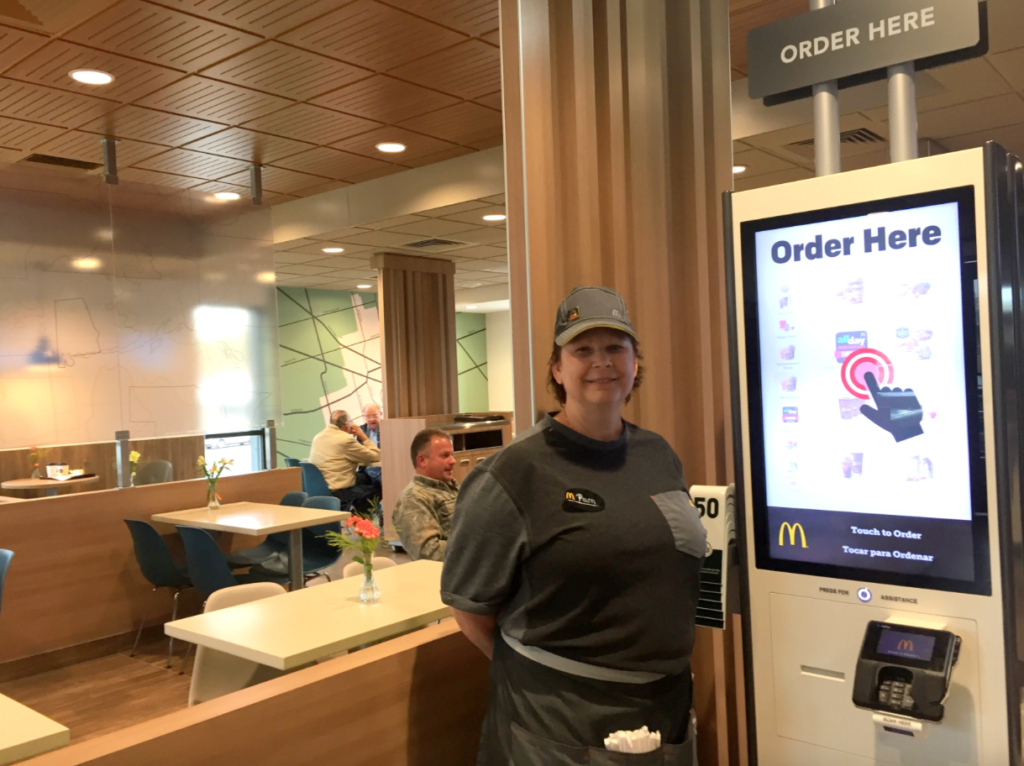
McDonald’s employee Pam Allion stands by the new self-service kiosk to assist customers.
Nicole Ault | Collegian
McDonald’s has spread American values around the world, said Charles Steele, associate professor of economics, as he described his experiences traveling and eating fast food from France to China on Sept. 11.
After shaking a carton of fresh McDonald’s fries onto a paper plate for the audience at the Classical Liberal Organization club to pass around, Steele began his talk, titled “McDonald’s: America’s Greatest Cultural Export,” by acknowledging the anniversary of 9/11.
America was attacked, he said, for its most fundamental cultural values and traditions, for the things that define America’s nature
“What is America’s nature? I’m going to talk about a set of ideas that I developed over decades, countries and continents through teaching at all these places,” Steele said. “I teach history through the history of economics, and I’m going to teach something about this American nature through the history of me traveling around the world and eating at McDonald’s.”
Steele said that he first noticed the appeal of McDonald’s while studying French in Paris in 1991.
“French young people, many of whom seem to hate the United States, are lined up at McDonald’s, trying to get food there,” Steele said. “I think that’s pretty interesting.”
McDonald’s, the iconic American burger restaurant, operates more than 36,000 restaurants across 100 countries, according to the company website.
It was at one of these locations that this seed of an idea — that the burger franchise might be inadvertently, but happily, spreading American values — grew eight years later in 1999 when Steele started teaching economics at China Agricultural University in Beijing. After a long day of sightseeing, Steele’s students took him to the only restaurant that had reliably safe food and clean restrooms: McDonald’s.
He described sitting down and looking at the people sitting down to eat, grandparents with their kids and grandchildren.
“I want you to think about what these people have actually seen in their lives,” Steele said. “They lived through the Cultural Revolution. These people went through that and now they’re living in the fastest growing economy in the world, and they’re buying American food for their grandchildren that has been produced by capitalism.”
Steele said he was incredibly frustrated that he couldn’t speak enough Chinese to go talk with these diners and ask about their experience coming to eat at McDonald’s.
“They went from pure communism to capitalism,” Steele said. “Knowing what these people have seen, I looked around and thought ‘I’m seeing a miracle.’”
A year later, in Ukraine, he said he saw the same attraction that a deeply different culture had to the American franchise.
The French McDonald’s served beer, and in Ukraine, safe food and clean bathrooms were easy to find. Even without those selling points, Steele said, the restaurant in Kyiv was still incredibly popular because it offered a distinctly American experience.
“It’s not the food, it’s something about the experience,” Steele said. “McDonald’s offers fun. And I started thinking that’s something that maybe is uniquely American. P. J. O’Rourke was an American humorist, and he said one thing uniquely American is fun. Other people, other cultures, have amusement, entertainment, things like that. But the concept of fun, the way Americans have it, is just something different.”
Steele honed in on the business strategy of McDonald’s that makes it uniquely successful once he finished showing the evolution of his thesis through the big-picture overview of the intersection between fast food and culture around the world.
Prospective franchise owners must go through extensive training, both in local restaurants and at “Hamburger University,” the McDonald’s-owned business management school, to create the best possible product, Steele said.
This applies to the rest of the workers, such as grumpy teenagers working their first job who learn how to put on a happy smile and treat the customers with respect. This process, Steele said, fits into Adam Smith’s statement that, to prosper, it is in one’s interest to serve other people.
“You may be grumpy, but you have to smile. The more you do it, the more it starts to seem natural to you. You turn from a grumpy teenager into somebody who’s grown up,” Steele quoted a friend of his as saying.
Audience members wondered if other cultural exports, like movies or music, might also qualify as the greatest transmitter of American values. Everyone agreed that McDonald’s was an appealing suggestion for the title of “greatest export” because anyone could take part in it.
“I was sceptical at first,” said postdoctoral Fellow Katie Wright ’18. “I think it’s less about the food — we kind of look down on McDonald’s because it’s fast food — but for a lot of people it makes American culture accessible.”
Brian Shia, junior and president of the CLO, said he enjoyed the speech and thought that it was representative of the kind of conversation he hopes to cultivate in the club.
“People sometimes ask, ‘Oh, is that a new club?’ We’ve been around for 20 years doing this kind of thing,” Shia said. “I don’t know about how many professors actually just talk with their students, but here we do it all the time.”
