
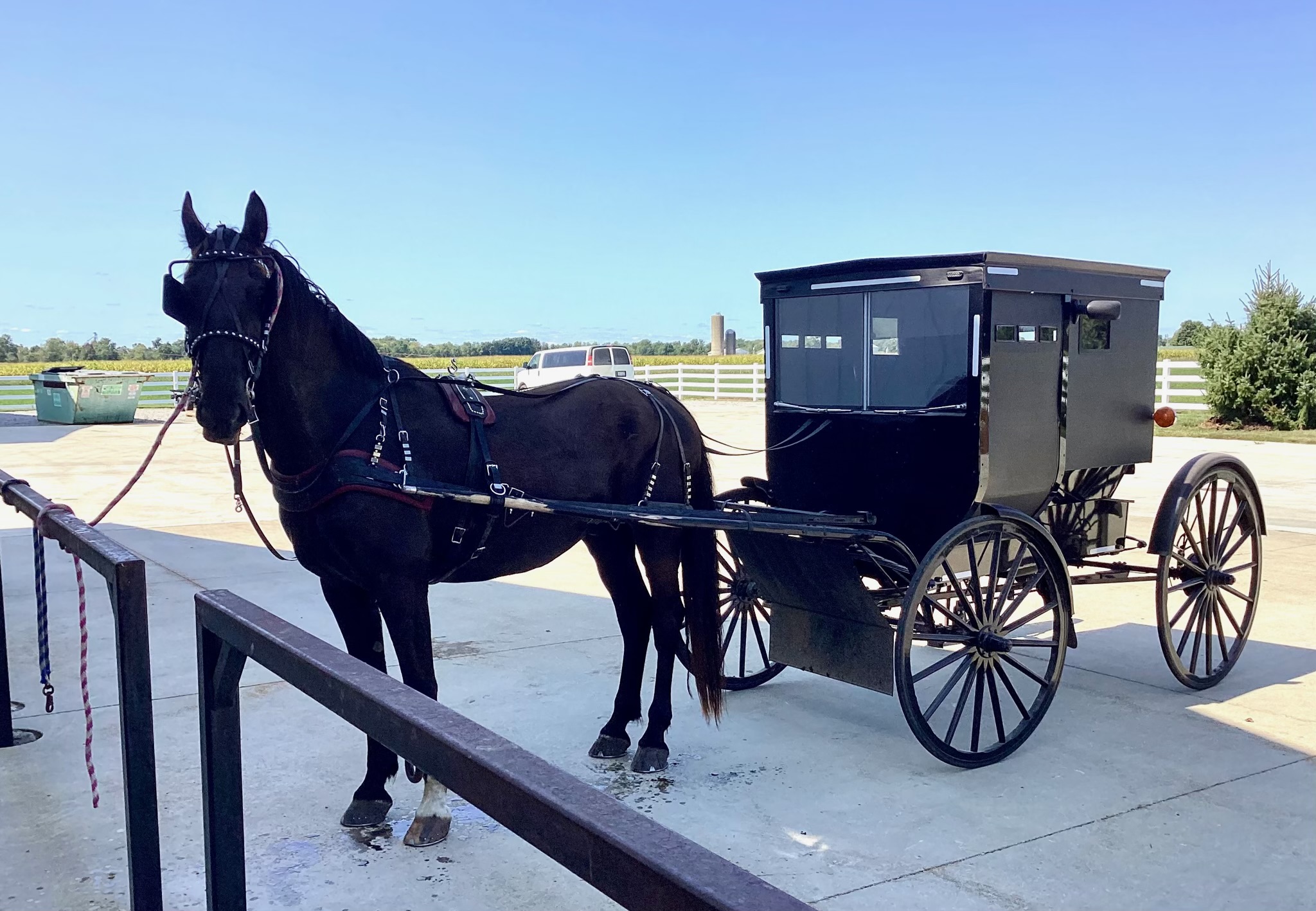
An Amish buggy in Branch County. Courtesy | Rita Hemker
Two vehicle-buggy accidents, causing several injuries and one death, occurred within four days of each other in Michigan last month.
Kris Dewey, of the Branch-Hillsdale-St. Joseph Community Health Agency, presented a project aimed at reducing buggy crashes to the Hillsdale County Board of Commissioners Sept. 9. The tri-county area is home to 1,100 Amish families, 30% of the state’s Amish population, and the health agency is using a $70,000 federal highway safety grant to improve buggy safety.
While the Michigan State Police and Michigan Department of Transportation attempt to ensure safe buggy transportation in highly Amish-populated areas, Lieutenant Rene Gonzalez, first district public information officer for the MSP, said buggy safety is ultimately the responsibility of vehicle operators.
“A majority of these crashes are the fault of the driver because they’re driving distracted, not paying attention, or driving too fast, and they misjudge the distance between the buggy and their vehicle, and that’s what’s causing these crashes,” Gonzalez said.
One of the accidents this summer involved a family in the Bloomingdale Amish Community, according to Emmanuel Yoder, a member of the neighboring Centreville Community. He said a daughter in the family needed amputation of both legs after the incident.
Yoder said more vehicle-buggy crashes may be occurring due to the higher concentration of both vehicles and buggies on the roads.
“Twenty-five years ago, our community had six churches with 20 to 25 families,” Yoder said. “Now we have 18 churches. It really has grown, and we could be prone to more accidents because there are more people.”
Aaron Jenkins, communications representative for MDOT, said the state agency has adjusted roads to improve buggy transportation safety.
“MDOT has mitigated Amish buggy safety in several ways,” Jenkins said in an email. “It has done so by installation of wider paved shoulders to allow for a buggy to be completely outside of the travel lanes when utilizing the roadway. Also, by the omission of shoulder rumble strips, or relocation of them to directly on the white edge line, to avoid buggy operators having to navigate around them.”
Gonzalez said that although improving shoulder conditions or mandating buggy lighting may be beneficial for buggy transportation, it will not solve the issue.
“Those are great ideas, but I don’t think that’s going to alleviate the problem because I think it comes down to distracted drivers,” Gonzalez said. “We get it all the time where we’ve got vehicles parked on the shoulders — police cars, cars that are broken down — and people run right into them, be it that they’re intoxicated or they’re not paying attention. It all comes back down to the driver of these motor vehicles needing to pay attention out there.”
Yoder said safe buggy transportation is also the responsibility of buggy operators.
“If we use our respect on the road the way we should, I think that would help a lot,” Yoder said. “I’d say 98% of the people are very respectful to us, and I appreciate that.”
Yoder said buggies should move to the side of the road to accommodate other drivers and protect buggy passengers.
“Some of our people aren’t respectful like I wish they would be,” Yoder said. “If it’s not a good buggy lane, you should get off, or if it’s gravel, get off on the dirt. If there’s something coming from either way, I like to get off and respect the traffic because it’s not just for them, it’s for your own safety.”
The Amish generally drive their buggies with caution, according to Gonzalez.
“Our district does not have a whole lot of buggies around here, but when I see them, I think they’re doing what they need to do,” Gonzalez said. “They’re keeping to the side of the road, they have signage on the back. They’re allowed to be on the road just like a bicycle or someone walking. It’s the other motor vehicles that really need to watch what’s going on out there.”
The MSP are trying to make the public aware of buggy presence on the roads.
“The only thing we can do is educate, like what we do with seatbelts, with speeding, with construction zones, through social media or even traffic enforcement,” Gonzalez said. “We’ll be out there, and we’ll try to educate the public, or we’ll enforce the motor vehicle code.”
Despite the recent accidents, Yoder said he doesn’t mind riding in a buggy.
“I always just felt about as comfortable in a buggy as in a car, to tell you the truth,” Yoder said.
Send tips to the City News team: collegiancitynews@gmail.com
