
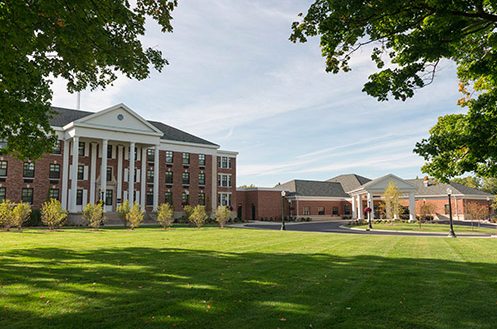
Hillsdale Hospital collaborates with the college to provide the best healthcare for its people.
Courtesy | Facebook
The hospital launched a media campaign to support rural health care
Hillsdale Hospital is anticipating budget cuts from the recently passed Medicaid reforms, but the hospital launched a media campaign to make sure other rural hospitals don’t suffer a worse fate.
Hillsdale Hospital debuted a publicity initiative called Rural Health Strong over the summer in response to the passage of the One Big Beautiful Bill Act on July 4, a federal tax and spending law that contained federal spending cuts to Medicaid.
Krysten Newlon, director of communications and donor development at Hillsdale Hospital, said the hospital launched the campaign because the Medicaid cuts threaten to eliminate rural health jobs or close rural hospitals entirely.
“Because of these funding cuts, we have been advocating since February for rural health, trying to encourage our legislators and encourage our communities to speak out on behalf of rural health,” Newlon said.
Hillsdale Hospital is expecting a tighter budget once the cuts go into effect, according to Newlon, but the hospital will not close or shut down any services.
“We are going to have a very reduced rate of reimbursement, and that’s very concerning to us. It means that providing care will strain our budget more and more,” Newlon said. “We are working very hard to make sure that we don’t have to make any cuts. We don’t want to lose any jobs. We don’t want to lose any services. We are very financially viable right now, and we are working very hard to stay that way.”
The hospital is primarily concerned by the new law’s upper limits on state provider taxes. These levies take in tax revenue from health care providers, like Hillsdale Hospital, but then return it to providers as Medicaid spending. Since the federal government partially reimburses states for each Medicaid dollar spent, higher provider tax revenue and expenditures trigger more federal funding.
But when provider tax limits are lowered under the new law, each state reports less in Medicaid spending, and thus receives less funding from the federal government.
According to Newlon, this law will decrease Medicaid spending by more than $1 trillion over the next decade. Rural hospitals rely more on federal Medicaid funds than their urban counterparts due to their lower-income population, so they will feel most of this reduction. At Hillsdale Hospital, 70% of the patients admitted are either on Medicaid or Medicare, Newlon said.
“By cutting that money, the states are not able to provide stable funding for the hospitals that need it, and it affects us disproportionately,” Newlon said. “We are getting reimbursed by the government, by Medicaid, and Medicare. Overall, that budget basically controls whether or not we can care for our patients, along with a lot of other rural hospitals.”
The OBBBA also adds a $50 billion rural health reconciliation package to be distributed to rural hospitals, with the goal of offsetting these losses. However, some experts, such as the Kaiser Family Foundation policy center, estimate that this will only cover a little more than one-third of the losses to rural hospitals.
On June 12, researchers from the Cecil G. Sheps Center for Health Services Research at the University of North Carolina at Chapel Hill released a list of more than 300 rural hospitals across the U.S. They concluded these hospitals to be at risk of closing or cutting back services as a result of the Medicaid cuts in the OBBBA. Four hospitals on that list were from Michigan: Mt. Pleasant’s McLaren Central Michigan, Carson City Hospital, Aspirius Ontonagon Hospital, and Dowagiac’s Ascension Borgess-Lee Hospital.
However, other statistics show rural hospitals may not be severely affected by the cuts. Abel Winn, associate professor of economics, said even for rural hospitals, Medicaid makes up a small percentage of a hospital’s revenue. A report by healthcare policy institute Chartis said Medicaid contributes 10% of a rural hospital’s revenue.
Winn said hospitals realistically will only experience a small cut in revenues.
“That doesn’t mean that this or that hospital is not going to be under significant stress, and there may be some hospitals that close,” Winn said. “But globally speaking, you’re talking about less than a 1% cut in profits. So I don’t think that it’s going to be earth-shaking in terms of the overall system. Since Medicaid pays so poorly already, it’s a much smaller percentage of their actual income.”
According to a press release from Michigan Gov. Gretchen Whitmer’s office, nursing homes and assisted living facilities are also expected to be at risk from Medicaid cuts. Despite most of the residential patients being on Medicaid, the Hillsdale County Medical Care Facility does not anticipate funding cuts, according to Terry Esterline, the administrator at the assisted living facility.
“We’re a skilled nursing facility,” Esterline said. “We have 170 beds in our nursing home. We are not anticipating a big impact on skilled care. I think a lot of the concern is in acute care like hospital settings, especially in a rural area. They’re anticipating a larger impact than we would here at the nursing home.”
Esterline said HCMCF receives Medicaid funds on a per-patient basis, which is consistent across all patients, while Hillsdale Hospital relies on funds that vary widely from patient to patient. He said that because of this, the Medicaid cuts will not affect HCMCF significantly.
“The reimbursement system is entirely different,” Esterline said. “Where a hospital could depend more on private insurance and Medicaid for their reimbursement, our reimbursement is set up on a per-diem basis, so the state reimburses a nursing home a set amount per bed per day.”
Send tips to the City News team: collegiancitynews@gmail.com
