
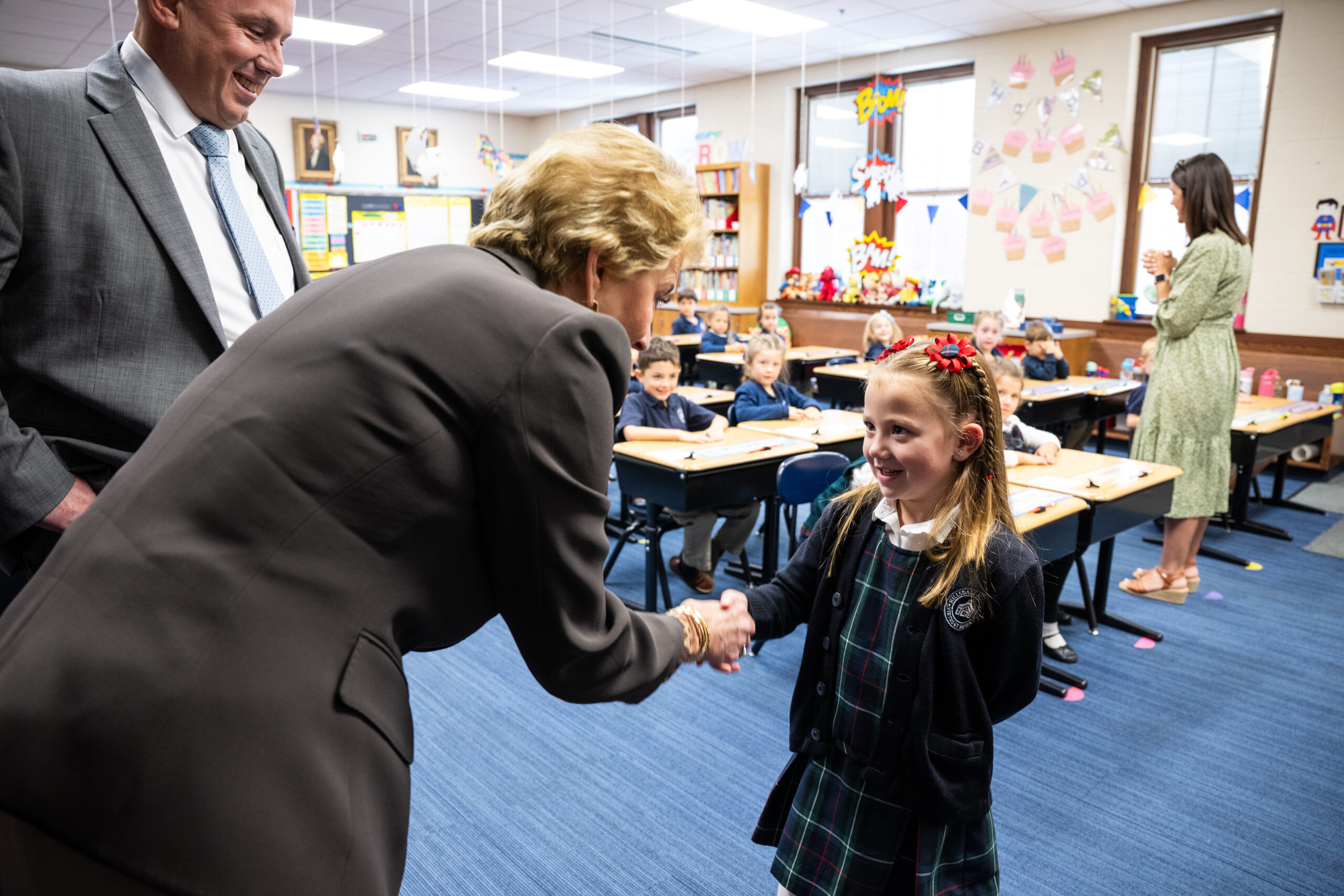
McMahon shakes hands with Hillsdale Academy kindergartener MacKenzie Thorne. Courtesy | Roger Hart
Secretary of Education Linda McMahon said Hillsdale College is a model for recovering higher education during a speech in Plaster Auditorium Monday.
“Let’s make them more like Hillsdale,” McMahon said. “We all love Hillsdale, but one school shouldn’t have a monopoly on excellence. First, university leaders must prioritize their students’ growth, even when it makes them uncomfortable.”
She was sworn in as Secretary of Education in March and has since decreased the size of the department by roughly half. Previously, she was CEO of World Wrestling Entertainment, on the Connecticut State Board of Education, on the Board of Trustees at Sacred Heart University, and was Administrator of the U.S. Small Business Administration during President Trump’s first term. She spoke at Hillsdale College following classroom visits at Hillsdale Academy.
McMahon called for decreasing the number of administrators in education, noting that there are more administrators than educators who can serve as mentors in higher education.
“Saint Paul wrote in his letter to the Corinthians that ‘they had 10,000 teachers but not many fathers,’” McMahon said. “Plenty of would-be authorities with their own opinions, but few mentors and leaders who would take responsibility for their personal growth. America’s colleges and universities, I think, are facing a similar shortage today.”
McMahon said administrators spend their time on topics like diversity and sensitivity, and micromanaging classrooms. She also noted that students and their families do not know the names, backgrounds, and biases of these administrators.
“How many true leaders do we really have? How many college presidents, provosts, and other officers with the courage and accountability to deliver on the promises in the college brochoure?” McMahon said. “Hillsdale College and a few other proud institutions are swimming against the current tide, proving that leaders can be more than figureheads.”
The college culture and purpose has also changed, according to McMahon. She said colleges have lost their importance and pride in the communities around them.
“They were on the cutting edge of research and intellectual movements, producing the movers and shakers of every domain and discipline,” McMahon said. “What is the difference between attending Hillsdale College and almost any other university today? At Hillsdale, this is still what the college experience is like.”
The liberal arts, including the sciences, must all aim for the same end and have the same level of difficulty, according to McMahon.
“Every discipline, whether it’s the humanities or the hard sciences, should apply the same level or rigor as medicine or engineering programs that have developed a reputation of obfuscation or ideological conformity must raise the bar when they need to disappear,” McMahon said. “Higher education’s greatest successes have come when its luminaries strove to transcend their biases, uncovering objective truths that advanced humanity’s understanding of the world.”
Colleges also must teach civic leadership and duties to ensure pride and knowledge of the functions of the nation, according to McMahon.
“Our nation’s history, laws, and culture are complex, and we need graduates who dive deeply into the principles of the American founding and the whole history of the West, ready to navigate its challenges with wisdom and courage and critical thinking,” McMahon said. “The best way for university leaders to influence the national discourse is by producing experts, critics, innovators, and entrepreneurs who carry forward this mission.”
