
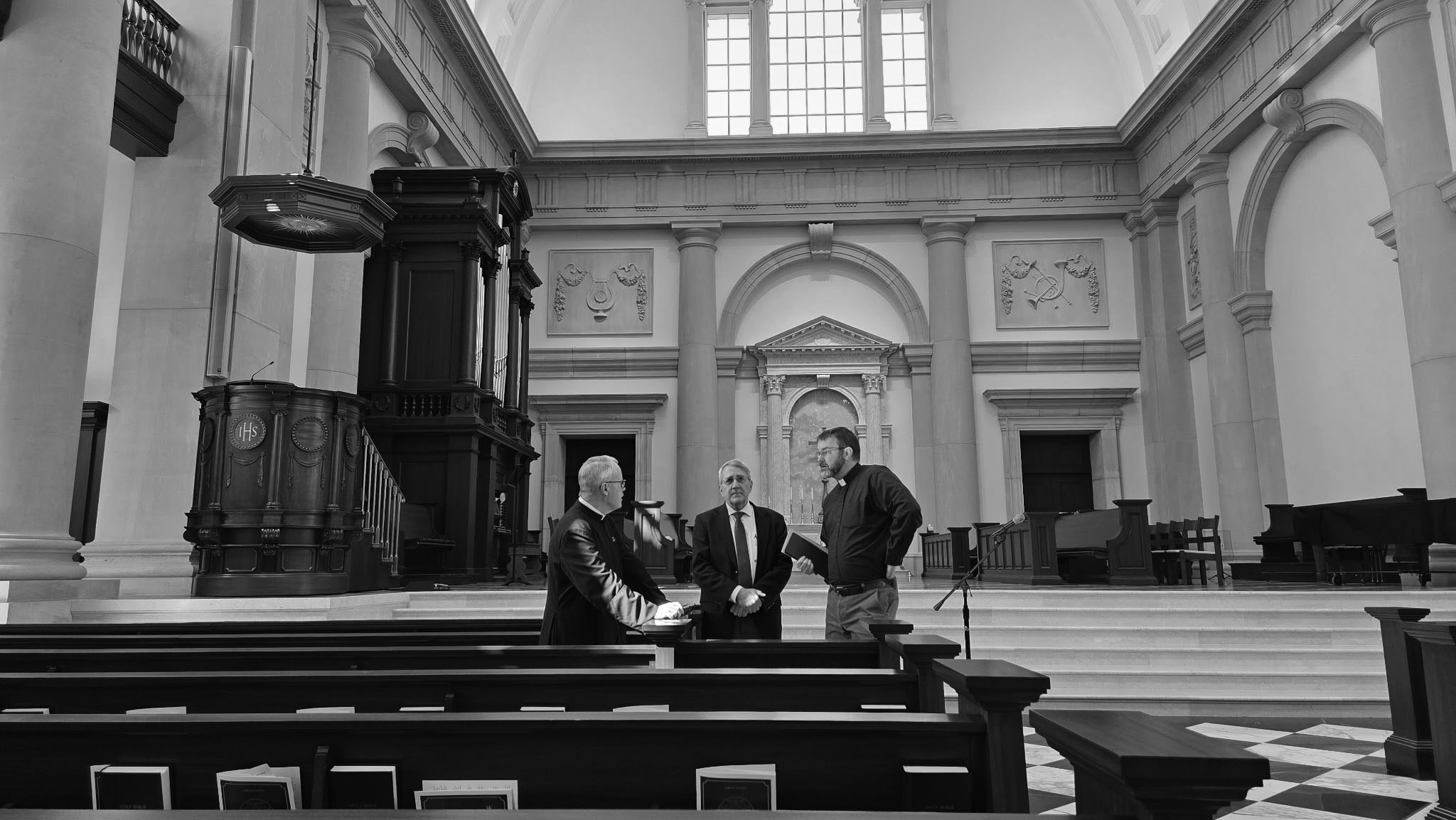
From left to right: Kiely, David Whalen, and Adam Rick in Christ Chapel. Logan Lyter | The Collegian
The West is unaware of the threat of Christian persecution in the Middle East, Rev. Benedict Kiely said in Christ Chapel on Sept. 12.
His lecture, titled “The Persecution of Christians — Background, Paradox and the Meaning of Martyrdom,” was part of the Drummond Lecture Series.
“The lack of knowledge of the reality of persecution of Christians, both historically and, more importantly, in the present, is perhaps the greatest problem we deal with,” Kiely said. “Wherever I go, so often, it’s not a coincidence. People tell me they know nothing of this issue, largely because of the lack of coverage in the mainstream media.”
According to Open Doors, an organization that raises awareness about persecuted Christians around the world, 4,476 Christians were killed in 2024. In Nigeria alone, 3,100 Christians were killed. An additional 4,744 Christians were detained or imprisoned for their faith.
Kiely also remarked on the apparent disinterest on this subject in the West. He said while churches address many subjects, such as climate change, persecution is often forgotten.
“If I went to a bishop and said, ‘Bishop, would you like me to talk to you about global warming?’ he’d be all over me. ‘Oh, come in, we’ll have the whole chapel.’ But if I say I want to talk about the persecuted Christians, ‘No thanks,’” Kiely said.
Kiely, a priest of the Catholic Church, started advocating for persecuted Christians in the Middle East in 2014, according to his website. He has written for publications such as National Review, the European Conservative, and the Catholic Herald and has spoken on radio and at international gatherings.
Kiely spoke about the history of Christian persecution, explaining that church history is full of “periods of calm interrupted by periods of persecution.” While the West may be living in a time of relative peace, persecution will come sooner or later, according to Kiely.
He then spoke of the paradox of persecution, where churches tend to thrive the most when persecuted the most. More Christians were martyred under the regimes of Nazism and communism than in any previous century, yet the church flourished, Kiely said.
Persecution continued into the 21st century, but its primary vehicle has changed, according to Kiely. The rise of Islam, especially in the West, corresponds to a rise in Christian persecution.
The power of Islam lies in its simplicity, Kiely said. At its core, Islam is a Christian heresy: a denial of the Incarnation.
“You have certain things you must do as a Muslim: you must pray five times a day, obey Ramadan, a few other things. And that’s almost it. It is incredibly, basically, simple. There’s no theological controversy,” Kiely said.
The growing popularity of Islam is coupled with a growing hostility towards Christianity in the West, according to Kiely.
“A post-Christian West, a world that exhibits hostility to and prejudice against Christian religion, is utterly unable to comprehend the threat of militant Islam; benevolent buffoons talk of an ecumenical dialogue, which is rather hard to do when your head has been severed from your body,” Kiely said.
Islam has seemingly joined forces with the political Left, leading to events such as the anti-Israel protests, according to Kiely. He said this “marriage” of Islam and the Left is made possible by their mutual hatred of the cross. They are against everything Christianity is for and will always work to deny the truth, according to Kiely.
“Many of you young people will be asked at some point in your career to do things which are against the faith,” Kiely said. “This is the point. Will you be martyrs for the truth? These are the clouds of witnesses who’ve always been for the church a source of inspiration and encouragement. The one thing necessary that the martyrs give us is the courage both to persevere and to be joyful in the strength of the Holy Spirit; lift up your drooping hands and strengthen your weak knees.”
Robert Whalen, a sophomore at Hillsdale Academy, felt the lecture was a vital reminder of life outside the West.
“I thought it was really necessary for this day and age,” Whalen said. “In our time, we don’t hear much about that. We’re very much in a safe spot, we don’t see much of that. I think it’s good for us to hear about that. So I think it’s easy for us to forget that persecution is still happening in the world, especially in our easy lives.”
James Shotwell, a first-year student at the Diana Davis Spencer Graduate School of Classical Education program, said this is a message he does not hear often enough.
“I feel like it’s not talked about very often, like, why have I never heard a sermon on this?” Shotwell said. “Where is the leadership talking about something? This is pressing and real.”
