
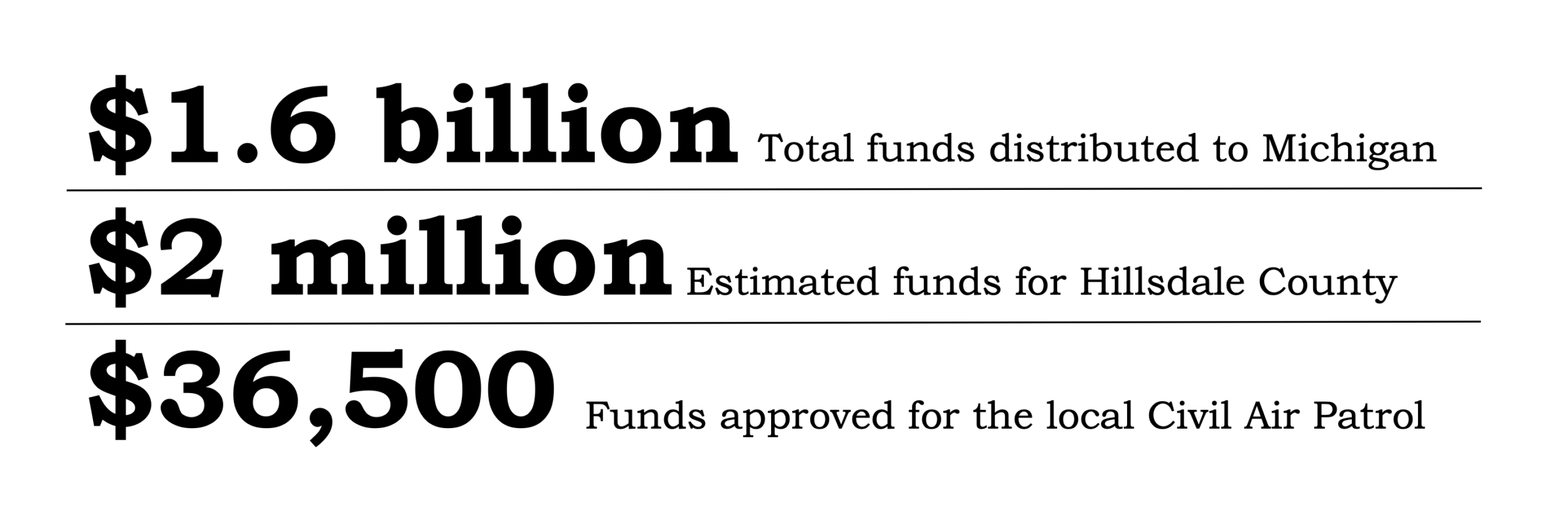
Hillsdale County will receive more than $2 million from the nationwide opioid settlement that is providing funding to affected states over the next 18 years, with $36,500 approved for the local Civil Air Patrol squadron’s outreach and drug remediation programs, while the Hillsdale County Commissioners are still considering other requests.
Through the opioid settlement efforts, the total estimated funds to be received across Michigan are approximately $1.6 billion. According to Wiley, Hillsdale County will receive more than $2 million in funding over 18 years due to the legal agreements in which pharmaceutical companies owe billions of dollars to U.S. states, trying to create remediation for their help in fueling the opioid crisis.
The commissioners considered two proposals for funding at an Aug. 26 meeting. The request from CAP was approved, while a request from the Coalition for Youth Drug Prevention was denied.
According to Commissioner Mark Wiley, the commissioners must allocate funds for new projects aimed at drug reduction and opioid remediation. The commissioners approved funding for CAP in a 3-2 vote during the Aug. 26 meeting.
“They presented a plan to go into the schools to recruit students and promote a drug-free program,” Wiley said. “It’s a small group and a small amount of money, but if you can keep one or two kids from drugs, it’s a good investment.”
Commissioner Brad Benzing said he voted no during the Aug. 26 meeting due to the small size of the organization.
“There are probably a lot of great programs out there, but I’m not sure if funding them is the point of the opioid funding,” Benzing said at the meeting. “If we are going to fund the Civil Air Patrol, then I would certainly encourage all the other local organizations similar to this to apply to the opioid committee as well, but I don’t think that is what this funding is for.”
CAP plans to use the funding to advance its Red Ribbon Leadership Academy and to help financially support cadets who otherwise would not be able to afford joining the Civil Air Patrol, according to Grace Hambleton, the Deputy Commander for Cadets and the Drug Reduction Officer for Hillsdale Composite Squadron.
“Our cadets provide a three-hour workshop to local middle school students, wherein they act as ambassadors and role models, guiding students to a basic understanding of the art and science of leadership as well as the dangers of drugs and the detriment that drugs are to lives,” Hambleton said. “Through Red Ribbon Leadership Academy, we — senior members and cadets alike — seek to show a better way of life to students — one that is filled with hope and possibilities about which they might not know.”
“We will look at all applications presented to us, and we will be more than happy to present it to the full board of commissioners,” Wiley said. “If we don’t take the opportunity on some of these programs, we will still have the money and this same situation in 18 years. Hopefully, we can get some of these programs instituted.”
Hambleton said she understands the guidelines for using the funding provided by the county but is confident that their programs will help the youth of Hillsdale County.
“We hope to reach as many in the community as possible,” Hambleton said. “As a ‘composite’ squadron, Hillsdale Composite Squadron can accept both cadets and adult members, so we want as many as possible to reap the benefits that CAP can provide.”
According to Wiley, a few other programs have been approved to receive funding from the opioid settlement money.
“Two that come to mind are helping schools fund counseling or calming corners where a student who is having issues can be supervised and counseled on how to cope with whatever they are facing,” Wiley said. “The other, which is coming to Hillsdale College in October, is called ‘The Elephant in the Room.’ The health department is leading the charge, and that will be targeted toward professionals on how to deal with addiction and drugs in the workplace.”
According to Wiley, new funding cannot be allocated to already established drug rehabilitation or education resources around the county. This has created a challenge for the commissioners to find programs that fit the requirements.
“One of the big things is that Hillsdale has a drug treatment court that we already fund, so we can’t supplant that,” Wiley said. “We can’t use the money we are getting to fund a program we already have in place. We can’t go buy a new snow plow, either.”
Send tips to the City News team: collegiancitynews@gmail.com
