
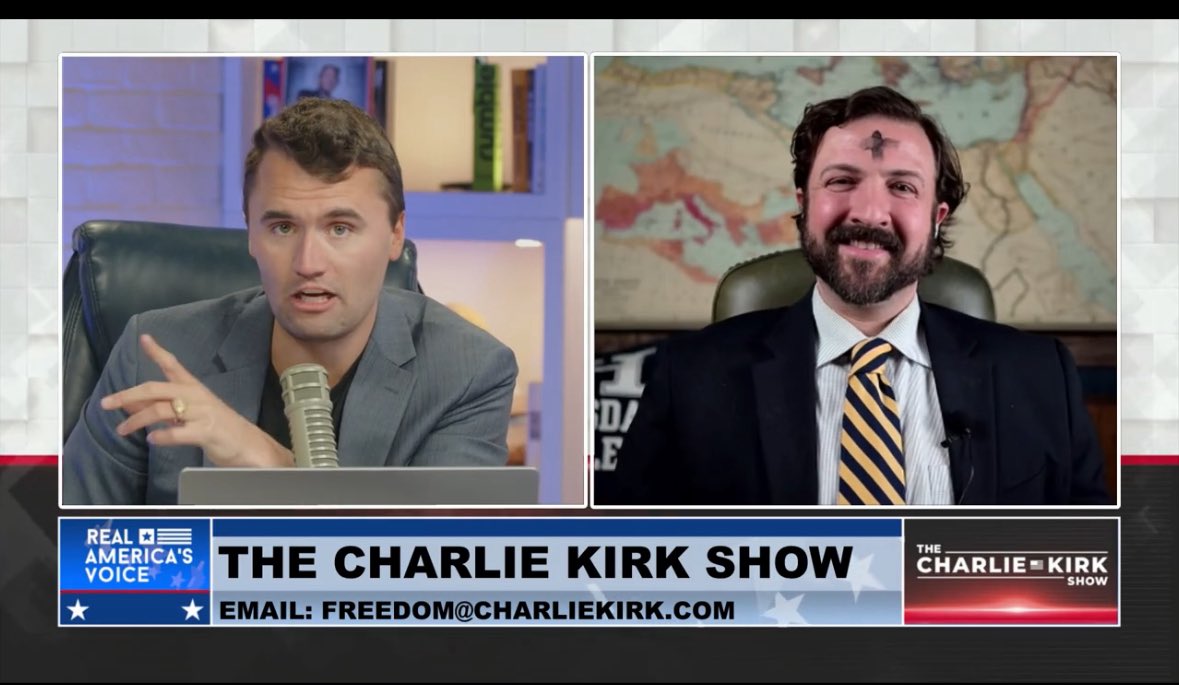
Charlie Kirk hosts Miles Smith IV on Ash Wednesday. Courtesy | The Charlie Kirk Show
I did not know much about Charlie Kirk when his handlers asked me to do a quick spot on his show at the beginning of Lent this year. What I did know I was indifferent to; he was loud, partisan, and combative. Granted, most of the clips I had seen were nearly a decade old by the time I went on his show, but I had not paid much attention. Now I see this as evidence of the generational and political divide that separates Gen Z from elder millennials like myself.
But millions of people, particularly Americans on college campuses and those under 30 years old, had been paying attention to Kirk, and they knew what I did not: over a decade, Kirk had become one of the most effective conservative public polemicists in the United States, if not the world, and his presence on college campuses in particular was slowly making him into an icon not of partisan Republican politics, but of two things far more sacred: free speech and Christianity.
Kirk’s interest in free speech is what apparently led him to read something I wrote at Law & Liberty, the flagship journal of the classical liberal-leaning Liberty Fund. When I went on Kirk’s show in the spring of 2025, I expected to find a sort of idealogue. Instead I spoke to a thoughtful and intense man who seemed genuinely interested in how free speech was understood over 250 years of American political experience. His questions were thoughtful and he never bristled or seemed bored with answers that didn’t conform to a partisan framework. Kirk’s politics certainly dovetailed with the New Right, but he remained in many ways a child of the gradual evolution of the conservative movement. He drew hard lines, particularly on questions of civil liberties and the treatment of Jews; because of this, Kirk uniquely carried the mantle of both Reagan-era conservatism and the most compelling aspects of the Trump coalition into spaces, particularly college campuses, that had metastasized into seminaries of the worst kind of totalitarian leftism.
For campus conservatives on left-leaning campuses, Kirk was a beacon and an evangelist of good news: that conservative college students had not been forgotten. And in the days following Kirk’s assassination, it does not seem likely that his devotees will forget him. Fox News reports that Turning Point USA, Kirk’s organization, received 54,000 new requests to start Turning Point USA chapters.
Free speech and conservative politics undoubtedly formed the essential part of why college students found Kirk compelling, but in his later years Kirk seemed as interested in Christianity as he did politics. His X feed increasingly featured Bible verses without any associated political admonition. Strong as he was, Kirk seemed powerless to escape the hound of heaven that sociologists say is statistically chasing young Americans, and particularly young men, in the third decade of the 21st century.
Kirk remained an Evangelical Christian but was married to a Roman Catholic even as he debated Roman Catholic friends such as Vice President JD Vance on what the latter called minor points of doctrine; but debate never became anger. Kirk was not a sectarian, and he increasingly talked religion instead of politics at TPUSA events on campuses and seemed increasingly aware that devotion to Christ was something different and prior to politics. For a man who was unknowingly facing eternity, that is a far greater comfort to those he leaves behind than any of his vaunted political achievements.
Miles Smith IV is an assistant professor of history.
